Eddie Green The Rise of an Early 1900s Black American Entertainment Pioneer

Eddie Green -Social MediaOk, let’s see, how can I put this? I AM A PUBLISHED AUTHOR. Eddie Green The Rise of an Early 1900s Black American Entertainment Pioneer is now available for public consumption. Of course, I let family members know first and now I am announcing to my wonderful blogging family. Woo hoo!!!

On November 12, 2014 I wrote these next two paragraphs on my first post on my brand new laptop:

Bestsellng author, Dean Koontz said, “I really believe that everyone has a talent, ability or skill that he can mine to support himself and to succeed in life.”

I found this quote while doing some research for a book I will eventually complete.  I began my research in about 1998 because my then small grandson’s favorite words seemed to be “I can’t”.  Usually in regard to why he did not finish his homework.  His homework was always too hard.  I came up with the bright idea to enlighten him on what a person can accomplish by telling him about, and by writing a book for him about my father, his grandfather, who was a black man born in poverty in 1896 and who rose to prominence despite many obstacles.

Well, it is now 2016 and eventually has arrived. My original idea of writing a book was small. I mean, you know, you gather the information and type it up and you have a little book. And then you give him, your grandson, this little book. Once I began the research my knowledge of the true progression of my father’s life from poverty to prominence grew. I knew Eddie was a radio star, had written a song, had made a movie, had appeared in a movie. But since Eddie died when I was three and he had only been married to my mom for five years, I never really learned half of the things my father had accomplished. My little book grew.

One thing I discovered which I could not share with my mom because she had passed on by 2010, was that my father lied about his age. She thought Eddie had been born in 1896, but according to his Social Security Application from 1937, Eddie was actually born in 1891. So when my twenty-two year old mother married Eddie he was actually fifty-four, not forty-nine. I learned that not only had Eddie written one song “A Good Man Is Hard to Find”, he wrote twenty-nine songs. Not only did he make one movie, he made wrote, produced, directed and acted in five all-black cast movies. He had appeared on and co-hosted radio shows, he had appeared on Broadway and on and on and on. My little book became a BOOK. And the progression has been documented on this blog.

I have loved every minute of sharing my journey here through WP, and I am very happy that I have a loyal group of followers (which I acknowledged in my book). This journey is not over. I have the job of marketing to do. I will continue to post regarding progress, and I will continue to share other items of interest to keep the spark of inspiration going. Thank you all so much for being a part of this journey. Check me out at http://www.bearmanormedia.com.

and we have a Facebook site for the book:

https://www.facebook.com/EddieGreenBook/?view_public_for=1134428443290744

As always, Thanks, for stopping by, and Spread The Word!

Sepia Pride

letterheadcropped

The above is a picture taken of the letterhead my father used during his 1939-41 movie making period. Eddie had two studios during his lifetime, the second studio he had was in Los Angeles in 1946-1950. As you can see, Eddie was very proud of his achievement and he was a man who was intent on furthering the African-American community.

Now that I have written the biography of my father, the manuscript has been sent for editing after which I will get to make any revisions deemed necessary and then the publisher will take over. So, the focus of this blog will eventually shift from writing about Eddie’s life to writing about how the book is received. Whether it will attract readers and whether it will hopefully provide inspiration. I will also write about how this book writing journey has helped to increase my understanding of the struggles that still exist for black independent film makers today.

I have become almost painfully aware of the lack of movies being made by African-Americans, of African-Americans and with African-Americans. Movies written by, produced by, and directed by African-Americans with an all-black cast.

Before 1950 there was The Lincoln Motion Picture Company of George and Noble Johnson. This company is considered to be the first all-black movie production company. The company made and distributed only five films. These films were limited to African American audiences in churches, schools, and “Colored Only” theaters, despite the Johnson brothers wanting a wider audience. Unfortunately production expenses and low sales halted future films to be made and distributed. There was Spencer Williams (he of Amos n Andy television fame), Williams along with a partner formed a movie and newsreel company, the Lincoln Talking Pictures Company. There was Oscar Micheaux of the Micheaux Book & Film Company (probably the most well-known early black film maker, who directed and produced over 40 films.) And there was Eddie Green, who owned two studios, Sepia-Art Pictures and Sepia Production Co. Like the Lincoln Motion Picture Company Eddie produced only five movies, four in 1939-1941 and one in 1949. Eddie directed, wrote, produced and acted in each movie.

Eddie died in 1950. Oscar Micheaux died in 1951. By then black owned studios were becoming a thing of the past, mostly due to production expenses.  White movie producers began producing the so-called “race” movies and were able to woo black actors with bigger paychecks.

Once Hollywood took off, black actors became famous through these mainstream “Hollywood” made movies, movies like  St. Louis Blues (1958) with Nat King Cole, Eartha Kitt, Ruby Dee, Ella Fitzgerald. Superfly (1972) which was produced by Warner Bros.

Then along came Spike Lee in the early 1980s, with his 40 Acres and a Mule Productions. I could be wrong, but from what I have researched he wrote, produced, directed and starred in She’s Gotta Have It, and the movie had an all-black cast in a black neighborhood. Hello!

Now, of course, there are more independent black owned film companies, but you have to stumble upon them. Well, maybe not Harpo, which produced the movie Beloved, which had a white director.

The integration of blacks into movies made by the major movie studios contributed to the decline of all black cast movies. Lack of money was a major factor. The deaths of our pioneers was another major factor. The early independent pioneers struggled. Blacks, whites, women.   Blacks have blended into the movie industry very well on the screen. The so-called “race” movies that were produced, directed, written, and photographed and starred in by only blacks, seem to no longer exist. There are how many black-owned film studios? Few. There is still a struggle going on.

Going forward with this blog, I want to research and write about more people who are working to achieve recognition. Who deserve recognition. There is room at the top and I would like to put some effort into pushing someone up. My book is about my father who happens to be black which gives me a good reason to focus on black progress. But my major desire is to be able to contribute some positivity to anyone’s ability to rise.


The Size of Success

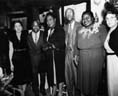
eddieandhattieThough this picture is very small, I wanted to lead this post with it because in more ways than one it signifies success. From left to right are my mom Norma, my father Eddie, actress Louise Beavers, Louise Beavers’ father, Academy Award Winner Hattie McDaniel, and unfortunately I have not identified the woman on the far right. This photo was taken about 1939.  Eddie, Ms. Beavers and Ms. McDaniel were role models of success in the entertainment business, especially in the African-American community. My mom had begun to achieve success as an opera singer. My daughter, Melony (a success in more eyes than just mine), loves this picture.

I have realized over the past few days that success for me is finishing the book about my father’s life.  Relatively speaking, it’s a small thing. Thousands of people have written books. But today I actually felt successful. I had the motivation and the ability to search out information and put it down on paper. My skills with a laptop grew along with my need to use a laptop. Every person has the ability to succeed in life, whether it be on a grand scale or on a less than grand scale.

I have learned that success is achieved with the help of others. I never thought that I would receive as much help as I have during this process. From the beginning of my research for my book, through the writing, the proofing, until today, I have received support and encouragement from people I have met along the way.

Of course, it’s not finished yet. I am working on a Book Cover design (with help). And I have to get a picture taken of myself for marketing purposes (which means I need a new outfit, a manicure, hahaha). By the way, the title of the book is: Eddie Green – The Rise of an Early African-American Entertainment Pioneer.

I started my very first blog post back in 2014 with this sentence:  Best-selling author, Dean Koontz said, “I really believe that everyone has a talent, ability or skill that he can mine to support himself and to succeed in life.” I wanted this blog to help others determine the skills or abilities they possessed. I hoped to be able to help determine what motivates each individual person, and what it means to succeed in life. Hey, if I can do it………..

Thanks, for stopping by.


49,957 words

untitled (34)

49,957 words.

Need to cross some more tees and dot some more iiiis (eyes). I’m feeling a little silly, cause I’m nervous. It has come time for me to begin my search for readers to proof my manuscript. I could not, for the life of me, come up with an idea for a post, so I decided to post Chapter Two of my tentatively titled book:

 Eddie Green: Star of Stage, Screen, Radio and Television

A Biography

Chapter Two: A Good Man Is Hard To Find

While continuing to perform as a magician, in 1916, Eddie wrote a silent movie titled, Eddie Green’s Rehearsal, which gives an early indication of the direction in which Eddie was heading. This movie was directed, produced and distributed by Eddie, the cast was Eddie. The movie was about a man by the name of Eddie Green, who is desperate to get into show business. Eddie borrows a friend’s clothes and car, and goes to an audition. He tells jokes, sings and generally performs to an encore. This scenario proved to be prophetic.

The movie did not actually make it to the big screen, at least not in its original format, and not until 1939, but it had enough merit to warrant a mention, in the form of a “clipping,” which was placed in a folder at the Margaret Herrick Library, a non-circulating reference and research library devoted to the history and development of the motion picture as an art form, where I found it in 2015, sixty-five years later.

About a year after Eddie wrote his silent movie, The United States entered World War I. Eddie was twenty-six years old when he reported to his draft board. I have not found out yet, where he may have been stationed. However, the information on his draft registration card provided me a good source of information. Listed was Eddie’s address at the time, 1405 Ten Pin Alley, in Baltimore, Maryland. Research showed me that Ten Pin Alley was, literally, an alley, located in what was then Ward 5, a part of East Baltimore, which, though dirty and crowded, was basically the only place in which poor blacks were allowed to live. Noted also on the card, was his occupation, actor, his place of employment, the Standard Theatre in Philadelphia, Pennsylvania and the fact that he was married and had a child.

Eddie’s place of employment in 1917, the Standard Theater was owned by a Mr. John T. Gibson, a native of Baltimore, who also ran Gibson’s Auditorium Theatre on South Street and made good money booking Black vaudeville acts on the national “chitlin circuit.” Stars such as Bessie Smith and Ethel Waters, also performed at the Standard. Ticket sales at the Standard helped make Gibson the “richest black man in Philadelphia.”

While at the Standard, Eddie dropped the magic tricks from his act. After catching one of his shows, a stage manager told Eddie to, “Get rid of the paraphernalia and just do comedy, you are really funny.” Eddie took the man’s advice and began performing strictly as a comedian, eventually adding singing and”soft shoe” dancing to his routine.

It was during this time, that Eddie wrote the his first of his twenty-nine songs, “A Good Man is Hard to Find, “ which he copyrighted on December 28, 1917, in Chicago. “A Good Man is Hard to Find” is a bluesy type of song, explaining what a woman should do when she manages to get a “good” man. Six months later, Eddie sold his song and on June 2, 1918, the song was copyrighted by Pace and Handy Music Publishers (Home of the Blues), and went on sale as a piano roll in the Fort Wayne Gazette.

“A Good Man is Hard to Find” became a hit. January 4, 1919, Eddie got his first top billing as an entertainer, though his name, as the songwriter, was in tiny print. The name of the song was in big, bold letters right at the top of the Billboard page. The Billboard listed the song as “a 1,000,000 copy hit, sure fire applause getter for any singing act or combination on the stage.”

Marion Harris, a popular singer, most successful in the 1920s, the first widely known white singer to sing jazz and blues songs, recorded the song in 1919 for Victor Records. Miss Harris’s recording has been digitized at the Library of Congress Packard Campus for Audio Visual Conservation.

Eddie decided to put together a company of eighteen actors, which he called the “Deluxe Players,” and as owner and manager of the “Deluxe Players,” he began to tour the south, featuring his song, “A Good Man is Hard to Find,” performing in places such as Tampa, Florida and St. Louis, Missouri. Eddie and his company were a sensation in St. Louis at the Booker Washington Theater, as was printed by the St. Louis Argus, January 9, 1920: “Green with his droll humor, and his coterie of performers made a big hit during a previous performance at this house.” The show bristled with tuneful melodies, graceful and eccentric dances and a barrel of side-splitting comedy.”

Eddie’s song caught the attention of Miss Sophie Tucker, one of the most popular entertainers at that time, known as, “the last of the red hot mammas.” While performing in the Sophie Tucker Room in Reisenweber’s in New York, Miss Tucker sang “A Good Man is Hard to Find” every night for ten consecutive weeks, and “will continue to use it until her engagement terminates.” Miss Tucker said that, “A Good Man is Hard to Find” is “the best blue number she has ever used.” {Photo 1. Caption: Sophie Tucker Says.}

This song has been recorded as a blues number, a fox trot and a swing number, by such greats as Wilbur C. Sweatman’s Jazz Orchestra, Les Brown and his Orchestra, Louis Prima and his Orchestra, Jess Stacy and his Orchestra, Dorothy Loudon with the Honky Tonks, William’s Cotton Club Orchestra, Muggsy Spanier, the Alabama Red Peppers, “Fats” Waller, Bessie Smith, Frank Sinatra, Rosemary Clooney, Cass Daley, Big Maybelle, Brenda Lee, Nancy Wilson, and Carol Channing, to name a few, and a version of the song has been heard in Woody Allen’s recent film Blue Jasmine, and even more recently in HBO’s 2015 presentation of Bessie. As was Sophie Tucker before her, Bessie Smith was instrumental in popularizing, “A Good Man Is Hard to Find.”

As I write this, I am realizing that, as the years went by, Eddie must have been aware of the impact this song had on people. At the time he wrote this song, though, he probably had a need for whatever money he received when he sold it to Pace and Handy. The popularity of this song, did, however, announce the arrival of Eddie Green, and with his talent for getting laughs, and his willingness to work for what he wanted, Eddie was on his way up.

End of Chapter Two

Hey, thanks for stopping by.


Progress-two of my viewpoints

momwithfur

This is my father, Eddie Green and my mom, Norma, in about 1945-46.  Progress had been made in Eddie’s life, as you can see by looking at that coat around mom’s shoulders.  As I have mentioned before on this blog, Eddie did not start out with a lot of money.  As a matter of fact, when Eddie left home at nine years of age he didn’t have any money.  But he must of had a plan (excuse my English).  Because he wound up quite well-known in the entertainment industry, and at one time, had a lot of money. When Eddie left home, He intended to progress.

Home in 1891 (when Eddie was born) was Baltimore.  According to an old report from the  Johns Hopkins Hospital, which was in the area where Eddie lived: Typhoid fever was then very prevalent in Baltimore, especially in the city’s outlying areas. Drinking water was obtained from public pumps connected to shallow wells, now mostly contaminated by the myriad of privies and cesspools located in backyards. Mortality from typhoid fever in the city during the years 1888-1892 averaged around 229 cases per year, disproportionately affecting poor Blacks.  Things were not much better until after a 1904 fire that devastated a large portion of the city.  After the fire, progress began in regard to the sewer issues.

By 1917, Eddie had progressed in regard to recognition when he wrote his first song: “A Good Man Is Hard To Find,” Words & Music by Eddie Green, which was recorded over the years by various artists, including Brenda Lee in 1967.

As a Black man making his way through the early 1900s, Eddie’s progress was steady, benefiting himself, those with whom he worked, his family and those who came after him.  His progress was a good thing.

I read somewhere the other day  that in some ways progress may not always seem good.  For instance, when I was little, I loved to play Tiddly-winks: images (15)

I mean I loved it. All by myself. Take one big disc, press down on a smaller disc and launch the smaller disc into a cup, wow! Today kids do not play Tiddly-winks, not even babies play Tiddly-winks, unless it’s computerized:  images (5)

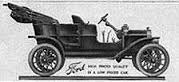
Or take cars, we started out with what we now think of as funny looking, A Model-T:  images9LPUJHQE

Thanks to progress, we now have all sorts of car models.  We have electric cars and self-driving cars: 18th-Century-Math-to-Solve-Traffic-Jams-2

My point is, progress is about persevering and moving forward. I applaud my father for doing so, but, man, I really think little kids are missing something if they never play Tiddly-winks.

Thanks, for stopping by.

Typhoid Fever and Johns Hopkins Hospital, Baltimore, 1891

Photo courtesy: New York Public Library

HApee New Year!

Happy-New-Year-Clip-Art-For-Facebook-555-5

2015 has been a good year for me.  I have written a book, my first ever. In the process of writing this book, I have increased my knowledge of show business, of people and of life in general. In order to write, I have had to read. Through careful reading, I have found helpful information that I would not have found otherwise.

I have met wonderful people who have provided me with great information, and hooked me up with other wonderful people, from the US to the UK. I have even met the family of a woman who was in one of my father’s (Eddie Green) movies from 1939.

I have enjoyed every minute of this experience, well, maybe not every minute, proofing my own work proved to be tiresome, after all, there is spellcheck, and one has to concentrate when proofreading, you can’t just skim through your manuscript. Anyhow, I do love it. I recommend biographical writing as a good way to learn history.

I have acquired a following. Haha, who would have thunk it! My brother told me it would happen. Keeps a smile on my face.

When I began this blog, I searched a certain site for images of my father and I could not find one picture.  Now, I think there are three pictures of Eddie on the site and one of ME.

January will be the beginning of the proofing and editing of my book.

May you all have a glorious new year’s eve and a happy, prosperous 2016.


My Brother Was Right!

jay-z-holiday-charity (2)
Jay-z holiday charity*

Happy Holidays to everyone!! My brother, Brad Beasley, has told me from the day I started writing a biography on my father, Eddie Green, that Eddie was just like Jay-Z, who is a hard-working man who has made a name for himself as a rapper and as an entrepreneur, and who is married to a gorgeous, talented woman. I put off mention of any similarities, cause I couldn’t figure out how to write a relevant post.  At last I have found what I needed!  A picture of Jay-Z and friends at a holiday charity.

This provided a link that I could work with, because, not only was my father, Eddie, also a hard-working man who made a name for himself as a songwriter, actor and as an entrepreneur, and who was married to a gorgeous, talented woman (my mother), Eddie was also involved in holiday charity work.  Thanks to the research I have done, I just happened to have a newspaper article that covered Eddie’s act of charity on Christmas of 1940.  Following is the article.

As per the New York Age, Saturday, December 21, 1940:  Eddie Green to Play Host to 250 Poor Christmas Eve.

importfromphonejuly 132

“Eddie Green will play host to 250 of New York City’s poor on Christmas eve morning. Along with Arthur Oliver, manager, and about a dozen of the girl employees of Eddie Green’s Bar-Bee-Q, they will assemble at the Eighth avenue link of this popular chain of restaurants where they will pack and hand out Christmas baskets containing roasting chicken and all of the fixings that go to make up a good dinner. Tickets for these baskets have been distributed among quite a few responsible persons who in turn are giving them to families that they know to be needy.”

Then and now these two gentlemen had and have the spirit of Christmas. Decades apart, yet similar in outlook. Role models.

I wish you a safe and happy holiday season. Thank you so much for stopping by!

*Jay-Z holiday picture courtesy http://www.fuse.tv and Google Advanced Images


ONLY IN A DREAM

images (9)

Time flies when you’re on a mission.

For the past week or so, my mission has been to get permission to use certain photos in the book I am writing, order the photos, re-read the book before I send it out for copy editing, and looking for a copy editor.  And for some reason, it seems like these things have to be done right away.  Which they don’t. I am not working on a schedule.  I don’t have a contract that says 4 books in 4 weeks.  I don’t HAVE a contract.  I started this project because I had a goal.  To bring my father, Eddie Green, out of obscurity to highlight his achievements as a Black man in the early 1900s, and to put the information in book form for my grandson.  Which is what I have done and what I am doing. I shared in an earlier post that, I look forward to my day because I can see the goal, and I am working towards that goal.  I am on track.  I need to remember that.

As I get closer to my book being a finished product, I realized that I have put next to nothing in this blog about my mother, Norma, Eddie’s fourth, I think, wife.  I have a chapter in the book on her, so I will just take from that for this post.

My mom, Norma, was born on November 17, 1923,  Her mother, Sinclaire was a very light skinned Black woman who chose to live as something other than Black, so by the time my mom entered school, Sinclaire was listing herself as Spanish on my mom’s school records.  My mom was born Norma Murcock, but by age sixteen, Sinclaire had remarried and mom’s last name became Amato. Norma began singing, violin and piano lessons very young, and began performing for audiences when she was seven, usually at the Second Baptist Church, or at the Murdock Music Arts Association, and as she got older, she would sing at weddings at the Wilfandel Club in the Historic Adams District in Los Angeles.

importfromphonejuly 145
Norma Amato, about 17

When mom was 18, an article appeared in a Los Angeles newspaper which helped me verify my mother’s heritage.  Here is a portion of the article:  “An assistant highway surveying engineer in the business world, Norma Amato, who sings fluently in Italian, French and Spanish, will render a selection. Norma Anne Amato, 18 years old daughter of Mr. and Mrs. Guiseppe (Joseph) Amato, who majored in music and graduated from St. Cecilia and Romona Convents was the young lyric soprano soloist featured by the Daughters of the American Revolution at their National Convention banquet in Los Angeles.”  Mom was studying to be an opera singer.

As time went on, Norma would appear in more articles:   “Miss Norma Amato is the protégé of Miss McDaniel of Gone with the Wind fame.”  The group picture here is Norma, Eddie, Louise Beavers, Miss Beaver’s dad, Hattie McDaniel and an unidentified woman,

eddieandhattie

In 1944 The California Eagle, printed this glowing tip: “Tip to Talent Scouts: Keep your ears on Norma Amato’s delightful thrushing. She has the kind of voice you hear only in a dream.”  imagesT553SX8Y

“Only in a dream.”  This was the path on which mom was working.

On November 17, 1944, Norma became 21 years old. At the time, she was still living with her mother, Sinclaire.  One year later, she was married to Eddie.

3rd set with new pictures 277

I am realizing a dream in real time.  Something anybody can do.

Thanks, for stopping by.

CAMERAS, LIGHTS……..


untitled (14)


When trying to write a book and posts for a blog, I forget there are other things to attend to.  Like grocery shopping, washing, visiting friends, calling people, eating three meals a day (ha!).  So every now and then I have to do these things.  When I get back to my laptop, it takes a while for my brain to settle back into the writing process (where was I?, what did I do with my highlighter?), so I waste a few minutes getting back in the groove of writing, and I was wondering today how in the world my father could do everything he did as a comedian, businessman, a director and a writer?  Then I remembered, he had a wife.  I just have me.

Which brings me to an article I found written in 1940, about Eddie, after he had begun his movie making career.  This was a full page article discussing Eddie as a comedian (funny), and as a business man (sensible).  It begins:  “Everybody knows Eddie Green as Koko in the “Hot Mikado”, or as the chief characters in his skit on Christopher Columbus and on Jonah and the Whale, (which he did on the Rudy Valley radio show), but there is another Eddie Green who is akin to these characters, but who is also very different.  That is Eddie Green Himself.”

The article goes on to discuss Eddie’s comedic talent, the fact that he owns and operates two barbecue restaurants in New York,

“Eddie Green’s Bar-Bee-Q 2149 8th (near 116) Specializing in Southern Bar-Bee-Q.
Always Open. Finest South’n hospitality. E. Green, Host.”

and that he is a writer and producer of “what many people believe are the finest films being released about our people.”  This paper was the Baltimore Afro American.   The article includes this quote from Eddie:

“The first thing I try for is naturalness.  I write my own stories, building them around some incident that has been interesting, but not offensive.”

The article mentions, that although Eddie had already released three films, he had no picture scheduled that summer because he was concentrating on a beauty contest at the World’s Fair.

Towards the end of the article, they talk about Eddie’s typical day.  He is up at 8 and off to the office.  At lunch he has coffee with Mrs. Green, at home, or she comes to the office.  If he is broadcasting, he goes to rehearsal, if not, he goes back to his office until dinner, then he goes home to eat.  He likes ham and cabbage which he taught Mrs. Green to cook.  He tinkers with his ham radio, then at 10:00p.m. he goes to check on his restaurants till about 12:00, then goes back home.  Mrs. Green, (the wife before my mom), was an entertainer, but decided to become a stay-at-home wife.  I assume that she did all the shopping, and washing, and cleaning, so Eddie had only to concentrate on his career path, he didn’t have to worry about thing falling apart at home.

In 1939, Eddie began a new venture and opened his own motion picture company:

movie company formed
in harlem
NEW YORK, Aug. 24  With familiar theatrical figure Eddie Green as guiding light, a new motion picture company was formed this week, the “Sepia Arts Pictures Company.”  Los Angeles California Eagle, August 24, 1939

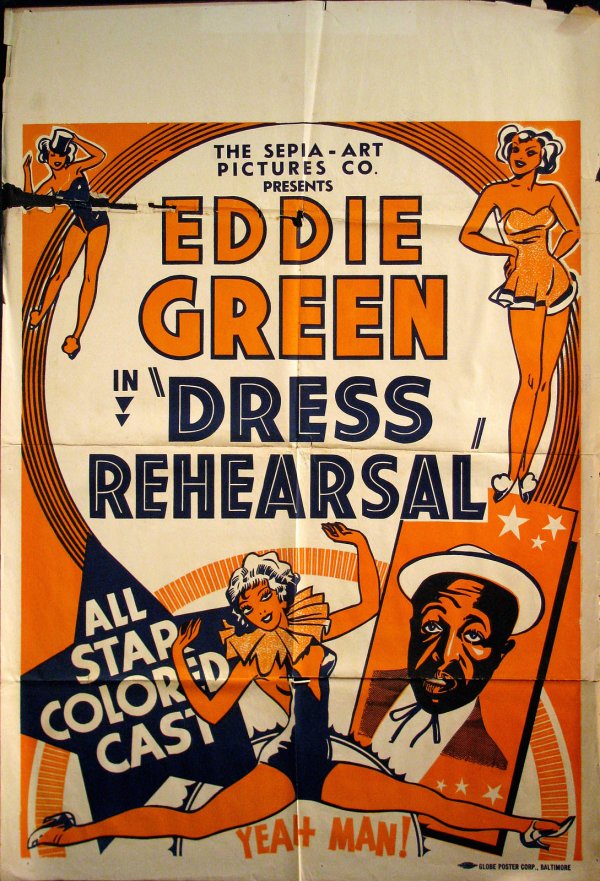
Eddie’s first film was:

courtesy live auctioneers

In my ongoing research I have actually seen my father’s original script for this movie.  Remarkable!  Though the script lists the cast members, it is difficult to tell which person was in which movie.  Anywho, “Dress Rehearsal” would have a long run, at theaters and on television, as noted below:

NEW YORK, Dec. 21.—History was made here Saturday
afternoon, Dec. 16, when the National Broadcasting Company picked the Sepia-Art Pictures Company’s featurette,”Dress Rehearsal,” featuring Eddie Green, to broadcast over their television station here in New York City. Not only is “Dress Rehearsal” the ” first ” Negro motion picture ever to be broadcast by television, Mr. Green breaks a precedent by staring in the first film of its kind ever to be sent over the air.  Pittsburgh Courier  12/23/39

AND, at the

Vogue  1905 Columbia
Edw. G. Robinson, “Destroyer”
Eddie Green, “Dress Rehearsal”   Dec 9, 1943

I do not have the rights yet, if ever, to post much information regarding scripts, but I did get a piece of a skit:  Eddie (who is the Director, the Writer and the Star of this featurette) is late getting to the set, so he is speeding and gets stopped by a policeman.  The policeman asks Eddie where he is coming from, Eddie says New Jersey, the policeman says “how did you ever get through the Harlem Tunnel?  Eddie says, “there’s a hole on both ends!”  Ba Dump Bump!

I hope that those reading these posts find inspiration for pursuing their own goals even though they may seem unattainable.  No matter the time period or the climate.  More action coming up!  Thanks for stopping by.


YOU ARE UNIQUE, RUN WITH IT

imagesOB78BD5W

Today, first, I want to wish all those suffering from the devastating earthquakes in Nepal an eventual sense of peace and comfort through those who have been able to help, and I am sad that so many others are using their energy to hurt rather than to help.

Now, on to the purpose of this blog.  Inspiring those who would like to accomplish something specific, but are reluctant to do so, because of seeming obstacles.  My father, Eddie Green, has been a great example to me, of a person who started out with rags (in various senses of the word) and rose to riches.  Eddie’s rise was not rocket-like.  But it was steady and continual.

Eddie was born in 1891, he left home at about age nine, got work where he could performing as a child magician in churches and whatnot until he got work in various theaters, by 1909 he was married for the first time, 1917 he was drafted for WWI and wrote his first song, he spent the 20s on the Vaudevile and Burlesque stage, in the 30s he got married again and started his radio career.  By 1936 Eddie was 45 years old and still climbing.

untitled (5)No, this is not Eddie.

On April 18, 1936 Mr. Joe Bostic of Radiograph wrote an article about Eddie.  He chose Eddie’s performance on the Rudy Valley radio show as the “peak radio performance of the Week.”  It was the second time within a month that Eddie’s performance had been chosen.  He said that “Eddie Green, it seems to be, is more than a new star in the radio firmament, he is a symbol of what race artists might achieve if they have a distinctive and individual entertainment idea to offer.”  He also states “We doff our hat to a sterling performer and a great fellow.”  Hear Eddie Green Thursday night WEAF 8 p.m.

Eddie’s distinctive and individual entertainment idea was to perform skits, with scripts written by John Tucker Battle, of people from certain literature, such as, The Courtship of Miles Standish, which I have just learned, is a poem written by Henry Wadsworth Longfellow about a love triangle involving pilgrims who may have actually been real people; and Sir Galahad and the Knights of the Round Table, I guess these skits were sort of a “What if the Knights of the Round Table were Black” kind of thing.  The skits were part of a sketch called “Heroes Wuz People”.  Eddie acted out these skits with a Negro’s impression (according to the Daily Herald) and evidently they were so funny he kept getting called back to the show.

On September 3, 1936, The Daily Herald announced:  Rudy Vallee to Present Karloff, Eddie Green – Mr. Karloff was there to do a dramatic sketchkarloff2.

And Eddie was there to perform a humorous sketch titled “Adam and Eve”.  What if Adam and Eve were Black?

adam2

This same year, Eddie performed, on the Rudy Vallee radio program, “Jonah and the Whale” –  The general consensus was this was his funniest skit of all.

jonah

My very first set of books was bought for me by Eddie.  Moby Dick, The Last of the Mohicans, Sir Arthur and the Knights of the Round Table, The Count of Monte Cristo.  As a young child these books were a connection to my father, now I see they were a connection to his entertainment career.  The set of books  looked something like this:

my books

Unfortunately, sometime before I turned ten, we needed some cash, so mom sold the books.  I still consider those books a legacy from my father.  Eddie was obviously a reader.  He taught himself.

Those appearances on the Vallee show when Eddie portrayed these classic characters, were added rungs up Eddie’s  ladder to success.

Keep reading and thanks for stopping by.