TEN PIN not TIN PAN, and no bowling!

Edward Green Draft Registration Card 1917-1918

I absolutely do not expect anybody to read the above, because it is so small, it’s just that I suffer with a need to show verification of my findings and maybe whoever is reading this can see my father’s signature on this draft card on the left side.  This is the most foolproof way for me to know that I am discussing the right Eddie Green.  If you are new to this blog, this is where I am journaling about my father’s life as an entertainer back in the day, way back.  Along with this project, I am writing a book about my father.  I started this blog also as a way to share my journey and to, hopefully, provide inspiration to those who need a push to get out there and pursue their dreams.

I stumbled across this 1917-1918 draft card a few days ago while looking for some other unrelated information about my father.  Now that I have an up-to-date computer system, I have access to more records.  This card provided a lot of new information, for example, it listed Eddie’s address as1405 Ten Pin Alley, Baltimore.  So, of course, I went on-line to find this address, but it no longer exists, which is not surprising.  What I did find was this:

ten pin alley
ten pin alley

And This:

bathroom
This is the plaque on the door at Ten Pin Alley

I finally found the  Index of Streets and Alleys found in Records, Plats, Atlases and Miscellaneous Drawings
at the Baltimore City Archives compiled by Rebecca Gunby, 1993.  And there between Pratt Street and Washington Blvd. I found Ten Pin Alley.  It was actually an alley that people lived in, in 1917.

10 Ft Alley: n of Pratt St 1959 M4205
10 Ft. Alley: Ten Pin Alley
10 Ft Alley: Washington Blvd
Here is a picture of Fells Point Alley, which was located in about the same area.

fells point

Eddie, who was still calling himself Edward, and who had a wife and child, and who would, in a few months write his first and most famous hit song “A Good Man Is Hard To Find”, probably could not imagine to what heights his talents would take him while he was living on Ten Pin Alley in 1917, or maybe he could.  Maybe he saw himself jamming on Tin Pan Alley, I don’t know.  What I do know is that I found a May 1949 article that says:. ” . . . It is now being said by Pigmeat Markham and John Mason, a duo of funny lads themselves, that Eddie has so much money now that he has stopped counting it and started weighing it.”

That’s all for now, good people.  Thanks for stopping by.

SEEK and YOU SHALL FIND

Hi there, welome back.

I have started writing my book on my father.  I find myself spending hours verifying, cross-referencing and typing said information into my new laptop.  My first laptop.  The most up-to-date device of this type I have used since acquiring my mom’s desktop that we bought in 2007.  Have you ever lost whole pages of typing?  It is maddening.  And takes time away from my blog, which I hate, because writing this blog has helped me believe in my ability to write cohesive sentences.

In cross-referencing Eddie’s whereabouts from year to year, I discovered THIS:

I pulled up the draft card and checked the signature.  Yep, Eddie’s signature.  Two years ago, I could not find this for the life of me.  This document yielded good cross-reference information, an address, his occupation as an actor and the street on which the theater used to be that Eddie worked in I at the time. It also provided some surprising information, Eddie had a wife and child.  I have always known I had a sister, I just didn’t know she was born that long ago.  Of course, Eddie was 25 years old.

The card also included the age of each person’s first marriage, 18.  So Eddie had gotten married for the first time at age 18 in 1909.  In 1909  Eddie was  performing his magic act and had added a comedy routine. I guess he was earning enough to get married.   He was performing in various theaters, one of which was the Horn Theater, which opened in 1909 and stayed open till 1920 when  it was closed for repairs.

Two days before this 1917 discovery,  I found Eddie (actually Edward) listed in the 1930 census married to a woman named Anna.  Anna was 29 years old, born in 1901.  Eddie was listed as 37.   Anna was an entertainer in a nightclub, maybe in Connie’s Inn, which is where Eddie performed.  He was appearing in a musical called “Hot Chocolates” for which he wrote the comedy sketches.

I also have the 1940 census report of Eddie being married to a woman named Constance.  He is listed as an actor in the theater and she is listed as a housewife.  Constance is 29 years old, born in 1911.   Eddie is now listed as 43.  (Somewhere along the way Eddie changed his birth year from 1891 to 1896, and the census is not always accurate.)

Eddie married my mom in 1945.  She was 22.  He was 54 in reality but claimed to be 50.

This is so much fun, but I have to stop, because I have lost this document four times and each time my stats line grows, very funny.

Till next time.

Name Dropping

Eddie Green-Getty Image
My father-Eddie Green

This is going to be short and sweet.  In my quest to find information on my father, Eddie Green, I have encountered a few blank areas in his life.  So far, I have found nothing about Eddie between 1910 and 1917.  So today I got the bright idea to check out what was happening in the world 100 years ago, this month.  I figured I might be able to connect with Eddie’s life somehow.  Basically, what I found was information about the War.  All about the War.  Eddie was 24 years old in 1915, he had yet to write his first song, nor had he begun making any headway in his career as a magician.  He was not in the service for this War.   He was married but, so far I don’t know to whom he was married.

One interesting fact I found out was that Frank Sinatra was born in Hoboken, New Jersey in 1915.

Well, Frank Sinatra would, years later, record the first song that Eddie wrote in 1917 “A Good Man Is Hard To Find”, as you can see below:

golden

10 2:55

I love dropping names.

Thanks for stopping by.

MY FATHER, A MAN OF MANY TALENTS

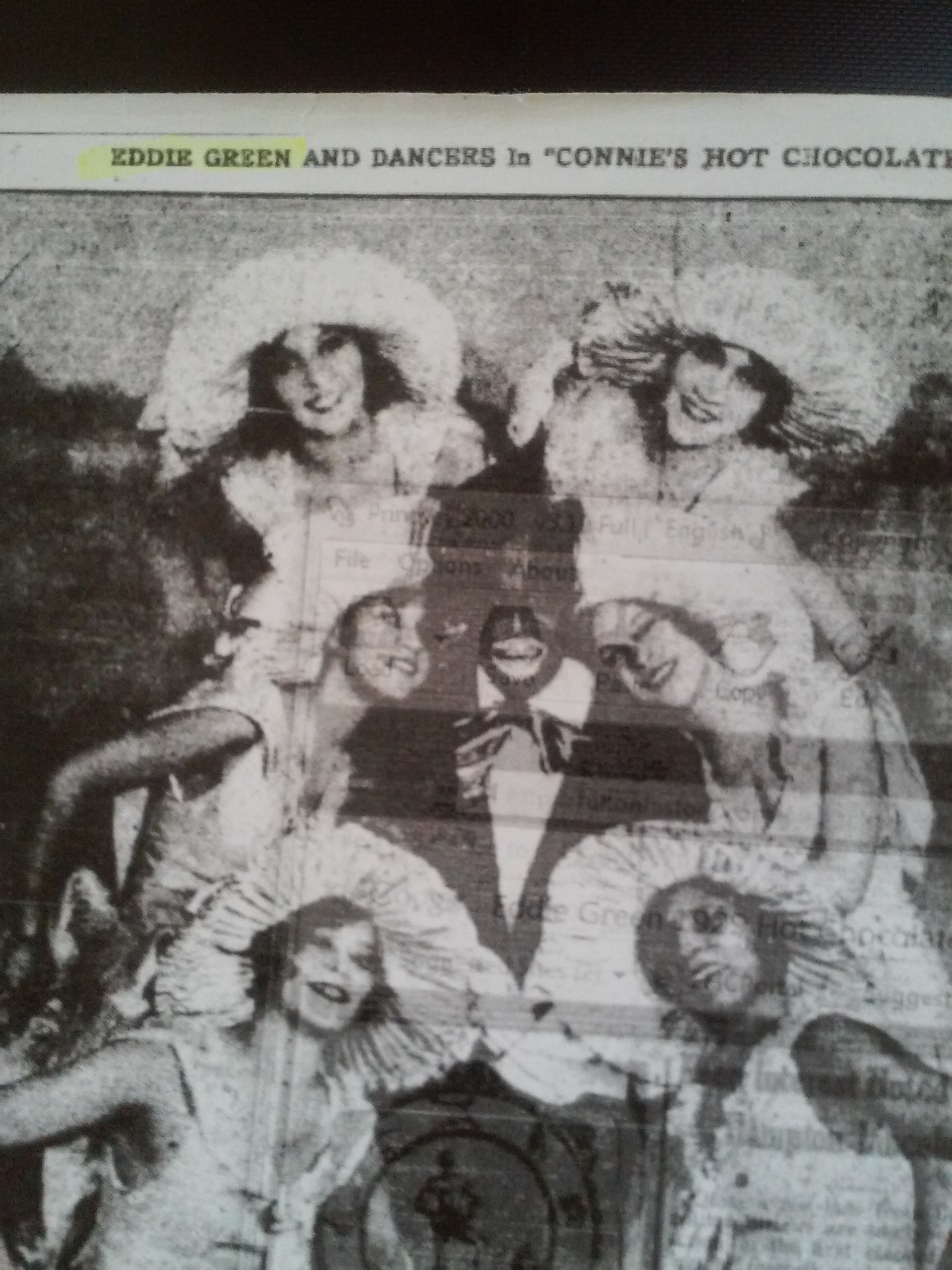
blackface 179Introducing Eddie Green and Dancers in “Connie’s Hot Chocolates”, in its fourth month at the Hudson Theater in New York, 1929.

When I was young, about ten years old, my mom told me that my father said that he had never performed in blackface.  The way she said it, sounded to me like she was saying, he would not stoop so low.  But, maybe, he told her he would never perform in blackface again, as he had already been there and done that, because clearly Eddie did perform in blackface as the above picture shows.  I found this picture while searching the net and I was shocked.  Like Mr. Fallon says, I was like “Eww!”  Which is where my mindset was about this type of performing.  Whether it stems from societal influences or parental influences, I realized, at that time, that I was embarrassed for Eddie.  And, I did not know how I was going to be able to present this to the public.

Hm.  Obviously, I had a problem.  One minute I am so proud of my father and the next I want to hide a portion of his life.  I had to take a good look into my thought processes.  I had to educate myself about the business of performing in blackface.  So I started reading.

I learned that way back in the 1700s actors were performing in blackface-supposedly as an exaggerated, humorous imitation of blacks as they were perceived in those times.  I learned that minstrelsy became wildly popular as time went on, with troupes performing in circuses in the US and the UK, and that a circus was not considered complete without at least one minstrelsy act.  I learned that at one time blacks were not allowed to perform in blackface on stage with whites.  It was exclusively a white thing.  I learned that though whites performing in blackface was basically about making a black person seem ridiculous, it also assured that a black person had no opportunity of performing on stage and, maybe, becoming famous.  This, as I now know was to change.

I learned that George M. Cohan, young author and actor, who became famous, appeared in blackface in 1891. he played  in his father’s production of “The Molly Maguires”; and he was co-proprietor and part producer of Cohan and Harris’ Minstrels, the first performance of which was at the Apollo Theatre, Atlantic City, N. J., July 27, 1908.*

I learned the  by the 19th century, blacks were allowed to appear on stage with whites only if they wore blackface. They painted their lips white and their costumes were usually gaudy combinations of formal wear; swallowtail coats, striped trousers, and top hats.  I learned that Bert Williams popped up, and of course, became famous.   Mr. Williams was the most popular blackface comedians of his day,and, was also the highest-paid in 1912, working for Ziegfeld Follies after signing a 3-year contract for $62,400 or $1.5 million today.  ( Strausbaugh 2006, p. 136)  I learned that It was through blackface minstrelsy that African American performers first entered the mainstream of American show business.*

I went back to some of the articles I have found in which Eddie’s performances were reviewed.  In an article of Stage and Screen it says:  “Eddie Green, late star of “Plantation Days, as he was billed on the program, was also exceptionally good.  His was a blackface number, dancing and singing and his droll manner won fave.  His talking song “Previous” was enjoyed.  He also did some clever dancing.”  The Utica Herald says “Eddie Green scores a hit with his softshoe dancing.”  A blurb in The Billboard from 1921 says,  Eddie “Simp” (his nickname to those who knew and loved him) Green, the acrobatic dancer is singing his own songs with “The Girls De Looks” Burlesque Show.  Eddie is a good business man and has his own publishing business. . . . He is contracted with the show for the next two years.”

Today, my personal perception of Eddie’s life as a performer has changed drastically.  My father was not degrading himself by doing blackface, he was presenting himself as the actor that he was in the makeup expected for the roles he played.  He had a plan.  He knew where he was going and what it was going to take to get there.  What to some was disgraceful, provided Eddie with a stepping stone to a better life.  He constantly received kudos.  I discovered new information from these articles, also.  Mom never told me that Eddie was an acrobatic dancer?  A softshoe dancer?  Really.  Eddie was exceptionally good at whatever he put his hand to.  That is the point.

Eddie wrote a letter to The Billboard in 1920 to let his fellow actors know about the most convenient place to get a room, the Hotel Francis, opposite the New York City Depot.  The editor of The Billboard had this to say about that letter:  “The following letter from Eddie (Simp) Green. . . . is beyond doubt the most unselfish communication that has come to us since the department has started, . . . Eddie Green writes something besides letters.  He wrote “A Good Man is Hard To Find”, “Algiers”, and the “Blind Man’s Blues.  He also has written himself into a class of regular fellows with the above letter.”

A class of regular fellows.  A good man.  A man of many talents.  My father, of whom I am proud.

p.s. I forgot to mention, is he surrounded by beautiful women, or what?

*Excerpts from Monarchs of Minstrelsy (1911)
by Edward Le Roy Rice (1871-1940)

Let The Good Times Roll

GothamCity
Gotham City-1920s

Hi there.  I have become addicted to finding images for my posts.  The thing is, once I start looking at the different pictures, I absolutely must look at just a few more, and then I want to know more about these pictures and before I know it, I have lost track of time.  Which means I start my posts later than planned.  The above photo is New York circa 1925.  My father, Eddie Green, was producing a play and performing at the Lafayette and other venues in New York, as opposed to being on the road in 1924 and 1925, so he brought his mother to live here.

In 1924 Eddie was working the Burlesque Circuit, first as the star of “Plantation Days”, which was a musical review.  According to A Century of Musicals in Black and White by Bernard L Peterson, (1993), Greenwood Press,  “The original “Plantation Days” toured from New York City in 1922, playing such eastern and Midwestern cities as Pittsburgh, Detroit, Cleveland, Toledo, and Chicago; staged by Leonard Harper.  Starring the dancing team of Harper & Blanks (Leonard Harper and his wife, Osceola Blanks), comedian Eddie Green, James P Johnson and The Plantation Days Syncopated Orchestra.”  After which they returned to New York.  Eddie went on to work with Barney Gerard in “All In Fun” with the Columbia Circuit where he was listed as: EDDIE GREEN-Late Star of Plantation Days.”

In September of 1924, Eddie found himself working, once again, with Leonard Harper, who had staged “Plantation Days.”  Mr Harper was a well-known producer, stager, choreographer and studio owner.

lips that touch liquor

Eddie was hired to produce the “Stepping High Creole Review” for Leonard Harper in September of 1924. at what was then the Hollywood Cabaret at 203 West 49th Street, in New York.  The Hollywood Cabaret was a nightclub that was very popular at the time, the band that was featured was referred to by Hollywood ads as either, “Washingtonian’s Hollywood Jazz Orchestra” or “Washington’s Hollywood Jazz Orchestra”, of which Duke Ellington was a member.  The Cabaret also served liquor. And since Prohibition was in effect, they also had liquor raids, here is an excerpt from court documents:

The search warrant which was issued recited as follows:
“Whereas, it appears from the affidavit of Frank Rickey, that certain intoxicating liquor containing more than ½ of 1 per cent. of alcohol by volume and fit for use for beverage purposes is unlawfully held and possessed in a certain cabaret known as Hollywood Cabaret, located in the basement of the building at 203 West Forty-Ninth street, borough of Manhattan, city and Southern District of New York, and in any closet, vault, safe, cellar, subcellar, kitchen, ice box, room or rooms connected with or used in connection with said restaurant.

I also found this little blurb:  “Wild Throng Dances Madly in Cellar Club, says the Morning Telegraph Hotels Restaurants and Cabarets column in the July 13 edition of the Morning Telegraph”.  Liquor can do this.

audience-dancing

As my mom would say, “This must be the place.”

Unfortunately, according to a New York newspaper article:

“The Hollywood engagement was ended by a fire at 5 o’clock the next morning. The fire ‘wrecked’ the club and damaged stores in the building. Water from the firefighters’ hoses poured into the subway; the Daily Star reported 2 feet of water delayed the Long Island city bound B.M.T. trains a short while, other papers reported there was no delay. Ellington, too, recalled a fire around Christmastime.”

I keep thinking Eddie must have had a Blast living his life.  I am getting a picture of a man who did not focus on what could not be done.  Eddie suited up and showed up.  That is how a person keeps moving forward.

Is there someone who inspires you to move forward?  Think about it.

Thanks for stopping by.

Family Oscars

Oscars-red-carpet
Oscars-red-carpet

So, tonight’s the night for the 2015 Oscar Awards.  I am not a big award show watcher, but since I am sans cable, I have not been able to watch TV, and now, of course, I am wishing I had cable again.  But, this means I have an excuse to skip ahead of myself regarding the telling of my father’s story, and also to touch on one of the reasons I am bringing him back into the spotlight.

spotlight

Eddie’s life in the entertainment world included singing, dancing, songwriting, comedy, magic, acting, producing and directing.  As an entrepreneur, he was a music publisher and owned two BarBQ Restaurants in New York and a Music School.    His name was always in the paper.  Even if he was just in town for the weekend.  He knew lots of people.  And lots of well-known people knew Eddie.  If I mentioned these people today, you would know who they were.  But, if I mention Eddie Green, almost nobody knows who he was.  It’s the opposite of that old joke that my step-father used to tell about the guy that everybody knows:

Bob tells his boss he knows everyone, even the Pope.  His boss doesn’t believe him.So off they fly to Rome. Bob and his boss are assembled with the masses in Vatican Square when Bob says, “This will never work. I can’t catch the Pope’s eye among all these people. Tell you what, I know all the guards so let me just go upstairs and I’ll come out on the balcony with the Pope.” And he disappears into the crowd headed toward the Vatican.  Sure enough, half an hour later Bob emerges with the Pope on the balcony.  Bob returns and finds that his boss has had a heart attack, Bob asks his boss what happened and his boss said his heart just couldn’t take anymore when a guy in the crowd jostled him and said “Hey, there’s Bob, but who is that guy standin next to him!”

In Eddie’s case, it’s “Hey, I know those people, but who is that little short guy standing next to them?”  So, tonight, in keeping with the Oscar Night theme I am bringing out my Eddie Green/Hattie McDaniel picture:

eddieandhattie

I know, it’s very small, my transfer skills are not that great yet.  From left to right are my mom, Norma, Eddie, Louise Beavers, a friend, Hattie McDaniel and another friend.  I received this picture from my Godfather, Atty. Walter L. Gordon, who also donated it to the Los Angeles Public Library where it can be viewed in the photo database.  And, speaking of the Oscars, this picture was taken around the time Hattie won the Academy Award for Best Supporting Actress in “Gone With The Wind.”  Hattie McDaniel and Eddie had worked together on the radio in the 30s and they also worked together on a radio program during WWII on a show called Jubilee.  Presented by the War Department, Jubilee was broadcast to American fighting men and women overseas and featured a mostly Black cast, including appearances by Louie Armstrong, Eddie “Rochester” Anderson, Nat King Cole, and Heavyweight champion Joe Louis.  You recognize these names, right?  I want the name, Eddie Green to be just as recognizable.

My mother, at the time, was a protege of Hattie McDaniel, as per this article from the The California Eagle, June 22, 1944:

momhattiehorne

The article in the middle of the paper, reads:  “Miss Amato Is The Talented Protege of Miss McDaniel – Representing Miss Hattie McDaniel as a guest of Miss Lena Horne at her “after theater” party closing her headline Orpheum appearance, was Miss Norma Anne Amato and her mother Mrs. Sinclaire White Amato. . . .”  This is the type of information my mother never mentioned.  Well, actually, she did tell me, but not my siblings, that her family knew Hattie McDaniel, but she left out the protege part.  She also left out the Lena Horne part.  As a matter of fact, it’s pictures and articles like these that have filled in my mother’s and my father’s life for me.  This was meant to be.

Well, it’s been fun, but I gotta run.  I hope you have enjoyed tonight’s mini Oscar award/tribute show.  I enjoyed bringing it to you.  Tune in again.

In searching the net, I found a husband and wife who were in the process of selling their business.  They had copies of old radio programs, on CD, that Eddie had done for the Armed Forces Radio Program-Jubilee, that I mentioned above.  The Mrs. sent me five CDs, one with EDDIE GREEN (LIVE EXCERPTS) Comedy Routines (W/ Lena Horne; W/Canada Lee; W/Ernie Whitman) and another with 4 Comedy Routines (W/Hattie McDaniels; And/Ernie Whitman from 1942 and 1945, respectively.  Now if that wasn’t cool, I don’t know what is.

A True Inspiration

Biddle Street-1907-Baltimore, Md.- Housing Conditions in Baltimore

svf_b_streets_biddle_alley

My father, Eddie Green, was born on a street like this in Baltimore, 1891.  According to my research, these dwellings were known as alley houses.  There was no public sanitation system until 1904 when a fire destroyed most of the area, and a system was built.   Leukemia was killing those people who had to live here because of their poverty and those people who had to live here because of the color of their skin.  Black people were confined to these areas by city laws.  Eddie hated his living conditions.  In 1900, when Eddie was nine years old he left home.

magic rabbit

Eddie taught himself to read and after reading some magic books, he decided to become a magician.  This is how he chose to earn money, which wasn’t much because of his age, and I believe he did handy work.  It is remarkable to me that he went out into a world that was facing a Depression, and a necessity to help a large immigrant population, Eddie had to move in with an uncle for a while in 1910, but by 1917 he had a comic act going and wrote his first song.

I believe that every human being possesses the ability to progress.  Finding that which motivates us is the thing.  Some motivation is inherent, such as the desire for food. Eddie found his living conditions intolerable and he made a determination to change these conditions for himself.

A_booklet_(How_to_Handle_Tough_Times_by_Norman_Vincent_Peale)_lies_amid_debris_130526-Z-TK779-009

This is a pamphlet that was found in the ashes of a fire in 1990.  It is a pamphlet written by Norman Vincent Peale.  And it is in the rubble.  Like Eddie was.  People need inspiration and motivation to help them have a better, happier life.  My motivation, is the desire to help others realize that we all have our own individual strengths.  We can all attain our goals for a good life.  And as we learn to get through our own tough times, we can, perhaps, motivate others.  Look around.  Look within.  Be inspired.

A Prayer For Christmas

Hi.  I am writing this post on December 22, 2014.  For whatever reason, I am not in the Christmas spirit this year.  At least, I am not in the spirit of buying Christmas presents, nor do I have the money.  I like listening to “Silent Night” by the Temps and “The Little Drummer Boy”, but I have not done so this season.  Maybe I am not looking at my life properly.

Today I read an article about a woman whose daughter was lost in the Tsunami 10 years ago.  At least, the daughter was assumed lost.  This lady has just found out that her daughter’s body was actually found and buried in a grave marked with a stone.  Somehow, someone found this lady and gave her the news about her daughter.  The article said that the mother is sad, but happy that someone took care of her daughter for her.  This mother is unable to travel to give her daughter a final goodbye as she doesn’t have enough money. She taps rubber trees for a living, which starts the process of making latex, and it probably does not pay very well.   She taps rubber trees for a living and, oh poor me, I can barely get out of bed and get to my computer or the TV.

I need to start looking at the fact that I can get up when I feel like getting up, I have a computer I can turn on and listen to all types of music from anywhere and I have a TV, AND my life is pretty calm right now.

For Christmas this year I will say a prayer for those whose children may not be with them, that they may find solace in the reason for the season.

bethlehem-silhouettes-ii-cross-stitch-chart-stoney-creek

remote village in Myanmar’s southern Karen state, where she taps rubber trees for a living.

May’s mother is too poor to travel to Thailand to retrieve her daughter’s body, or to pay to have it brought home. She hopes the body can be cremated in line with Buddhist customs.