YES! Just What I Needed To See.

yes

I watched a video yesterday from the Arsenio Hall late night television show, of a young black woman answering someones comment on her speaking voice.  She put into words an idea I have been trying to project via my blog and, eventually, my book.  One of the things she did was to champion women who had come before her.  Women who were just ordinary women, but did extraordinary things.  Like Dorothy Height, The President of the National Council of Negro Women for 40 years.  Born in 1912, Dorothy Height she was an educator and an organizer.  She was on committees and commissions.  In the 1960’s she organized Wednesdays in Mississippi, which was a group of black and white women who came together to create a dialogue of understanding.  In 2004 Dorothy Height was awarded the Congressional Gold Medal.  She fought for civil rights and women’s rights.  Dorothy Height even has a building named after her.

Dorothy I. Height Building Pennsylvania Ave. Washington, D.C.
Dorothy I. Height Building
Pennsylvania Ave. Washington, D.C.

For that young lady to communicate positivity by championing who we are as black people, people like Dorothy Height, made me wish I could hug her.   I thought, this is how you encourage people to achieve their goals, as opposed to focusing on how others may have held you back.  The thing is, I want to reach, not just people of color, but anyone who feels they “can’t” do this or that, because of what others may say.  Encouragement is what we need in this world.  Television was the perfect place for her to be able to express herself and reach millions of people.

That young woman I saw put her passion into something positive, as opposed to projecting anger, she projected pride in those who came before her and paved the way.  And she was young.  Meaning she is able to reach an audience that I may not attract.  I want our young people to remember the folks who struggled for the freedoms we enjoy today.  To remember them and to use them as examples of perseverance and dedication and pride.

On June 26, 1948 there was an article in the New York Age newspaper about my father and his thoughts on television:

Eddie Greens Firm Aids Show Business Through Television. The fast growing field of television offers a fertile one for Negro performers, is the opinion of radio comedian, Eddie Green, who revealed that because of this fact his motion picture firm has interested advertising agencies in having their sponsors products sold to the millions who view television via the singing and dancing route.

Designed to catch and hold the attention of the millions who want entertainment on video, Green asserted that instead of the hackneyed manner of selling national consumer goods to the public, his firm will “Deliver the message in a way to keep viewers from turning the dial”. Organized two months ago in Los Angeles with the famed comedian as president, Sepia Productions has already lined up five three-minute skits which they plan to lease or sell outright to ad agencies.

Backstage at the Strand Theatre here, where he’s a member of the “Duffy’s Tavern” radio show,  Green said that colored performers save(sic) their niche in the television picture and they should demand that their agents establish contacts with those that handle the shows In order not to be left out in the cold when the infant industry attains maturity. He pointed out that the decline of vaudeville witnessed many good Negro acts going out of business and little hope for the birth of new talent was anticipated until television offered vast potentialities!

Two years earlier, Eddie told the Baltimore AFRO: “I have little doubt that there will be more roles for colored entertainers in radio and although it may still be sometime away, I believe the day will come when at least one of the major networks will offer a chance to some young artist to head his own show.”  Eddie may not necessarily have been talking about television networks, but I bet he had them in mind.  Eddie knew what he was talking about.  Though he was not the first person of color to be on a major network, Arsenio Hall did have  his own show back in 1989 and now, once again, he is back and providing some very uplifting entertainment.

One last thing.  My father was an electronics wiz.  He liked to tinker with radios and television sets.  He had ideas.  My mom told me that Eddie was the way ahead of his time regarding television.  One day in 1945,  Eddie decided to cut a hole in the wall between the kitchen and the living room so that he could put the TV in the wall.  Mom said that the fact that people have their TV on their walls these days is nothing new.  She said the only problem was, that the back of the TV stuck out into the kitchen and was really ugly.

That’s all for now.  Thanks for stopping by.

THE ADVENTURE CONTINUES…..

1923 Feb 16, In Egypt the burial chamber of King Tutankhamen’s recently unearthed tomb was unsealed by archeologist Howard Carter.  In June, 1923 my father, Eddie Green, had his song, “King Tut Blues” copyrighted.  It’s really small, but you can see his name right in front.

king tut blues 78 album

SOMEone who reads my blog sent this picture to me.  So cool.  I posted a few days ago about this song that was written by my father in 1923, and I have received information which is going to help me in my quest to locate the copyright documents.  I call it a quest because I know where the documents may still be, but in order to get them I must have lots of money to pay the Copyright Office for searches.  I have received the words to this song and it turns out that King Tut’s blues had something to do with his mother-in-law.

In 1923, Clarence Williams had just moved into New York, when he became the publisher for “King Tut Blues” and another song titled  “The Right Key, But The Wrong KeyHole”, words and melody by my father.  Along with writing these songs, Eddie was also performing in a couple of plays in New York,  “Plantation Days”, at the Lafayette Theater,  after which he did a play titled “All In Fun” , for which he wrote his own songs, at the Yorkville theater.  Then it was on to the Palace in Baltimore, to Toledo and to Ohio, then back to New York by 1924.

The  Schnectady Gazette,  April 8, 1924, stated in part,

“For pep and go the “All In Fun” burlesque show which opened at the Van Curler yesterday for a three-day stay is recommended to the patrons of the theater”.  “Eddie Green, late star of “Plantation Days,” as he was billed on the program was  exceptionally good.  His talking song, “Previous”  was enjoyed.”

The performance at the Van Curler was a song and dance skit that also featured this young lady, Momi Kalama., seems she was known as “the Anna Pavlova of Hawaii.”

momikalama2 momi kalama girls de looks
Somewhere along in here, my father got married for the first time and had a daughter.  His daughter was born about 1923.  I have no memory of her as I only saw her once when she came to my Eddie’s funeral in 1950.  My mom told me that she and Eddie’s daughter were the same age, and they did not get along.  I actually found an article with a little blurb about Eddie Green’s daughter rushing to his side.  If she is still alive, she would be about 91 years old today.

I have not had much luck in finding my half-sister, nor have I been able to locate any information about Eddie’s parents.  It is difficult to locate folks from 1950, not to mention trying to find someone from the late 1800’s.  Since Eddie was born in 1891, records from that time may be forever lost.

I do, however, have some information about my maternal grandmother, she who became my father’s mother-in-law in 1945.  Her name was Sinclaire White Murdock when she met my father.  Sinclaire was born in 1896, in Chicago.  She came to Los Angeles in 1920.  In researching my father, I have also included my mother and her history and while checking out my grandmother, I found this article in “The Crisis” magazine, A Record of the Darker Races, started by W. E. B. Dubois in 1910 and which is the official magazine of the NAACP,  Vol. 4 No. 4:

sinclaire white

I have been able to follow Sinclaire up to her death here in Los Angeles, thanks to newspaper articles and my mom, of course.  Sinclaire became a violin teacher and started her own Music Arts Association in the 1920’s.  She started my mom on the violin and piano at around age 7.  There will be a chapter or two about my mom in the book I am writing about Eddie, so I want to incorporate some of her story here into this blog.  I do not remember my grandmother and I have only seen one picture of her.  One of those black and white pictures where she has on a high neck white dress and her hair is piled on top of her head, very victorian looking and very stern.  Later, in 1945 when Sinclaire and Eddie met, and Eddie began to court my mother, he discovered that he, too, might wind up with mother-in-law problems.

I have discovered that I enjoy writing.  I don’t have any lofty aspirations in this regard, I simply want to get down on paper the accomplishments of those family members who have contributed much to society, but have pretty much been forgotten.  I appreciate my readers because they let me know that I can, in fact, write a book that people will find interesting and, perhaps, inspiring.

To me:

“Don’t let the fear of striking out, hold you back”- Babe Ruth

Two Tremendously Inspiring Gentlemen

Courtesy Google Advanced Image Search

Jimmie Fallon

Not since Johnny Carson have I actually thoroughly enjoyed late night television as much as I enjoy Jimmie Fallon on The Tonight Show.  To me, Mr. Fallon is an example of a person doing exactly what they want to do and liking what they do.  He seems to get such a kick out of his life.  He is energetic and fresh.   He looks like he is having fun.  I feel like I am having fun when I watch him on television.   He is putting in the work and it is paying off.  Mr. Fallon is a singer, songwriter, actor and comedian. He puts me in mind of my father.  Tremendously inspiring.

Eddie Green, my father, was a singer, songwriter, actor and comedian.  Eddie found what he liked to do, put in the work and became a prominent entertainer.  Eddie was enamored of the radio world and appeared on a variety of programs which led to his biggest radio role, movie and television work.   Also, tremendously inspiring.

new eddie
new eddie

Today, Mr. Fallon is “trending” on social media.  He’s good.  Back in Eddie’s day, actors got their names in the paper.  Below is an article from the Brooklyn Eagle, 1939, in the Trend! section about Eddie’s radio interests, and, it also mentions Eddie’s own involvement with television.

TREND! BROOKLYN EAGLE SUNDAY , JULY 9 , 193 9

By ROBERT FRANCIS
Most of you know Eddie Green at
least by ear. He’s been around show
business a long time, but for the
last couple of years you’ve been
laughing at his quaintly plaintive
Napoleons, John Alderis and Jonahs
over the airwaves.
He’s
got his work, his radio to tinker
with—and he’s the proud possessor
of the first television set in Harlem.

1939_GE_HM171
1939 GE

See ya!

EXPANDING MY MIND

350px-Tam_o'_Shanter_and_Souter_Johnny_at_Kirkton_Jean's

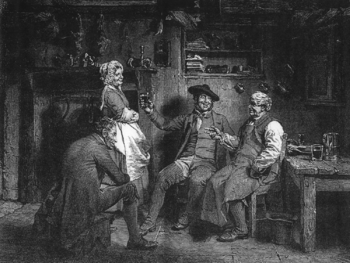
Tam and his Cronies drinking at Kirkton Jean’s-Courtesy Wikipedia

Hey there, welcome back.  Researching my father, Eddie Green, is proving to be so much fun and is also teaching me to broaden my mind-set.  Today, while trying to arrange my hard copy documents in a way that would allow me to make sure what I write is correct, I came across an article written in 1927 or 1928,  which introduces Eddie as the star in a play titled “Tam O’Shanter” at the Alhambra Theater.  (I have pictures of Eddie on some of my other posts, I just haven’t figured out how to incorporate them into current posts, in case you are new to my blog and wonder what Eddie looks like, and I think one shows up on my landing page at the bottom.)

By GERALDINE DISMOND , Eddie Green, who is famous for his ‘A Good Man is Hard To Find” and “Don’t Let No One Man Worry Your Mind” will appear all next week at the Alhambra,. playing the lead in “Tam O’ Shantcr,’ love story set to music – . ‘ “: .’. – ‘ ‘. – Mr. Green has been in the show business practically all his life. He was born in Baltimore and began his career as the “Boy Magician” playing small towns and ‘packing the “”entertainment halls….   He worked in burlesque four years for Columbia and has the distinction of having produced and managed for a year. ‘.’All in Fun, for Barney Gerard. Then followed a year with the Schuberts, and three ‘ years at the Apollo. He comes  to star in Tam O” Shanter. This week at the Alhambra.

This is exactly the type of article I need to help me stay organized.  My problem was, however, that every time I looked at this article, I wondered what he, Eddie, a black man, was doing in a play in 1927 with an Irish theme. The play, directed by R. E. Jefrey is about a man who recites a poem in a village inn.  The poem, I finally noticed, was written by the Scottish poet, Robert Burns, and it was titled “Tam o’Shanter”.  I realized that, of course, I had heard of Robert Burns but not the poem, so I looked it up.  The poem is about a man named Tam who spends a lot of time getting drunk with his friends, neglecting his wife.  It begins like this:

“When chapman billies leave the street, And drouthy neibors, neibors, meet; as market days are wearing late, and folk begin to tak the gate, while we sit bousing at the nappy, an’ getting fou and unco happy, we think na on the lang Scots miles, the mosses, waters, slaps and stiles, that lie between us and our hame, where sits our sulky, sullen dame, gathering her brows like gathering storm, nursing her wrath to keep it warm.”  

The actor sits in a chair and recites this play, which takes about 90 minutes.  It is one of Mr. Burns longer plays.  There are different versions if you care to look them up, or maybe unlike me, you have already done so.

I have just made the discovery that this is an extremely well known poem.  There has been an overture named after this poem.  There has been a hat named after this poem.  More recently, there has been an adaptation of this poem by a British heavy metal band.  Readers of history, painters and builders have made use of this poem.  The poem even mentions Cutty Sark, though not in the way I know Cutty Sark.  (It means “short shirt”, not hard liquor).  My point is, I have had a sort of narrow-mindedness due to a lack of knowledge in certain areas.

My father was a well read man.  As a former Burlesque comedian, Eddie probably used satire in his sketches.  At the time, satire was used to ridicule dignified works.  That the audience had a high degree of literacy was taken for granted, therefore the actor had to know his business.   Eddie read, he studied.  He prepared himself.  He did the work.   He was an Actor, period.  He acted in plays, period.  My vision of life and my mind is expanding, thanks to my father.

It has to be very freeing to simply decide what you want to do and proceed to do it.  Sounds simple.  I tended to proceed out of necessity most of my life.  The need and desire for additional life knowledge is providing me the impetus to continue going forward with this project.  It is absolutely stimulating.  Thanks for stopping by.   Do come back.

?????????????????????????????????????????????????

Research-Extremely Satisfying

king tut papers

One of the things I did not count on when I decided to research my father’s life, was the amount of paperwork I would have to browse through to verify my writing.  I started out at the central library in downtown Los Angeles.  I had to search the Catalogue of Copyright Entries and I had no idea how to read these catalogues.  But I learned.  Eventually, I learned to peruse these catalogues on-line, but since I only had a cell phone at the time, it was slow going.  I ended up at the local family history library where I was able to print whatever information I found on Eddie Green.  Which brings me to this document regarding the song “King Tut Blues” written by my father.

This is a copy of the catalogue entry for my father’s song, “King Tut Blues”, (listed at the top of the third column) written back in 1923, showing Eddie as the Author of words and music and showing also that he renewed this song in 1950, about six months before he died.  I was able to locate this last piece of information with the help of one of the readers of my blog posts, which just goes to show that we can and do participate in each other’s progress through our posts.  Which is something else I never expected when I was stressing over whether I could even maintain a blog.  Even if my book flops, this experience will totally be worth the time and effort.

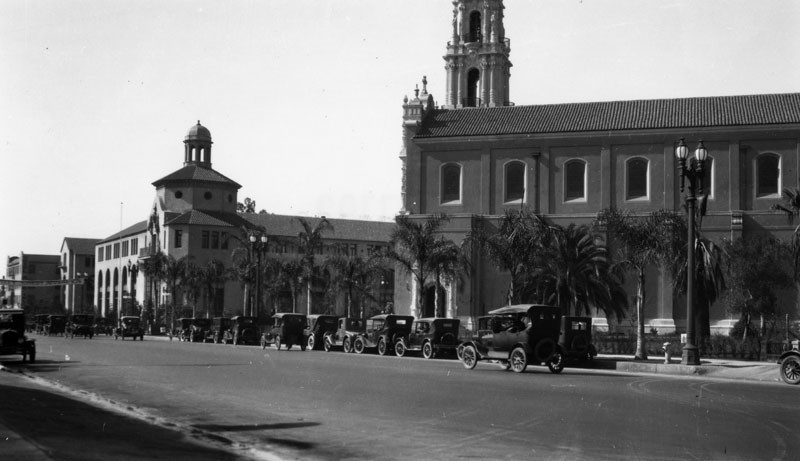
Eddie was about 22 when he wrote this song in 1923.  My mother, Eddie’s third wife, was born November 17, 1923.  Her parents at the time lived in Los Angeles, California on Jefferson Street.  They lived very close to the Triple A Automobile Club which was located on Adams Boulevard and Figueroa Street and is still there today.  As a matter of fact, after living all over Los Angeles County, my mom died while living back on Adams Boulevard about 5 minutes from the Automobile Club.

Auto_Club_ca1926

My mom’s mother, Sinclaire White-Murdock was, in 1923, the President of The Music Arts Association,  which held regular weekly meetings at the Sojourner Truth Home, in Los Angeles.   Sinclaire was a violinist, so I guess it was bound to happen that when Eddie got to Los Angeles years later, he and Sinclaire would meet through musical venues.  But that wouldn’t happen for another 20 years.

I encourage you, out there, to consider researching someone in your family, it really is extremely satisfying.  Thanks for stopping by.

Turn The Faucet On

L'amour

faucet off turn out

I have been having difficulty beginning a new post so I decided to search for ideas and I found the above quote that seemed to speak just to me.  I thought, man, that is deep.  Turn the faucet on.  Start writing.  Write anything.

So,  I decided to write about a song my father, Eddie Green, wrote in 1923 titled “King Tut Blues”.  I found out that for this song, Eddie was responsible for words and melody, and arrangement was by W. Benton Overstreet.   W. Benton Overstreet was an African-American pianist, composer and bandleader, who, in 1917 composed the song “There’ll Be Some Changes Made”, along with a man named Billy Higgins.

This has nothing to do with King Tut, but I also found out that In 1929, six years after working with W. Benton Overstreet, Eddie composed a song with Billy Higgins titled “Big Business”, that was performed in the Broadway production “Hot Chocolates”. Billy Higgins, wrote the words to “There’ll Be Some Changes Made”, to which W. Benton Overstreet wrote the music.   Billy Higgins was an African-American who was born in 1888 in Columbia, South Carolina, and became a singer and comedian. By the late 1910s, he was a top performer in a string of vaudeville shows, traveling troupes and burlesque revues.  I actually own a copy of a recording of “Big Business”.  The production “Hot Chocolates” also showcased such performers as Louis Armstrong, Fats Waller and Andy Razaff.

Hot Chocolates 184

Some of the names on this recording are still recognized today, but Eddie’s name has sunk into obscurity.  Maybe because Eddie died in 1950.  Or, maybe it’s like my mom said, Eddie was low-key.  One of the reasons I have begun writing a book about my father, is that I want Eddie to be remembered for his contribution to the entertainment industry that flourishes today.  Because he was there.

You know, it’s hard to stop once you get started.  I guess Louis L’Amour was right.  You have to turn the faucet on.

whole lot of water

Learning to Honor and Share In Life’s Truths

Constellation_Fornax,_EXtreme_Deep_Field_(tile_section)

Grief is a normal and natural response to loss. It is originally an unlearned feeling process. Keeping grief inside increases your pain.

A friend of mine passed away recently and I will be attending his funeral in a few days.  Not something I want to do.  When I received the text that he had passed, my first reaction was to look out the window at the sky, as if I thought that, that is where he is now, somewhere “up” there with his Creator.   Later, when I received the information about his funeral, I thought going would only make me really sad.  But now I think that maybe I don’t want to go to the funeral because that would make his death really real.  If I believe he has gone back to his Creator I could use my belief to sooth my soul.  Death is, I believe, Life’s Ultimate Truth.  I will attend the funeral and share this loss that his family and other friends are also experiencing.  Especially his family.

Eddie Had A Plan

you can read my letters

It’s 1921, and my father was now a music publisher with his own office.   Each of the above songs was written by Eddie.   I like the first title “You Can Read My Letters, But You Sure Can’t Read My Mind”, I can only imagine what was going on in his life at the time.

According to records, Eddie is now 30 years old.  The song-writing thing seems to be working, he has an office on 135th Street, in New York, and he has also contracted to play for two years as a dancer and a singer of his own songs in the “Girls-de-Looks” burlesque show.

By 1925, Eddie had an office in D.C., had appeared in a few more plays on the Columbia Circuit and had moved his mother to Gotham, as it was called in the newspapers, or New York, as we know it.  January, 1925 Eddie began working stock at what was then Minsky’s “Little Appollo Theater” on 125th in New York which featured Burlesque.  By 1925, topless girls frozen in tableaux vivants were old news, permitted by law as long as they didn’t move, but in April of that year one of the girls moved and Minsky’s was raided.   My father was there that month and for a year after that which was news then because he was the only person of color in the show.

little appollo

Somewhere during this time, Eddie married his first wife and had a daughter.  His daughter was born the same year my mother was born, 1923.  By 1935 Eddie had another wife and by 1944 Eddie had made plans for the next wife, I know that because according to a newspaper article, Eddie had bought a house in Los Angeles and was “just waiting for the next lovely to come along.”

When I look at pictures of my father, I see a short (5′ 2″),  bald-headed guy, average looks, kinda turned-down mouth and dreamy eyes (I look just like him, except I’m not bald), and I wonder how in the world he managed to attract my mom, and how did get on so famously with women? (My mom once told me Eddie loved to be surrounded by women.)  My mom was gorgeous.  She was taller than he was. she was educated in a convent school, my mother spoke Latin, for Heaven’s sake, and Eddie was self-taught.  One thing I know now is that my father had ideas and he acted on those ideas. Eddie was a man of action.  He was a fun-loving, happy, hard-working man.  And Eddie is the reason I read as well as I do now, he bought me my first set of literary classics, which included Moby Dick and Last of the Mohicans.

I believe his attitude is mirrored in how people saw him, he could always get the gig and once he got it he was extended for two years or asked to come back.  He had a busy mind and he planned ahead.  I see him as a man with a vision for himself.   He was pretty much a self-made man.  He had drive.   I would love to tell Eddie how much I admire him as a man.  I was able to tell my mom that her ability to overcome rough times in her life was an inspiration to me.  She had drive, also.  Are there people you know who inspire you with their drive?  I would love to know.

A Journey of Awareness and Motivation

Great-grandfather, great-grandmother, great-grandson.

my father & mother 1945
my grandson
my grandson

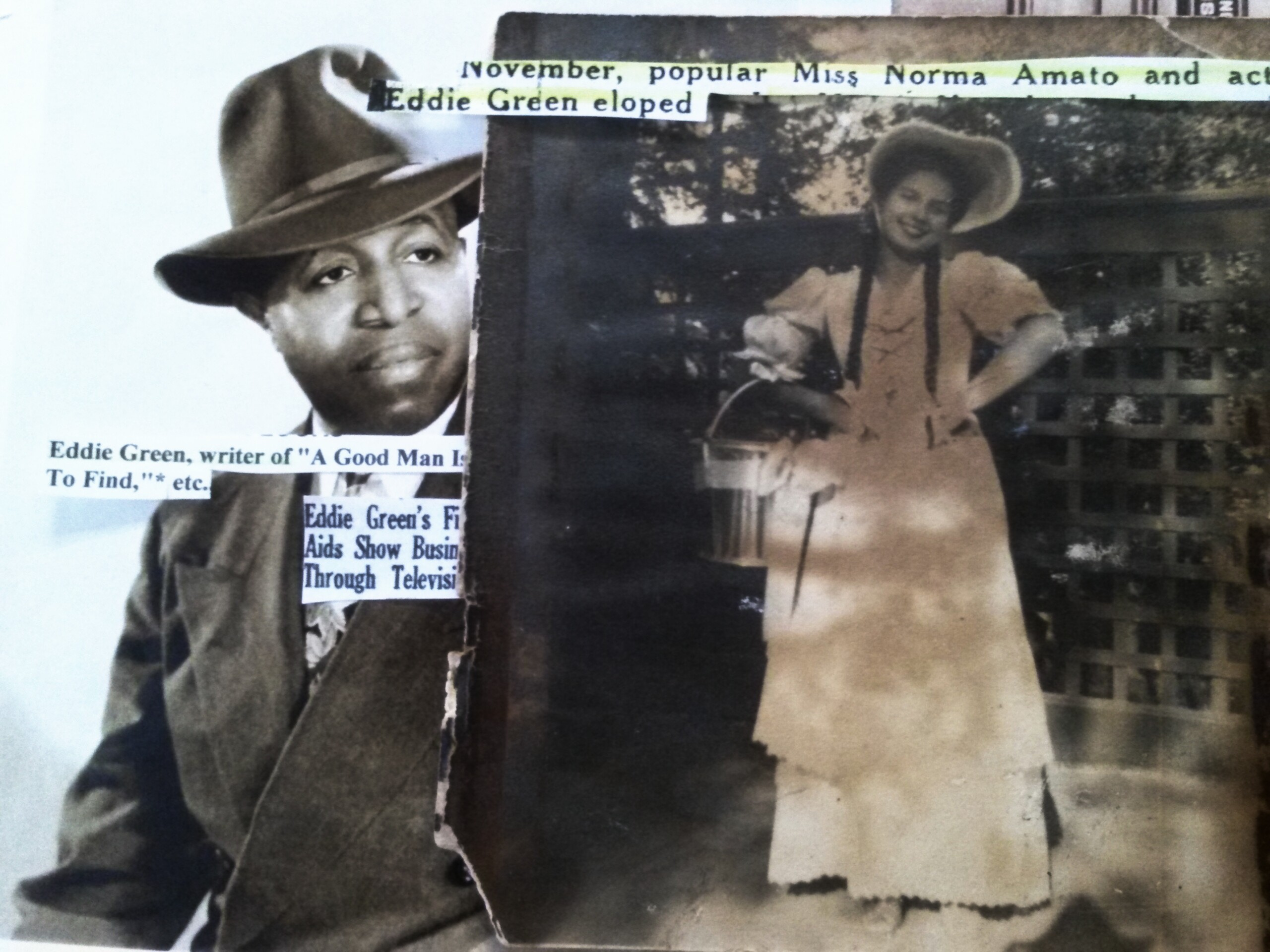
Ok, here are pictures of my father, Eddie Green, my mom, Norma and my grandson, Edward.  When my grandson was born he was named Edward, not because he was Eddie’s great-grandson, but because it was simply the name his mother chose.  Until 2014 I thought my father’s natal name was Eddie, in my research I came across information verifying my father’s birth name was Edward.   I was ecstatic.  Another discovery!  Which totally aligns with the fact that Eddie copyrighted his first song under the name Edward Green in 1917.  Another fun fact for me has been that my grandson, Edward has chosen to have people call him Eddie.  Just like his great-grandfather.  Plus, they look so much alike, don’t you agree?

My idea of writing a biography about my father came from the fact that when my grandson, Edward, was little, he used to use the phrase “I can’t” a lot.  So, I decided to put together what I knew about my father, who rose from poverty to prominence, and put it in book form.  My purpose for doing a biography of my father, was to give my grandson an example, from within his own family, of what a person can accomplish. I figured  if I show him what his own great-grandfather was able to accomplish as a black man, beginning in the early 1900’s until 1950, that it would provide him some motivation and inspire him to believe in himself and his own abilities.

I had no idea 15 years ago when I came up with this book idea, that the information I had about my father would lead me to finding so much more, and that I would still be discovering, to this day,  new articles and more pictures featuring my father, such as this one on the set of the radio program, “Duffy’s Tavern”, in which my father played “Eddie, the Waiter”  from 1941-1950.

Duffy_s_Tavern_-_Sandra_Gould_Eddie_Green_Charles_Carton_Ed__copy (1)

Life happens.  It interrupts the flow of our endeavors.  Edward, my grandson, is an adult now, and my book has just gotten started.  But it’s OK, because Edward has been able to follow along with me on this journey of awareness.  We are both learning about accomplishing our goals and what it takes to do so.  I have to say here, that I am truly proud of my grandson, he has grown into a good listener and has kept himself on the right track.  As for myself,  I have accomplished a new skill in starting a blog, I wasn’t sure I could do it, but here I am!  I am learning that in regard to my own endeavors, “Can’t Is Not In My Vocabulary.”  Stay tuned!


A Special Friend Passed On Today

aa

In 1990 I walked into a room with a bunch of people sitting around swapping stories and drinking coffee.  I met a man in this room who became a very special friend to me.  Today this man passed on.  He was not only a friend to me, but to my mom, my brothers and sister, my daughter, my grandson.  He even knew my favorite cousin that I grew up with.  Each of these people, especially my mom, thought highly of my friend.  I though highly of my friend.  He helped me to learn how to have patience and tolerance, he was kind, respectful and never sugar-coated his advice.  He helped me grow into the woman I am today, though he was younger, he had a bit more rational wisdom than I did when I met him.  By watching him, I learned how to have loving relationships with others.

friends talking 2

He spent a lot of time talking and listening to me (even when he obviously wanted to be somewhere else).  We would sit behind the building in which that room was, and I would  try to explain my situations to him and he would try to give me answers.  A few times his answers rubbed me the wrong way, and I would stomp off only to call him later.

BellWesternElectricRotaryPhoneC

We spent so much time on the telephone, he would fall asleep while I was talking!  That always pissed me off.  I was always the one who got pissed off.  He never once hung up on me or talked down to me.  He shared his family with me, his lady and in the past few years, his granddaughter, who is only about four or five.  She loved him so much.  He was a great example to me of how to live life when life hands you lemons.  He had great physical difficulties, but was usually just glad to be living the life he had.

He gave me the chance to have a person in my life who was not a significant other or relative, that I could love the way I wish all people could love each other.  A love that helps make life a little smoother.  He was a good friend to me.  I will miss you, Johnny.

May you rest in peace.candle