
 Joseph Bologne, Chevalier de Saint-Georges (December 25, 1745 – June 10, 1799) was a champion fencer, classical composer, virtuoso violinist, and conductor of the leading symphony orchestra in Paris. Born in Guadeloupe, he was the son of George Bologne de Saint-Georges, a wealthy planter, and Nanon, his African slave. During the French Revolution, Saint-Georges was colonel of the Légion St.-Georges, the first all-black regiment in Europe, fighting on the side of the Republic. Today the Chevalier de Saint-Georges is best remembered as the first classical composer of African ancestry.
How many people know about this man. In regard to classical music somehow I learned about Mozart, Beethoven, (bugs bunny cartoons, Disney movies, documentaries.) But not this guy. Some scholars call him the Black Mozart, except that he was born 10 years before Mozart and after they met Mozart was said to have echoed a few of Joseph’s bars.
When I went to school I learned a lot about White inventors, musicians (we sang Oklahoma in Glee Club), presidents, television stars. But very little about important Blacks. Well, there was George Washington Carver. But all we learned was that he had something to do with peanuts. We did not learn about the numerous honors he won for his work or that in an era of very high racial polarization, his fame reached beyond the black community.
Seems we heard a lot about Nat Turner though, the guy who led that slave rebellion. According to some scholars, the stereotype of African Americans males as criminals was first constructed as a tool to “discipline” and control slaves during the time of slavery in the United States. More recently , a study examining the news reports from The New York Times, The Washington Post, The Wall Street Journal and USA Today covering the effects of Hurricane Katrina showed that in 80% of the time black evacuees were portrayed in photographs, the word “looting” was mentioned in the captions, suggesting that the black evacuees were criminals. In America we have had the good actions of White people and the emphasis on bad actions of Blacks ingrained into our psyche. Blacks were not celebrated in our education. So I don’t believe in unconscious bias. That we make snap judgments about people and situations based on who we are, how we live, and how we were raised, yes, but it’s not unconscious. I believe we act from ingrained teachings.
The idea that Black men are dangerous exists today. Still. Sitting While Black is the hashtag on Twitter.
It’s sad that this is happening in 2018. My father lived during the early 1900s when Blacks were still being lynched in large numbers. One of the bloodiest race riots in the nation’s history took place in East St. Louis. A Congressional committee reported that 40 to 200 people were killed, hundreds more injured, and 6,000 driven from their home. Fifty-three black Americans are known to have been lynched in 1920. Eddie was in St. Louis in 1919-1920. He performed at the Booker Washington Theatre (a Black vaudeville house) with his Deluxe Players, he had been called back by popular demand. In those days he sang his own songs, danced and told “side-splitting” jokes. I’m sure he saw his share of horrors.
By the 1940s Eddie was appearing in the radio program Duffy’s Tavern. Things in America had progressed enough that The Library of Congress placed Duffy’s Tavern on the Honor Role of Race Relations, because they did not have Eddie resort to stereotypical “Black” language. They said “Green clicks as a waiter, not because he’s a Negro, but because he’s a good comedian.” So, it is clear in this instance that changing how Blacks were treated was a priority.
I wonder what he would think about two Black men being arrested because they were sitting in a Starbucks and asked to use the restroom but didn’t buy anything and wouldn’t leave because they were waiting for a third party. I mean we have not gone back to lynching but it certainly seems that we have at least gone back to the 50s or 60s. Some people today still see Black men as trouble-makers. I don’t think that providing unconscious bias training is going to change that mind set. I think something has to change within the person. Maybe as more time goes by people will be able to just see each other as fellow human beings, floating around in space on a friggin’ planet.
Hey, thank you so much for stopping by. Peace and Love
Check out my Book: Eddie Green The Rise of an Early 1900s Black American Entertainment Pioneer.

 “Radio for Negroes is a very hard field to get into . . . very hard! But the returns are so great that it’s worth the try.”
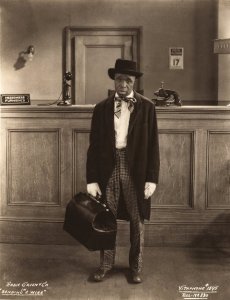 According to today’s news, a new Black female movie director who has just finished directing Madeleine L’Engle’s “A Wrinkle In Time”, has been chosen to direct Jack Kirby’s “New Gods” for Warner Bros. I have been following her rise, and when I read the words Warner Bros., my father flashed into my mind because he did a Warner Bros. Vitaphone Film.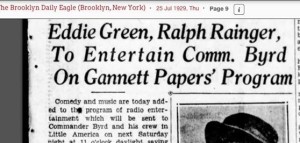
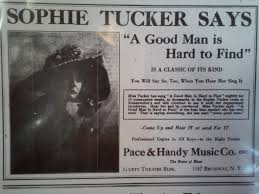 On March 7th I had the best time doing a book talk at a local library here in Los Angeles. There was a nice group of people, snacks and tea and I was prepared. But, I was a bit nervous. I think I was worried about how “cute” I was, or not. I said “uh” a lot. After I shared the Toastmaster tips I was not following I got a laugh and I felt more at ease. I spoke for almost an hour. I passed photos around. One thing I have noticed is that once the audience begins to hear my father’s rags-to-riches story they become truly interested. They are amazed in some instances and sad in others. And they laugh. His story is inspiring. I love it. I have begun to want to be a Cheerleader for Trailblazers, not only Eddie, but others. I find that keeping in mind those that paved the way is a motivating factor for future endeavors. One of the things I talked about was that Eddie wrote the song “A Good Man is Hard to Find” way back in 1917. During the early 1920s Sophie Tucker loved this song so much she sang it in her nightclub act every night for ten weeks.
 Depending on who was talking about it, the song was listed as a Blues song or a Fox Trot or as Jazz. Sophie did a Blues version. As you can see by this poster she was a red hot mamma, so you can imagine how she must have sang that song. After my talk at the library, a few of the people stayed around to talk with me. One of them was a gentleman who just happened to be a big Sophie Tucker fan and an Eddie Green fan. When I got home he had posted this message on my Facebook Book Page: “Dear Miss Green, I attended your talk at Memorial Library yesterday afternoon and enjoyed it very much. I am going to order the book from Amazon and look forward to reading it. Good luck to you and thank you for bringing Eddie Green back to life.” Now, of course, he did not know it but basically this is exactly what I was hoping to do with my book. Bring Eddie back to the fore of the public’s mind because of his many achievements during his lifetime which people have forgotten. What a treat to have spoken with this man.
 The gentleman also told me a story I had never heard before about Sophie Tucker and Alberta Hunter. Alberta Hunter was an American jazz singer and songwriter who had a successful career from the early 1920s to the late 1950s. He saw Alberta Hunter on a late night talk show probably in the 60s or 70s. She was discussing the night she decided to sing “Sophie’s” song-A Good Man is Hard to Find-on stage. And so she did. With Sophie Tucker sitting right there in the audience. So there!! They each participated in making the song a big hit. The gentleman who told me this story also said he looked and looked for a Sophie Tucker recorded version and finally found it just by happenstance. And here he was now talking to the daughter of the man who wrote the song. This is one of the reasons I love doing these talks. I get to meet and connect with people who know about my father or want to know. Since Eddie died when I was three this is so special for me.
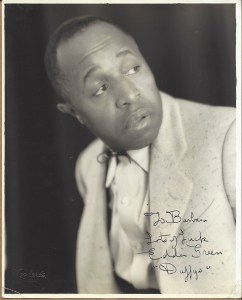
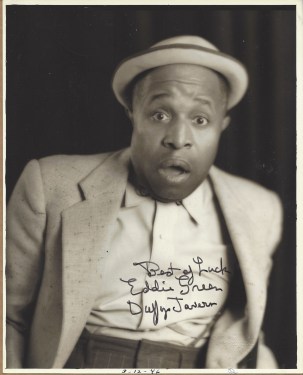 To those new to this blog, say Hi to my father.
 Well, it’s not that funny! Well, actually, I was able to laugh at myself, eventually. In this post I hope to impart to you the absolute necessity of “Proofreading!”. My error ought to provide propelling encouragement to get the writer immersed in proofreading every aspect of getting your writings out to the public. Don’t confuse them. One title here, another title there (on the same book).
 This is my book. Correct title. I love my book. I corrected my oversight on this blog and have forgiven myself.
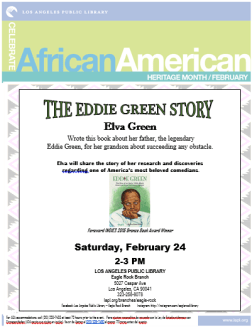 Hello again. Here is a poster announcing my next appearance at a local library here in Los Angeles, the Eagle Rock Branch Library to share my father’s inspirational story. When I started this book writing journey my thoughts never went further than getting the writing done and getting a publisher. The idea of being asked to give a presentation at a library never entered my mind. I simply knew that I wanted to put my father’s story down on paper and present it to my grandson. My doctor asked me the other day how I wrote the book-did I have any help? I realized that this is one of the first questions people ask. So this past week I sat down and wrote out what I did to get this book written. Once I took a good look at what entails getting a book written, I was in awe of myself. I am beginning to realize what a big deal this is.
 Here I am last week speaking about writing the biography of my father. I have pictures, we played a cd of a comedy skit with Lena Horne and I was happy to be there. Especially as there were two grammar school girls sitting in the front row. Paying attention. Sitting still. One little girl would take a photo I handed out, show it to her friend, have a little discussion and place the photo on the table. They even contributed to the discussion when I managed to touch on something currently relevant. I loved talking to them and assuring them that they too could achieve their dreams, like Eddie, if they learned as much as they could and believed in themselves.
 Of course I told these young girls that I started my research in the Central Library in Los Angeles. That I went to the library a lot when I was little, which I did. And, in fact, the Central Library is exactly where I began my research for my book. My mother actually found the first picture we had of Eddie on stage doing an Amos n Andy radio show back in the 1930s or 40s. This is Central Library.
 Central Library is beautiful. All of the information I found here about Eddie (and my mom) was housed in the basement level. So I went down this escalator many times. This is where I found the copyright entries for Eddie’s last movie. This is where I found old copies of Black newspapers that had so many articles about Eddie. And my mom. This is where I got carried away with reading those old newspapers. And how I found my aunt mentioned and my Nana. And my godfather. I even began genealogy research here. I made lots of copies here. I usually ate lunch in the building. And of course you can’t just visit one area of this library.
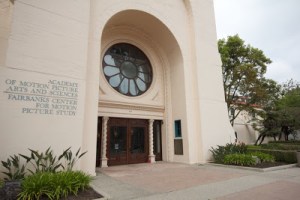 Along the way someone told me they had found information on Eddie at the Margaret Herrick Library in Beverly Hills and suggested I check it out. This is the library for the Academy of Motion Picture Arts and Sciences. It houses the Oscars library. So I went to this library. What an experience. First of all, I would have never thought of going to this library. Even though I knew my father was a filmmaker-I did not realize how big an impact Eddie had in the entertainment field. I must say here that at the time I did not have a car. I used public transportation. L. A. has good public transportation, but, some buses only run once an hour or once every 30 minutes. And visiting these libraries took me from the East to the West side of town. I visited the African American Museum in Exposition Park, the Mayme Clayton Museum in Inglewood, AND I spent hours at the Family History Library in West L.A. (a 2 hour bus ride one-way), I found so many books here on US history.
 The inside of the Margaret Herrick Library is gorgeous. One must leave one’s bags, coats and books in a little locker. When looking at photos or scripts of old papers, one must wear gloves and be very careful when handling delicate items such as old invoices. Oh, and you cannot just walk in, you have to have an appointment. The people that work in here are so nice. You tell them what you are looking for and they get it and bring it to you. I found Eddie’s movie scripts!! Posters of his movies!!! Invoices from Seiden Cinema in New Jersey for the film work they did for Eddie (with signatures). I even found the contract he made with Paramount when he was in the 1945 Duffy’s Tavern movie. Of course,, some of those items I could purchase, some not, but I could write down what I found and pay for copies. I made three trips to this library.
 Visiting libraries and museums was a big part of my journey. There were also conventions. I spent many hours online. There was a lot of reading, emailing, learning how to get with social media. Reading how-to books and articles. Reading other people’s biographies to study writing styles. Studying how to get a publisher. Biting my nails. After my mother passed in 2010 I used my grieving time to focus on the book. I was retired. Footloose and fancy-free. I had time to put into this book. Today, now that it is published I have time to share Eddie’s story in the libraries here in Los Angeles. This photo of Eagle Rock library is where I will be on the 24th of February 2018. I hope to get more kids involved. Because after all, I began this writing venture to try and motivate my grandson who grew up while I was in this process. But I also want to bring Eddie out of the shadows of time and share his many contributions to the entertainment industry and beyond.
 My father liked two things for sure: Pretty women and he liked being happy. From the first time he went out on the road with his first song in 1919, through his movie making days in 1939, ’40 and ’41 his ensemble included chorus girls and comedy. He even incorporated dancing girls, tap dancers, singers and comedic skits in his last 1949 movie that depicted Blacks and how they dealt with life after the Atom Bomb. For those new to this blog you can see his last movie on YouTube-it’s titled Mr. Adam’s Bomb. A young lady (Margaret Westfield) sings a song called “You can Always Believe Your Heart” which Eddie wrote. I am still looking for information on Ms. Westfield.
 Eddie became a household name as Eddie, the waiter in the radio program Duffy’s Tavern, during the last ten years of his life. Everyone loved Eddie. February is Black History Month. I am going to inundate social media with “fun Eddie stuff”. I want to get him as much exposure as possible. I want to get as many people as I can to experience Eddie’s good nature and for them to get a few laughs as well. I think our world could use uplifting right now. Eddie’s life story is truly inspiring. I will also be pushing the biography I have written about him, “Eddie Green The Rise of an Early 1900s Black American Entertainment Pioneer“, it’s much more fun that that “other” book everyone is talking about these days.
 In this still from Eddie’s 4th movie you can see that Eddie (in the striped shirt) liked being silly (which is why, I am sure I like silly jokes: What kind of flower is that on your face? Tulips!!! Hahahahaha!) There were even chorus girls in this movie.
 NORMA and EDDIE choose the name “ELVA” for their new daughter. Elva Green. This was of course a few years ago. Well, more than a few. I got the idea for this post because Kanye and Kim are trending on twitter because of their newest child’s name. I like to show my blog’s younger readers that famous couples have been trending in the news for years. Readers of today’s news have come up with all sorts of reasons K and K chose the name that they did for their child. And this reminded me that most of my life I have wondered how my father chose my name. Despite the fact that my name contains only 4 letters, people have mispronounced it always. Evelyn, Eva, Elvis, Alva, Elba. When I was a kid, the other kids called me Greenie stickum caps (I think some of you older folks might remember those).
 When my father was still alive, mom would put me in our Buick and drive me to see the street sign that read Elva Ave. It was located in Compton, California. I remembered looking at the sign out of the passenger window. So I thought I was named after that street for a long while. As an adult I wondered why that name was chosen for a street in Compton. In my lifetime I have met less than ten women named Elva. And none of them were Black. There were a lot of Black people in Compton when I was a child. I researched a bit and discovered Elva has roots in Scandinavia-I think it means “running brook”. Compton was named after a settler who travelled from Pittsylvania, Va., where Scot and Irish had settled.
 Well, here is the announcement in the newspaper about me and my name and my proud daddy. And my mom, the former Norma Amato. The name my father gave me has taken me around the world. I am proud of my name as I am sure Kim and Kanye’s daughter will be of her name.
 For the last couple of weeks I have been running on empty. It’s not new for me. Periodically, I slow way down. Family issues, world events, self-doubt and other issues overwhelm me. But, my misery does not love company, besides, everybody has problems. The day after Christmas I went out and seemed like everybody was pissed off. And today because of the snow back east a newscaster was talking about a “misery map”. Anywho, this is my reason for not posting lately. So, while looking for a photo on Google Advanced Images for this blog I typed in “Misery Loves Company: and got “the freeze”. Because I have such a weird sense of humor this picture cracked me up. This guy looks miserable. The fact that I laughed when I saw this picture lets me know I am still my old self-silly. And I am not as miserable as he looks. In fact, January has started off well for me (I had the best day with my daughter and her honey) and I do hope this year brings all of you happiness.
 There is more, of course, but these words spoke to me. They said what I feel, that I am simply an average, struggling, female human being who happens to be Black and who just wants to live the best life I can. I go to work. I’ve raised a child. I pay bills. I’m not pissed off because I am Black. I just am who I am. I decide what I want or need to do and I do it. Eddie was like that. When he was asked about Blacks being able to get into radio back in the 30s he said: “Radio for Negroes is a very hard field to get into . . . very hard! But the returns are so great that it’s worth the try.” Commenting further he also said: He found one thing to be true, “Talent is appreciated . . . you get respect if you know your business.” Eddie also said: “If you’ve got the talent, you can’t miss in the long run, even if it’s mighty long!”
 pininthetush