
Too tired of US politics. Going to talk about my father. Hello good people. Maybe I would have done a blog about something scary for Halloween, but I had my trick yesterday-someone egged my car. Right in front of my abode. The freaks were out last night! You ever had to clean egg off of your car? I didn’t even get angry. Another thing that is just not worth the energy. Focusing on my father feels good to my soul, so I post a lot on Social Media about Eddie. Then I forget what I put online. Someone found this photo I posted with an article about 2 years ago on Twitter and they Retweeted it!. They liked it that much. And that made me feel good. It really made me LOL.

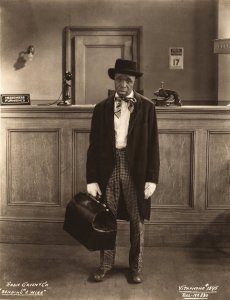
In 1929 Eddie was in a musical called “Hot Chocolates”. He wrote a couple of songs and he wrote the comedy sketches. One sketch was “Sending a Wire”. A newspaper article read: The Brooklyn Daily Eagle said “The whole town is talking about Eddie Green, prime colored comic, who will put on one of the funniest skits on the stage. He will dash from the Hudson Theater immediately after the final curtain to the National Broadcasting Company where he will re-enact his side-splitting “Telegraph Office” skit for Commander Byrd and his crew.” (Brooklyn Daily Eagle July 18, 1929).
Seeing this photo again made me wonder why a skit about a telegraph office would be funny. Eddie was trying to send the wire and James Baskette was the clerk. Sending a telegraph or “wire” was the thing in 1929, it was fast and you could communicate with people across the world. It led to the telephone, the fax machine and now the internet, losing favor after the 1929 stock market crash. However Eddie kept up with the times in his comedic sketches, and the telegraph would have been of interest to him as he was already a ham radio operator (had his own station) and he loved to communicate with people all over the world. The internet would have been right up his alley.
Well, Warner Bros. certainly liked the sketch as they produced a film for their Vitaphone Varieties series. The skit from “Connie’s Hot Chocolates”, “Sending A Wire”, became a Warner Brother’s Vitaphone film that was said to be the funniest Vitaphone comedy act “which has yet been produced”, and that it “kept thousands shaking with laughter.” The film is registered in the Library of Congress as Sending A Wire, Eddie Green and Co. (Warner Bros. (as The Vitaphone Corporation) 1929 Sending a Wire © September 28, 1929 Murray Roth (director); Eddie Green with Jimmy Baskett & (NYC) (vitaphone varieties – Cinematop). There is just the one film in existence and I will probably never get to view it, but just knowing it exists helps me know my father as an entertainer.
This was all so long ago. Even before my mother met my father. As a matter of fact she was only six in 1929. Eddie was 30 years older. Chronicling my father’s life has been deeply satisfying. I know my own positivity comes through Eddie. (My inner sarcasm comes from Mom.) My ability to laugh out loud comes through him. I used to tell her I was funny because Eddie was (she didn’t think I was funny). It’s good to be able to keep Eddie’s name and face in the fore of people’s memories. I feel much better now. I love you, Eddie.
Friends and family, stay safe, love each other and thanks, for stopping by. 🙂
 Well, here we are all quarantined together. A good time to take a look back into the past. The first picture on this post is a copy of a financial document from my father to Joe Seiden from about 1939. Eddie had his first movie studio in Palisades, New Jersey as did Seiden (Seiden Cinemas). Seiden edited Eddie’s films and helped with sound and the making of prints. Eddie made his first four films here from 1939-1941. What is now Fort Lee, New Jersey was, at one time, the “movie capital” before there was “Hollywood”. Fox, Universal, Biograph studios all began here. Oscar Micheaux was at Metropolitan Studios at this site. The last movie Eddie made here was “One Round Jones”, a movie about a nightclub owner who comes up with the idea to pay $50 to anyone who can go “one round” with his mystery fighter, who of course turns out to be Eddie.
 When I wrote the biography about my father I discovered one thing. The more I searched for information, the more I found. This has carried over until today. When I first received this press sheet I was overjoyed. I had to have permission to use it in the marketing of my book which was fine with me. What I didn’t realize was that this sheet held a font of information that would eventually hook me up with more information four year after publication of the book. My first example is in the lower portion of the 4th column of this article a Mr. Lorenzo Tucker is mentioned as part of the cast. I did not expand on this in the book, mainly because I had no idea exactly who he was and how he would pop up in future. About a month ago I heard from an Eddie Green fan who had some original photos of my father that he wanted to gift to me. One of the photos is of Eddie and Louis Jordan and a woman name June Richmond. Louis and June had starred in the 1947 movie Reet, Petite and Gone. I decided to research this movie and learned that Lorenzo Tucker appeared in this movie as the shyster lawyer, Henry Talbot.
 Reet, Petite and Gone is about an Old-time musical star Schyler Jarvis, now wealthy, who is dying; his last act is a visionary plan for the future happiness of his son, swing bandleader Louis Jarvis, and Honey Carter, daughter of his long-lost love. But crooked lawyer Talbot has a nefarious scheme to get his hands on the Jarvis money. There is also plenty of swing from Louis Jordan’s Bands. Lorenzo Tucker also appeared in 18 of Oscar Micheaux’s films. He eventually went totally off the movie track and became an autopsy technician for the New York City medical examiner, where he worked on the body of Malcolm X. That original photo that is being gifted to me shines more light. Lorenzo seems to have started out with my father’s movie studio.
 Then I noticed that Mr. J. Louis Johnson was also in the 1947 movie Reet, Petite and Gone. He played Senator Morton’s Butler. Well, J. Louis Johnson was a cast member in my father’s Sepia Art Pictures Company, Inc. in 1939. I did mention him in the book but I just did not see the connection. Mr. Johnson was in a lot of great movies. Mostly bit parts, but hey, he must have been a good actor because he worked with such stars as Clark Gable in Homecoming (1948), Lena Horne and Eddie “Rochester” Anderson in Cabin In The Sky (19400, and he had parts in Hitchcock’s Strangers On A Train and Orson Welles The Magnificent Ambersons (1942). But he was with Eddie before these others.
 Hello friends. The fact that I have begun the process of writing a book about The Jeffersons tv sitcom is beginning to make it clear just how diligent I am going to have to be in getting my facts straight. Somehow it seems a lot more involved than corroborating the information I learned about my father when writing his biography. In researching the actors and their participation in their various shows, I have found out that one person will say what they think things were like, some will say what they heard, and some will assume. Getting the actor’s stories in their own words is difficult, especially if those actors are no longer with us.
 Today I decided to write about actor Mike Evans who played the character Lionel Jefferson, the son of the Bunker’s new Black neighbors. The Bunkers were the family from “All In The Family” or AITF, with Carroll O’Conner, as Archie and Jean Stapleton, as Edith. Mike Evans began portraying Lionel in this AITF in 1971 through 1975 before moving on up to “The Jeffersons”.
 What makes you smile before you even know you are smiling? It’s a nice thing to have happen. It’s nice to know that in a world where bad things happen, there exists happenings that make me smile, automatically. My lips turn up at the corners by themselves. For instance, a few days ago I got up, turned on my laptop and checked my mail. There was a message from a friend in England. She started her message with “Hello Dearest Elva”. Since it was early morning I hadn’t had time to become grumpy so I was able to receive this greeting as I know it was meant. My friend is such a nice lady. Someone I met during my book writing journey. She is a good-hearted person. And I know she is genuine. And so it made me feel good to hear from her. It was like an “Awwww” moment.
  The song was sung in the movie by Margaret Westfield. I snapped this while watching the movie on Youtube from the Internet Archives. Unfortunately I have not been able yet to find anything on her. Though she had a lovely voice.
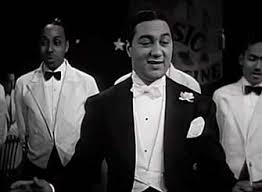 Ralph Wilhelm Cooper, 1908-1992. Actor, dancer, screen writer, emcee, choreographer (Shirley Temple-Poor Little Rich Girl). Ralph Cooper spent five years acting and directing in Hollywood and while there folks began calling him the “Dark Gable” because of his “handsome, rugged good looks and his charm and wit”. * I would like to say instead of giving him a nickname that reminds people of a White man, can we just say that this man was Ralph Cooper, a handsome, charming Black man who was very active in the world of entertainment in the 1920s, 30s and 40s. And beyond.
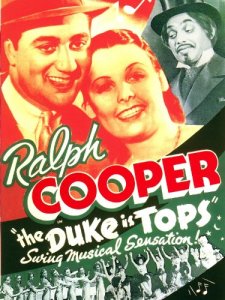 Like my father, Eddie Green, Cooper was also a filmmaker. Meaning he wrote, directed and starred in his own movies. In the late 1930s he was making movies during Oscar Micheaux’s filmmaking time (Micheaux began making films in 1915). He wrote, directed, produced or starred in at least fifteen films. My father began making his films in 1939, right about the time Cooper left filmmaking. In 1937, Cooper formed Million Dollar Productions with black actor George Randol and white producers Harry Popkin and his brother Leo Popkin to produce race films.
 Ralph and my father appeared on the same bill during those early days; their names are kind of close to the bottom of the ad as they had not “blown up” yet. But they must have met backstage. Maybe Eddie talked to him about making movies someday. Both Eddie and Ralph were successful in their chosen pursuits. Through their own talent and hard work. When it was truly a struggle for a Black man to get ahead. I salute my father and Ralph Cooper and their own special uniqueness in bringing a little entertainment into the lives of others.
 According to today’s news, a new Black female movie director who has just finished directing Madeleine L’Engle’s “A Wrinkle In Time”, has been chosen to direct Jack Kirby’s “New Gods” for Warner Bros. I have been following her rise, and when I read the words Warner Bros., my father flashed into my mind because he did a Warner Bros. Vitaphone Film.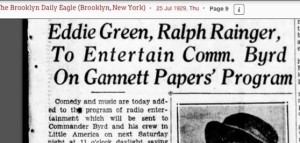


 This movie, written, directed and produced by my father, Eddie Green, in which he also starred, prompted one journalist to refer to Eddie as the “comic movie making mogul”, because the movie proved to be quite popular.
 pininthetush