
 In the 1940s when my father, Eddie Green, was looking for women to dance as chorus girls or to star in one of his movies, he would put on beauty contests. Beauty contests were not exactly new in 1940, but they were definitely segregated. Which means that these contests only got media attention from the White owned newspapers. If you were to google “beauty contests” from the 1940s, you could find many images of the White ones, but none of the Black ones. This particular contest was for Miss Sepia America. Anyhwho, this is not a post about segregation. Or beautiful girls as it says in the first article from 1940. “Eddie Green Bringing Six Beautiful Girls to Affair At Claver (The St. Peter R. C. Claver Church, located in the Burrough of Brooklyn was hosting their annual post-season Basketball Game and Matinee Dance.) This is a post about communication, then and now.
 As it is next to impossible to read this article from 1941, I will type it out. From the Courier-Post (Camden, New Jersey) – 09 Oct 1941: “Each and every fine cat in Harlem is figgering on draping out in their most much of hard-hitting togs, donning their up-to-date sky pieces and collaring a broom down the midway to Harlem’s Renaissance Casino on the early black of Oct. 9. To dig the most mad lay-out of fine and mellow chicks Eddie Green’s gonna drop on them. Now Eddie is a square (and actually needs some prayer) when it comes to beating up his chops on a bid like this to you. So trilly up Harlem way and dig in on something to gumbeat about . . .Now if that spiel is too panicky for you to latch on, and you’re a Lane from Spokane, or a Home from Rome, may I simply say the date is the early black of Oct 9th. So be on hand to gim those gams…..Dig?”
The funny part here is that it says my father was a square which is probably why I think of myself as being square. But I had a difficult time trying to understand just what this article was talking about!
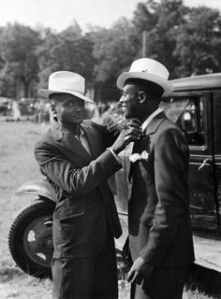 I do know what “fine cat” means (I’m not THAT square) and I know togs are clothes. And back in the 1940s men were always sharp (meaning they always made sure they looked good). If you were going to the Renaissance Casino you definitely had to look good because the Renaissance Casino, provided the backdrop for the area’s most elegant dances and exciting sporting and political events. In the 1940s it was also one of the few places Black people could go to have a good time. And of course I know the article must mean Eddie was bringing some of his beauty contestants for the fellows to ogle.
After I read that article from the Courier I just had to look up some other terms people have used over the years since the forties. I didn’t really use much slang until the 60s when everything was groovy. I particularly liked “Be there or be square”. Oh, and “book it” (meaning to leave from where you were. “Chick” is a word I still use today. My step-dad could always use some extra “bread”.
Then “book it” became “split”. If you were smoking some grass you had to watch out for the “fuzz”, can you dig it? Women were “foxy” and “phat”, word? Pretty soon everything was “totally tubular”, dude. And then along came Run DMC and I was “illin”. As far as slang goes I think I kind of petered out about this time, though I still hang on to “cool”. So before I bounce I will share with you what I think about slang today. WTF does cray-cray mean anyhow? Being a square, of course I thought LOL meant “Lots of Love”. (LMAO) It took me an hour to figure out what my daughter meant when she sent me this one night while texting: gn. (Oh! good night) She ended one of her texts with ty-I thought “why would she end her text with my nephews name-then I found out it meant thank you (ty, get it?) ROFL. Sometimes it’s hard AF to figure out what people are talking about. But it’s all good.
KCB
(Keep Coming Back)

 pininthetush