A BOOGIE WOOGIE HALLOWEEN

images (10)

Hi, there.  Well, I would like to wish you a Happy Halloween, although the guy in the above photo would probably not agree with me as he doesn’t think Halloween should be a fun holiday like everyone else does.  But since it’s the season, I chose Oogie Boogie to lead off this post.  (Thank you, Mr. Burton.)  I also chose Oogie because of his last name, Boogie.

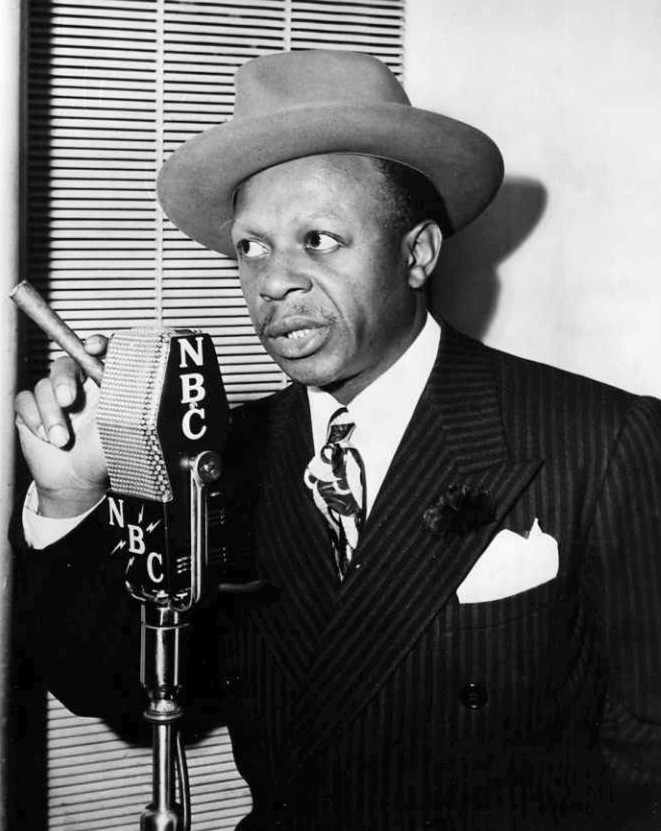
My father, Eddie Green, was doing well in radio entertainment career in the 40s.  According to the Syracuse New York Journal   One of the radio programs Eddie appeared on was the Canada Lee show on WEAF, ” Eight to the Bar.”  In the 1940s, the phrase “eight to the bar” was up-tempo slang meaning “a boogie beat.”

New York Post, Thursday, July 24, 1941, HIGH SPOTS OF THE DAY’S BROADCAST OFFERINGS

WEAF- Benny Goodman’s Orchestra. Joan Bennett.
8:15 WOR—Drama. Florence Reed in “An Englishman’s Home.”
8:30 WEAF—Drama. Canada Lee, Eddie Green in “Eight to the
Bar.”
WABC—Barber Shop Quartet Society.

There was a boogie-woogie dance:599fc67ba64af1846452c75a83984b41

In 1945, a person could buy  a Two-piano Boogie Woogie album for Dancing for $2.50.

When I found the “Eight to the Bar” Canada Lee program in the Syracuse newspaper, I remembered that I have in my possession a DVD of a Jubilee radio program from 1943 with Mr. Lee and my father doing a comedy skit together.  Being a good researcher, I looked up Mr. Lee, and I am so glad I did.  Canada Lee is another of those famous, successful, Black pioneers, like Eddie, who seems to have been forgotten by the general public.
th (4)

Canada Lee was born Lionel Cornelius Canegata in 1907.  At one time he was a jockey, and then became a boxer, welterweight division, until he sustained an eye injury.  Before he had his radio show, Mr. Lee began an acting career. He was cast in his first major role, that of Banquo, in the legendary Federal Theatre Project (a New Deal program started to help struggling writers, actors, directors, and theater workers) production of Macbeth (1936), adapted and directed by Orson Welles, with an all-black cast.  Macbeth was sold out for ten weeks at the Lafayette Theatre.  Mr. Lee played Banquo (When Macbeth kills the king and takes the throne, Banquo—the only one aware of this encounter with the witches—reserves judgment for God.)  Having never read Macbeth, I had to read it to understand what the heck I was writing about in this post.  Anyhow, The play debuted in 1936 at Harlem’s Lafayette Theater and was performed for segregated audiences. It was so popular that it exceeded its initial run, then toured the country, spending two weeks in Dallas at the Texas Centennial Exposition.

Canada Lee appeared on Broadway in Anna Lucasta.  He also appeared in the movie Lifeboat in 1944, directed by Alfred Hitchcock:

300px-Lifeboat_(1944)_1

There is much more information out there to be found on Canada Lee, if you care to look it up.

Below is the comedy skit I referred to earlier.  Canada Lee and Eddie performed  in 1943, on Jubilee, a radio program that was broadcast to the nations military to help ease the stress of war.  The skit was titled “Boxing”, from January 5, 1943:  I have heard this skit and Mr. Lee has a nice, strong voice, where my father’s voice was a tad higher which Eddie said himself in a newspaper article. Hattie McDaniel acted as Mistress of Ceremony:
MISS McDANIEL: The clock says it’s laughing time. And when it’s time to laugh, then it’s time to listen to Eddie Green  and Canada Lee!
CANADA LEE: Remember some time ago, Eddie, I told you that I think you would make a good prize fighter?
EDDIE, laughing: .Yea, I member that, I do.
CANADA LEE: Well now, listen Eddie. Just like I told you. You’ve got the makings of a great fighter. I’m gonna build you up to be a champion.
EDDIE: No, is you?
CANADA LEE: Yea, I can see the whole thing.
EDDIE: You can.
CANADA LEE: Yea, First, I’ma have you fight some ham and eggers.
EDDIE:  some what?
CANADA LEE: Some ham and eggers.
EDDIE: Oh, right away I get scrambled.
CANADA LEE: No, no. I mean these fights are free, see. We pay these fighters to lay down.
EDDIE: Well, why can’t they pay me to lay down?
CANADA LEE: Oh Eddie, don’t be silly, you’re honest. When it comes to fighting you’re upright.
EDDIE: Yea, but not for long.

I started this blogging project as a way to get noticed by publishers, as a writer, which would help me when I was ready to publish the first book that I have written about my father for my grandson, because the general consensus is publishers want to see something other than just one book.  The blog is also a way for me to get over a fear of putting my writing out into the world.  What I did not expect was the education I would get from this process, through research.  Nor did I expect to have ideas about the possibility of continuing to write after this first book.  But I do.  Have ideas.  But first, I must finish proofing my first endeavor.

I like to finish my posts with something that refers back to the beginning:

untitled (26)6

Thanks, for stopping by.

Thank you Francis Lee

CLOSE KNIT TIES, THROUGH SHOW BUSINESS

quote-Irving-Berlin-theres-no-business-like-show-business-66100

Hi there, welcome and welcome back.  Today my brain is empty, well, almost.  I have been focusing on which photos I want to put in the book I am writing and as I have a one track mind, I have not been able to come up with a post.  My main issue is that some of the photos I want must be purchased from newspapers or museums before I can use them, so I have to spend my money wisely.  Do I want ten photos or twenty?  The photos will be sent to the publisher along with my manuscript., and I am shooting for a month or so from now.  So, with this post I am going to cheat a little and let the newspapers do the talking.

In 1943, Duffy’s Tavern and the Jack Benny programs were big hits.  The two main stars were Ed Gardner and Jack Benny.

Ed_Gardner_Duffy_1949 (2)
Ed Gardner

.

Jack Benny
Jack Benny

However, the popularity of these shows was also due, in part  to two other gentlemen:  Eddie Green and Eddie “Rochester” Anderson:

Eddie Green
Eddie Green
Eddie "Rochester" Anderson
Eddie “Rochester” Anderson

In 1943, both Eddie and Rochester appeared together on “Duffy’s Tavern”.  The following article appeared in The Pittsburgh Courier, January 1943, with the title, “Rochester, Eddie Green Steal the Show” – Eddie “Rochester” Anderson and Eddie Green climaxed the season’s laugh riots with a battle of wits on the popular Blue Network show “Duffy’s” on Tuesday evening. The comedians, together for the first time, were featured prominently during the hilarious half-hour, contributing much to the success of the show. Although old friends since vaudeville days, when Rochester was a dancer and Eddie a comedian their opportunity to appear on the same entertainment bill did not come until Jack Benny’s show began a tour of service camps in the East.  Rochester’s success in pictures has paralleled that of his work in radio, having been featured in “Jezebel,” “Gone With The Wind” and several Jack Benny films.  Eddie Green is heard regularly with Ed “Archie” Gardner on the Duffy’s program; following a successful run on Broadway with Bill Robinson in “The Hot Mikado.” He started as a boy magician and now owns the Sepia-Art Pictures, film producing company, servicing over 500 theaters.”  Pittsburgh Courier, January, 1943.

I am proud of Eddie and Rochester.  Rochester remained a family friend after my father died and would visit us periodically.  I have had the pleasure of having a conversation with Rochester’s son, during the past year, and I have also had the pleasure of communicating with Ed Gardner’s son.

Eddie Green, Ed Gardner, Eddie “Rochester” Anderson and Jack Benny were a show business family.  They showed us how it can be done.

Thanks, for stopping by.

Photos courtesy of Google Advanced Images.

ONLY IN A DREAM

images (9)

Time flies when you’re on a mission.

For the past week or so, my mission has been to get permission to use certain photos in the book I am writing, order the photos, re-read the book before I send it out for copy editing, and looking for a copy editor.  And for some reason, it seems like these things have to be done right away.  Which they don’t. I am not working on a schedule.  I don’t have a contract that says 4 books in 4 weeks.  I don’t HAVE a contract.  I started this project because I had a goal.  To bring my father, Eddie Green, out of obscurity to highlight his achievements as a Black man in the early 1900s, and to put the information in book form for my grandson.  Which is what I have done and what I am doing. I shared in an earlier post that, I look forward to my day because I can see the goal, and I am working towards that goal.  I am on track.  I need to remember that.

As I get closer to my book being a finished product, I realized that I have put next to nothing in this blog about my mother, Norma, Eddie’s fourth, I think, wife.  I have a chapter in the book on her, so I will just take from that for this post.

My mom, Norma, was born on November 17, 1923,  Her mother, Sinclaire was a very light skinned Black woman who chose to live as something other than Black, so by the time my mom entered school, Sinclaire was listing herself as Spanish on my mom’s school records.  My mom was born Norma Murcock, but by age sixteen, Sinclaire had remarried and mom’s last name became Amato. Norma began singing, violin and piano lessons very young, and began performing for audiences when she was seven, usually at the Second Baptist Church, or at the Murdock Music Arts Association, and as she got older, she would sing at weddings at the Wilfandel Club in the Historic Adams District in Los Angeles.

importfromphonejuly 145
Norma Amato, about 17

When mom was 18, an article appeared in a Los Angeles newspaper which helped me verify my mother’s heritage.  Here is a portion of the article:  “An assistant highway surveying engineer in the business world, Norma Amato, who sings fluently in Italian, French and Spanish, will render a selection. Norma Anne Amato, 18 years old daughter of Mr. and Mrs. Guiseppe (Joseph) Amato, who majored in music and graduated from St. Cecilia and Romona Convents was the young lyric soprano soloist featured by the Daughters of the American Revolution at their National Convention banquet in Los Angeles.”  Mom was studying to be an opera singer.

As time went on, Norma would appear in more articles:   “Miss Norma Amato is the protégé of Miss McDaniel of Gone with the Wind fame.”  The group picture here is Norma, Eddie, Louise Beavers, Miss Beaver’s dad, Hattie McDaniel and an unidentified woman,

eddieandhattie

In 1944 The California Eagle, printed this glowing tip: “Tip to Talent Scouts: Keep your ears on Norma Amato’s delightful thrushing. She has the kind of voice you hear only in a dream.”  imagesT553SX8Y

“Only in a dream.”  This was the path on which mom was working.

On November 17, 1944, Norma became 21 years old. At the time, she was still living with her mother, Sinclaire.  One year later, she was married to Eddie.

3rd set with new pictures 277

I am realizing a dream in real time.  Something anybody can do.

Thanks, for stopping by.

Into Each Life, Well, you know the rest.

untitled (23)

Well, as my dear sweet mama would say, into each life, some rain must fall.  Actually, she would usually say it sarcastically, but it still means the same thing.

In the on-going saga of my father’s life, considering he was born a Black man in 1891 in the “poor” part of town in East Baltimore, Eddie, who, by 1941, had become a star of stage, screen and radio,  owned two restaurants and a movie studio, had a good life.

Two years later……  In an article, dated January 2, 1943, an article was printed in the local newspaper, well, it wasn’t even an article, it was a paragraph:

Eddie Green the comedian, who once owned a chain of Bar-b-q places in Harlem, his own movie producing company and who ran the gamut of one stage and radio success to another, has filed a voluntary petition in bankruptcy in the U. S. District Court.  His listed liabilities are $5,119.00 and assets $473.00.  He owes the government $445.74 that should have been paid weeks ago.  Always a fine fellow, the misfortune of Eddie is not without sadness.

Imagine having your personal business in the neighborhood newspaper.  Of course, today everybody knows everybody else’s business, whether we want to or not, but I still think he may have experienced some embarrassment.  But, maybe not.  He probably used it in his comedy routines, like the one he did three days later in the  January 5, 1943 Duffy’s Tavern show with Milton Berle as the guest:

EDDIE:  What is that sign you’re making, Mr. Archie, is it a welcome sign for Mr. Berle?  ARCHIE:  No Eddie, it’s a resolution, you know, one of those New Years things.  Listen to it, “There is a well known golden rule, through the ages it’s been true, always be good to your neighbor, they may live next door to you.”  That’s good, huh?  EDDIE:  Yea, it makes a lot of sense, too.  How bout hangin up a sign for the waiter, me.  ARCHIE:  Like what, Eddie?  EDDIE:  Like this: “The golden rule has a fine intent, but a ten cent tip will pay the rent.”

I really do believe that it pays to have a good sense of humor.

So, Eddie did still have his job as the waiter on Duffy’s Tavern and two months later, in March Eddie was a guest on the Caravan radio show, along with the popular radio emcee, Gary Moore, who was also a guest on the program.

Screen shot 2011-08-19 at 2.41.44 AM Some of you reading this may be too young to remember, but I know a few of us vaguely remember The Gary Moore Show, or I’ve Got A Secret or To Tell The Truth which Mr. Moore hosted till about 1976.  I remember Mr. Moore as always having a smile on his face.

Despite Eddie’s setback, his success story was far from over.  More to come….

Thanks, for spending some time with me.