CAMERAS, LIGHTS……..


untitled (14)


When trying to write a book and posts for a blog, I forget there are other things to attend to.  Like grocery shopping, washing, visiting friends, calling people, eating three meals a day (ha!).  So every now and then I have to do these things.  When I get back to my laptop, it takes a while for my brain to settle back into the writing process (where was I?, what did I do with my highlighter?), so I waste a few minutes getting back in the groove of writing, and I was wondering today how in the world my father could do everything he did as a comedian, businessman, a director and a writer?  Then I remembered, he had a wife.  I just have me.

Which brings me to an article I found written in 1940, about Eddie, after he had begun his movie making career.  This was a full page article discussing Eddie as a comedian (funny), and as a business man (sensible).  It begins:  “Everybody knows Eddie Green as Koko in the “Hot Mikado”, or as the chief characters in his skit on Christopher Columbus and on Jonah and the Whale, (which he did on the Rudy Valley radio show), but there is another Eddie Green who is akin to these characters, but who is also very different.  That is Eddie Green Himself.”

The article goes on to discuss Eddie’s comedic talent, the fact that he owns and operates two barbecue restaurants in New York,

“Eddie Green’s Bar-Bee-Q 2149 8th (near 116) Specializing in Southern Bar-Bee-Q.
Always Open. Finest South’n hospitality. E. Green, Host.”

and that he is a writer and producer of “what many people believe are the finest films being released about our people.”  This paper was the Baltimore Afro American.   The article includes this quote from Eddie:

“The first thing I try for is naturalness.  I write my own stories, building them around some incident that has been interesting, but not offensive.”

The article mentions, that although Eddie had already released three films, he had no picture scheduled that summer because he was concentrating on a beauty contest at the World’s Fair.

Towards the end of the article, they talk about Eddie’s typical day.  He is up at 8 and off to the office.  At lunch he has coffee with Mrs. Green, at home, or she comes to the office.  If he is broadcasting, he goes to rehearsal, if not, he goes back to his office until dinner, then he goes home to eat.  He likes ham and cabbage which he taught Mrs. Green to cook.  He tinkers with his ham radio, then at 10:00p.m. he goes to check on his restaurants till about 12:00, then goes back home.  Mrs. Green, (the wife before my mom), was an entertainer, but decided to become a stay-at-home wife.  I assume that she did all the shopping, and washing, and cleaning, so Eddie had only to concentrate on his career path, he didn’t have to worry about thing falling apart at home.

In 1939, Eddie began a new venture and opened his own motion picture company:

movie company formed
in harlem
NEW YORK, Aug. 24  With familiar theatrical figure Eddie Green as guiding light, a new motion picture company was formed this week, the “Sepia Arts Pictures Company.”  Los Angeles California Eagle, August 24, 1939

Eddie’s first film was:
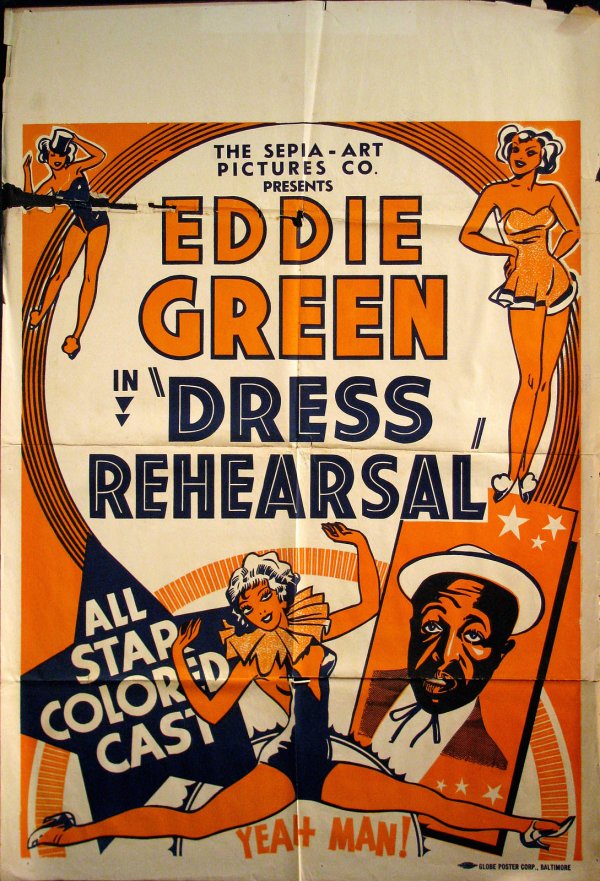
courtesy live auctioneers

In my ongoing research I have actually seen my father’s original script for this movie.  Remarkable!  Though the script lists the cast members, it is difficult to tell which person was in which movie.  Anywho, “Dress Rehearsal” would have a long run, at theaters and on television, as noted below:

NEW YORK, Dec. 21.—History was made here Saturday
afternoon, Dec. 16, when the National Broadcasting Company picked the Sepia-Art Pictures Company’s featurette,”Dress Rehearsal,” featuring Eddie Green, to broadcast over their television station here in New York City. Not only is “Dress Rehearsal” the ” first ” Negro motion picture ever to be broadcast by television, Mr. Green breaks a precedent by staring in the first film of its kind ever to be sent over the air.  Pittsburgh Courier  12/23/39

AND, at the

Vogue  1905 Columbia
Edw. G. Robinson, “Destroyer”
Eddie Green, “Dress Rehearsal”   Dec 9, 1943

I do not have the rights yet, if ever, to post much information regarding scripts, but I did get a piece of a skit:  Eddie (who is the Director, the Writer and the Star of this featurette) is late getting to the set, so he is speeding and gets stopped by a policeman.  The policeman asks Eddie where he is coming from, Eddie says New Jersey, the policeman says “how did you ever get through the Harlem Tunnel?  Eddie says, “there’s a hole on both ends!”  Ba Dump Bump!

I hope that those reading these posts find inspiration for pursuing their own goals even though they may seem unattainable.  No matter the time period or the climate.  More action coming up!  Thanks for stopping by.


HAPPY FATHER’S DAY!!!!

Hello, it’s me.

fatherday2

THE PITTSBURGH COURIER

Eddie Green is A Proud Daddy

LOS ANGELES—It’s a girl for
Mr. and Mrs. Eddie Green (he’s of Duffy’s Tavern fame) and widely known in stage and screen, and she is the former Norma Amato, Los Angeles beauty.

The six-pound, seven-ounce infant, named Elva Diane, was born Sunday, June 22 at 11:15  P. M. at California Hospital.  Both mother and child are doing well.


HANGING OUT AT THE WORLD’S FAIR

Hotmikado

Hello.  In the on-going saga of my research into my father’s life, as far as the book is concerned, I have completed my first draft.  So emotional…..I had to come to the end.  I cried for three days after I finished.  Going so thoroughly into Eddie’s life was almost like being there.  Of course, I still need to edit, add-on, delete, clean up the manuscript.  And I need to add the TOC and a Bibliography, etc.  But it is really happening!

In this blog, after showing you Eddie’s television debut in my last post, and after having already mentioned that Eddie opened a restaurant in Harlem in 1937, I am now at 1939.

“The  Hot Mikado” was a 1939 musical theatre adaptation of Gilbert and Sullivan’s “The Mikado”, with an African-American cast. Mike Todd originally produced it after the Federal Theatre Project turned down his offer to manage the WPA production of “The Swing Mikado” (another all-black adaptation of “The Mikado”).  In this production, Eddie played, Koko, the High Executioner (formerly a tailor).

Eddie Green
Eddie Green

The musical was first produced at the Broadhurst Theatre from March 23, 1939 to June 3, 1939, running for 85 performances. The original cast included Bill “Bojangles” Robinson as The Mikado; Frances Brock as Pitti-Sing; Rosa Brown as Katisha; Maurice Ellis as Pooh-Bah; Eddie Green as Ko-Ko; Rosetta LeNoire as Peep-Bo; James A. Lilliard as Pish-Tush; Bob Parrish as Nanki-Poo; Gwendolyn Reyde as Yum-Yum; Freddie Robinson as Messenger Boy; and Vincent Shields as Red Cap.

The musical was then produced at the 1939–1940 New York World’s Fair for two seasons and was reportedly one of the most popular attractions at the fair.

The video below, which I found on-line and which is extremely rare, is a silent filming of portions of the performance at the World’s Fair.  Eddie enters first as Ko-Ko, the Lord High Executioner, and then you see him standing next to Bill “Bojangles” Robinson, the “Mikado”.  Eddie appears in a few more places in the film.  As Ko-ko, Eddie performed a number of songs, including “Titwillow”, though this was not caught in the film.

“Titwillow”  occurs in a scene with the love interest, Katisha.  “Katisha wonders why death refuses to come and bring peace to her broken heart (she sings “Alone and Yet Alive),  and Ko-Ko springs into action, telling her that he’ll die on the spot if she doesn’t accept his love. Katisha claims no one has ever died of a broken heart, so Ko-Ko responds with the tragic tale of TitWillow, a little bird who wasted away due to blighted affection.”

My mom, Norma, told me about Eddie singing this song in a play, but never did I think I would actually see a portion of this play with my own eyes.  Picturing Eddie singing “Titwillow”, is not easy to do, but according to the Brooklyn Eagle on July 9, 1939:  “Anyway, he gets a hilarious twist into Ko-Ko that Messrs. G. and S. never thought of, and when he swings “Titwillow” usually comes close to stopping the show.”

Eddie was living in Harlem, by now with wife number three, or four, and he already had a grown daughter.  He had met my mother, through friends in Hollywood as he travelled a lot by then from New York, to L. A., but his home at the time was 138th Street in New York.  After the “Hot Mikado” Eddie would begin making his own films.

I love sharing this information.  It may be too old-timey for a younger generation, but keeping the achievements of those who came before us alive, allows the younger generation a chance to see from whence they have come and, also, to see how far they can go, especially with the knowledge, technology, and, yes, opportunities available today.

Hey, comments are welcome, keep comin’ back, and thanks, for stopping by.


Wikipedia


THERE ARE BIG DEALS IN LIFE

Hi there.  In recounting my father’s (Eddie Green) life in the entertainment business on this blog, I have also been writing a biography of my father.  Eddie died in 1950 and I am now in the year 1949 when he began to experience his medical problems.  So, I am almost finished with my first draft, minus add-ons and proofreading.  I have deliberately let this blog lag behind the book so no one will get the whole story before the book comes out.  I have to leave something for which folks will clamor.  Or, not.

Eddie Green-Getty Image
My father, Eddie Green

I have shared in my “Hookups” post about a radio show that Eddie  was on in 1935, “Uncle Charlies Tent Show” starring Charles Winninger, and about Eddie being on the Rudy Vallee show, and about Eddie appearing in and writing comedy sketches for “Hot Chocolates” in 1929, with the music of Fats Waller and Andy Razaf, and Louis Armstrong.  And today I would like to share a bit of my father with you, as he appeared on the first public broadcast demonstration of television.  Woo Hoo!

First, however, I am going to post some information about Mr. George Wiltshire.  George Wiltshire was my father’s “straight man” in an act Eddie had going in 1936.  I needed to do some background searching on George before writing about him, so yesterday I looked him up and while doing so I became aware of the fact that there are a lot of people who have had successful careers in show business of whom we no longer hear.

george wiltshire
GEORGE WILTSHIRE

What a handsome man.  George Wiltshire was born in 1900.  I read that he was an actor, known for Killer Diller (1948), Midnight Menace (1946) and Hi-De-Ho (1947), that he first appeared in the 1930 Broadway revue play “Hot Rhythm” at the Times Square Theatre, that he made his first film appearance in the 1938 all-black film “Keep Punching” and, more recently, that he had  appeared in a couple of episodes of “Sanford and Son” in 1976, as Elroy Pitt, a sidekick of Hutch (Arnold Johnson), and a friend of “Fred” (Redd Foxx).   Imagine that, one person who was alive in 1976, besides my mom and my Godfather, who knew Eddie.   I found an article that spotlighted George  in 1939 as having been one of the leading straight men and as the  only “straight man” still carrying on.  George  died in 1976 in California.   What I found in only one place was this:

EDDIE GREEN AMD GEORGE WILTSHIRE
ON TELEVISION TRYOUT BROADCAST
NEW YORK CITY, July —Eddie Green., popular stage, radio and screen comedian, and George Wiltshire, well-known “straight-man,” are the two men of color chosen to lend their bit to the first test television broadcast by the Radio Corporation of America.  The program was specially broadcast to a select group of listeners and watchers.  The program, announced by Milton Cross, also featured Ed Wynn, Graham MacNamarra, Henry Hull and the Pickens Sisters.

July 7 – At David Sarnoff’s request for an experiment of RCA’s electronic television technology, NBC’s first attempt at actual programming is a 30-minute variety show featuring speeches, dance ensembles, monologues, vocal numbers, and film clips. It is shown to 225 of RCA’s licensees on 22 centimeter screens.

The film can actually be found online as “First Television Broadcast NBC/RCA July 7, 1936 Part 2 of 2.”  Eddie and George’s act is at the very beginning of Part 2.  Trust me, I was a bit shocked at first at the way they looked, but there they were in 1936, on television, because these two men were who the people wanted to see.  As far as I have been able to ascertain, Eddie Green and George Wiltshire were the first two black men to appear on television.  Be aware, the film may begin in the middle on my site, so you might have to run it back to the very beginning which is where you will hear Milton Cross make the introduction, Eddie and George are the first act to appear, then the Rockettes, etc.  If you would like to see an explanation of this broadcast with David Sarnoff go to “First Television Broadcast NBC/RCA July 7, 1936 Part 1 of 2.”

I did not type the whole act, but simply as clarification, I have typed in a portion of Eddie’s “Grandfather Joke”, the last joke of the skit, because the sound portion of the film is not very good.   This was one of Eddie’s stock in trade jokes that his audiences got a kick out of.  This particular joke was about how fast his grandfather can cook a meal in his restaurant (I typed a mini version):

(Eddie) “75 people were coming from L. A. to New York and they only had 10 minutes for lunch.  (George)  There were 75 people and they only had 10 minutes for lunch?  (Eddie)  That’s right.  (George) I bet it scared him (grandpa) to death.  (Eddie) It didn’t even scare the waiter.  Grandpa was back in the kitchen smokin’ a pipe.  The waiter just walked over to the kitchen door and yelled “HAM AND EGGS FOR SEVENTY-FIVE”.  (George) And what did grandpa say?  (Eddie) TAKE ‘EM AWAY BEFORE I BURN THEM!

Ha ha, so funny.  I didn’t even get the joke for about two weeks, probably because I was so busy focusing on the white lips.  I got over it, though.  I love seeing my father on stage, especially since I was only three years old when Eddie died.  I have come to realize that Eddie put in the work necessary to get where he eventually got.   I actually found the script for the joke in the library last month.  I did not put the film up on the internet, but I thank those who did.  I thank Mr. Wiltshire’s people, if there are any left out there, for the chance to bring him a bit of recognition.  And I certainly thank those of you who have stopped by and are hanging in here with me.


historyomestolife

Pittsburgh Courier July 16, 1936

New York Age, November 18, 1938

A Hodgepodge of Family and Historical Information


EDDIE GREEN OPENS
HARLEM RESTAURANT  August 7, 1937

Eddie Green, star of the radio.
stage and screen, has entered another
field with the opening of his
swanky and cozy Bar-Bee-Q shop on
Seventh avenue near 126th street In
the heart of the section frequented
by sportsmen, actors and artists of all
kinds. In the short space that it has
been opened, this food emporium has
become a rendezvous for celebrities of
the theatrical world.

The above is a quote from the New York Age newspaper, August 7, 1937.

Pop_ch3b_2_200
Paul Whiteman

In the Brooklyn Eagle, 1939 it says:  Eddie “Is one of Harlem’s busiest citizens.  Outside of theater and radio work, owns and operates two barbeque emporiums.  Serves nothing but spareribs.  Says Paul Whiteman is his best customer at the one on 7th Avenue.


Eddie came from East Baltimore’s alley house area where he was born in 1891, and worked himself up to owning two restaurants in Harlem.

I watched the funeral for B. B. King today and the Rev. Herron Wilson, said, in his eulogy, talking about life and death and conduct,  “It’s not where you come from, it’s where you’re headed.”  So far, Eddie is headed in a good direction.

Eddie, at this time, was married to a lady by the name of Constance from Newark, New Jersey, happily married according to the newspaper.  He hadn’t met my mother, yet.

I decided to insert her into this post since they would meet soon, and because mom was pursuing her own career in the entertainment field at about this same time.

Found this particular article today, just by chance, so I thought I could put it here as a bit of background on my mom’s home life.  In 1933, when my mom was ten years old, she found out that the man who she thought was her father, was not.  In those days, everybody’s business got in the papers, I guess just like today.  This is what happened with my mom’s mother, Sinclaire and her husband, Alfonso Murdock:

WHITE MAN NAMED CORRESPONDENT
IN SENSATIONAL DIVORCE SUIT
Californian Accused Wife of Remaining Away From
Home On Pretext of Caring For Sick Friends

LOS ANGELES, CaL, June 8.—(ANP)—Declaring that
his wife had remained away from home weeks at a time residing
in San Bernardino, Cal., Alfonso Murdock, pioneer
and widely known in social circles, was granted a divorce
Wednesday by Judge Harry F. Sewell, from Sinclaire White
Murdock.

Mr. Murdook testified that his
wife would come home only to get
fresh clothes and return to San
Bernardino. He said that he
thought at first that his wife was
caring for a sick friend and did
not learn different until he went
there and made the discovery that
his wife was attending different
places in company with Joe Amato,
white.

This was the prelude to me learning who my mother’s biological father was.  In fact, my mother was not 100% certain before she died and I have only verified who Amato was within the last few years.  That he was indeed white, an Italian gentleman that her mother had been seeing on the side for years and that he was my mother’s father.    Sinclaire eventually took the name Amato for herself and my mom.   At ten years of age my mother wasn’t quite sure what had transpired, except that Murdock was gone and never wanted to see them again and Joe became a permanent fixture.  And she had to change her last name from Murdock to Amato.

Sinclaire, my grandmother, was a “pillar” of the church.  She taught violin and piano.  She taught my mother.  Here is an article from the Los Angeles California Eagle:

Music loving Southlanders
crowded to capacity the auditorium of the Zion Hill Church
when Professor William T. Wilkins.
director of the well-known
Wilkin’s Piano Academy presented his show.
With the appearance of Professor Wilkins on
the stage there came a deafening
round of applause … he was
ably assisted by Mme. Sinclair White Amato, violin virtuoso,
whose several violin pupils were
also a part of the splendid programme . . . too many numbers
to mention each one in detail; but
many received an unusual
amount of applause. I refer to the violin playing of little Norma
Anne Amato . . . .
In 1937 Eddie was in the news in New York, and mom was beginning to be mentioned in the news in Los Angeles.  Mom was 14.  Eddie was 46.  They would not meet for another three years.

My mom was also in pursuit of a career on the stage as an opera singer and as she got older she began to sing and play the piano at weddings at a place called the Wilfandel Club in the Historic West Adams District, while in serious operatic study.

And here we have an extra bit of Black History-because of course I had to look up the Wilfandel Club and I found that the architect was Mr. Paul R. Williams. PAUL_R._WILLIAMSC_A.I.A._-_NOTED_ARCHITECT_-_NARA_-_53569_Straightened

Paul Revere Williams,  (February 18, 1894 – January 23, 1980) was an American architect based in Los Angeles, California. He practiced largely in Southern California, and designed the homes of numerous celebrities, including Lon Chaney, Bill “Bojangles” Robinson and Frank Sinatra. He also designed many public and private buildings, such as The Kenneth Hahn Hall of Administration and the Los Angeles County Courthouse and the First African Methodist Episcopalian (FAME) church in Los Angeles.  Who knew?  Mom did, she mentioned to me a few times how unfortunate it was that Paul Williams did not get the recognition he deserved for his works.

l
Wilfandlel Club on Adams Blvd.


The thing about this research I am doing is that I can in almost every instance link Eddie up with all the folks I mention.  And I found an article that does just that in this instance also:

At the 68th Anniversary celebration of  the Los Angeles California Eagle , on April 3, 1947, Paul R. Williams was the main speaker and Eddie Green, of “Duffy’s Tavern”, was the emcee for a sparkling floor show featuring Mabel Fairbanks, ice-skating star, the Basin Street Boys, and Phil Moore, singer and composer.

In 2010 when my mom died, she lived on Adams and St. Andrews Place, within walking distance from the Winfandel Club’s building, which still stands.

Thank you so much for dropping by.


A “Love” Letter

untitled (11)


DC WWI Memorial
DC WWI Memorial


WWII National Memorial

I downloaded the form to send for my father’s separation papers from WWI today.  I was going to write about this process until I remembered that:   Memorial Day is a federal holiday in the United States for remembering the people who died while serving in the country’s armed forces.  Eddie did not die while serving in WWI or after he signed up in 1942.  But he was a Veteran for which they have Veteran’s Day, which I had to take myself online and read up on to find out the  difference, which is:  Veterans Day is an official United States holiday that honors people who have served in the U.S. Armed Forces.  I’m sure most people know the difference, but, well, you know, I had to be sure.

While I was online I read about the efforts at Arlington National Cemetary for continuing to provide room to bury our war dead, including Chaplains, Nurses and persons who are permitted to be buried at Arlington through their efforts in working for the good of those serving this country.  If only we could somehow, see our way clear to the cessation of wars, these are national holidays I would not miss.

imagesHSFLTQU9


images0Z8W9005

Love, Elva

STAYING FOCUSED ON THE GOOD STUFF

“A Good Man Is Hard to Find”, written by Eddie Green and popularized by the singer Bessie Smith in 1927.

Hi there!  I missed out.  I wanted to watch “Bessie” with Queen Latifah on HBO, May 16th, but my landlady cancelled our cable, boo hoo.  I received a comment today about “Bessie”, so of course I had to see if I could find it on the net.  For this post, however, I decided to post a video of Bessie Smith singing the song my father wrote way back in 1917.

There were also a few other people who recorded the song, for instance:

A GOOD MAN IS HARD TO FIND
By Eddie Green
Marion Harris – 1919
Wilbur C. Sweatman’s Jazz Orchestra – 1919
Viola McCoy – 1927
Eddie Condon & His Band – 1940
Butch Stone – 1942
Frank Sinatra – 1951
George Lewis – 1953
Big Maybelle – 1956
Brenda Lee – 1959
Also recorded by: Trinity; Di Anne Price; Bix Beiderbecke; Fats Waller; Rosemary Clooney; Les Brown;
Champion Jack Dupree; Barbra Streisand; Frances Faye; Hank Thompson; Lizzie Miles; Louis Prima;
Carol Channing; Nancy Wilson; Ralph Sutton; Juanita Hall; Kid Ory; Judith Durham; Dorothy Loudon;
Bob Wills, to name a few.

I should be finished with the first draft of my book about Eddie at the beginning of June.  I have the feeling that this year will be a good time for this book to become available.  To my knowledge, Eddie’s song has been performed in two recent movies, “Bessie” and “Blue Jasmin” (a Woody Allen movie).  I love the fact that this song has endured and remained relevant all these years.  Eddie died in 1950, so he was only aware of a few of these people performing the song.   While he was alive  he knew a few of the people on the above list, like Fats Waller and Frank Sinatra.  Oh yeah, and Sophie Tucker, he knew Sophie, she used Eddie’s song as her “torch” song (if you are too young to remember Sophie Tucker, look her up, she was what they called a “real hot mama” back in the day.

My father continues to provide the inspiration that helps me stay focused on this book-writing process, as do those who read my posts and those who comment.    Eddie has shown me that there are obstacles in life, Eddie had them as a Black man living his life in the early 20th century through 1950, but he never stopped moving forward,  he went on to write 29 more songs, to perform on Broadway and radio, and even to write, produce and star in his own movies, as I have mentioned in previous posts and will elaborate on in future posts.  I am experiencing a sense of optimism through tracing Eddie’s life and I hope I am able to pass this feeling on.  Thanks so much for stopping by.

1

FROM NEW YORK TO HOLLYWOOD

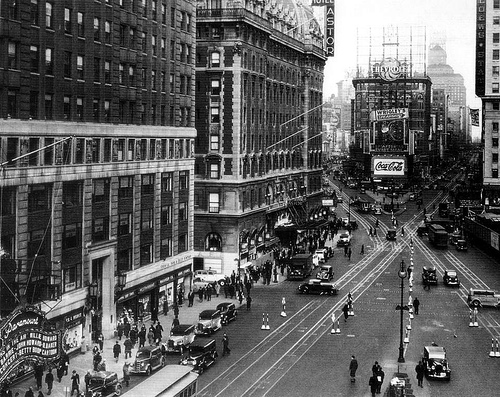
1939 Downtown District-Manhattan-Courtesy Google Images

I am deep into writing my book about my father, Eddie Green, and his life as a star of Stage, Screen and Radio, and how he has become literally wiped from most people’s memory, I believe, because he died in 1950, and when he died his works were put aside by those who knew him, and life moved on.  Now, for me as an adult with a grandson, I am trying to document Eddie’s time on this earth because Eddie contributed much to society, despite the poverty of his family, and the segregation of his time.  As I began to discover, through my research, what my father had accomplished, I was rather upset that even though Eddie worked with some of the greats of the 30s and 40s, he is not remembered as they are remembered.  So I am trying to change that with my book.

Unfortunately, I wind up putting my posting aside.  I know there is no one I need to apologize to for not posting more often, but I also know had I not started this blog, I may not have started actually writing my book.  The research began some years ago, and, for someone who may be contemplating book-writing, research is on-going.

Over the past month I have discovered a Paramount Contract Eddie had in 1945, I have read scripts from some of his movies (I will get to those later), and I have found about fifteen original photos from the sets of Eddie’s movies.  It’s fascinating and absolutely unexpected.

But before I get to that part of Eddie’s life, I will share with you what I found today.  I have been searching the World Wide Web for just the right thing to share and lo and behold, I came across the best picture.

Eddie lived in New York for a large part of his career.  He lived in Manhattan and worked in Harlem.  He was called “The Harlem Funster”.  In 1937 Rudy Vallee had a Radio Program on NBC-Blue Network and when Mr. Vallee went on his summer vacation, he convinced his sponsor, Fleischman’s Yeast, to hire Louie Armstrong to host the show for the summer.  In 1937, at Vallée’s insistence, Louis Armstrong hosted the show during Vallée’s summer vacation. This made Armstrong the first African American to host a national network program.  Guess who shared billing with Mr. Armstrong as one of the shows comedians.

According to BALLSTON SPA DAILY JOURNAL, BALLSTON SPA, NEW YORK, FRIDAY, APRIL 9, 1937:

A new variety show, an all-negro revue, makes its debut on* WJZ-NBC revue, at 9 p.m.  Based on the hot rhythm of Harlem as dispensed by Louis Armstrong’s orchestra, together with his trumpet, it will present Eddie Green and Gee Gee James, comedy team, and guest artists.  The script is being put together by Octavus Roy Cohen.

Below is the picture I mentioned, celebrating this huge event.

.

Left to right are Luis Rusell, Eddie Green, Gee,-Gee James aid Louie Armstrong, •/ho on Friday night, over station WJZ, under the sponsorship of the Flelschman Yeast Company, made show world history.—Photo by Continental News.
Left to right are Luis Rusell, Eddie Green, Gee,-Gee James and Louie Armstrong,
•/ho on Friday night, over station WJZ, under the sponsorship of the Flelschman
Yeast Company, made show world history.—Photo by Continental News.

RECEIVE CONGRATULATIONS FROM COAST-TO-COAST
APRIL 17, 1937
T h e Pitttburgh Courier

The first time I have ever seen this picture.  It’s too bad Mr. Armstrong is difficult to see, but it’s an old picture and I have a cheap printer.  Anyhow, there they are.  Making history.  But who remembers Eddie Green?  Well, I guess I do and I am sharing him with the world of today, not just because Eddie became  “somebody”, despite the obstacles, but because there are still people who believe they cannot achieve their goals because of seeming obstacles.

Of course, we have to put in the work, acquire as much knowledge as we can about our pursuits, and if we have a talent, put it out there.  I read that my father said that talent is respected in his business, and you have to keep at it because all the work and practice and time you put in pays off in the end.

Speaking of work.  Right after the ending of the Fleischman Yeast’s Summer Program, Eddie was off to Hollywood where he appeared on “Showboat” a radio program which I talked about on my previous post.   But before he left New York, Eddie had another bit of  business to attend to, per the Pittsburgh Courier  “Eddie Green, the radio comic, has gone Into the restaurant bis. He’s now the proud owner of a Bar-Bee-Q eatery off 139th” street on Seventh avenue. .”

Busy, the man was busy.

Thanks for stopping by.
*


Outstanding in His Field

Pittsburgh Courier
Pittsburgh Courier

A Woman’s a Fool – to Be Clever

National Theater

Opening Date:October 18, 1938

Closing Date:October 22, 1938

Playwright: Dorothy Bennett, Link Hannah

Opening Night Cast
Vera Allen Christine Foster
Donald Foster Lew Lerner
Eddie Green Major
Margie Ann Kaufman Rosemary Littleproud
Ian Keith Jeff Foster
Edith Meiser Josephine Lerner
Edwin Philips Eddie Sommers
Sandra Stanton Minerva Himmelman

It’s too bad this play had only seven performances.  According to the critics, it was a flop.  However, the critics were in agreement that, Eddie Green as “the cast’s lone Negro actor” gave the best performance.  Eddie, in the role of butler and coachman for the Foster family, was “genuinely funny.”  The newspaper articles mentioned also that Eddie had appeared many times as a guest on Rudy Vallee’s radio hour, and that he had also held a spot with Gee Gee James over the airways with Louie Armstrong and his revue.

The Pittsburgh Courier said “Even Walter Winchell, in his review of the play published in the Daily Mirror agrees “that the most popular member of the earnest little troupe is Eddie Green.”  And “to him is entrusted a few sallies.”

Walter Winchell worked for the New York Daily Mirror where he became the author of what would be the first syndicated gossip column, titled On-Broadway.

Using connections in the entertainment, social, and governmental realms, he would expose exciting or embarrassing information about celebrities in those industries. .  His newspaper column was syndicated in over 2,000 newspapers worldwide, and he was read by 50 million people a day from the 1920s until the early 1960s. His Sunday-night radio broadcast was heard by another 20 million people from 1930 to the late 1950s. It was a big deal then to get a thumbs-up from Mr. Winchell.  My mom did not have a lot of information about Eddie before she married him , but she did know about the mention from Mr. Winchell, so this was one item I grew up having knowledge of, and I knew, even as a child the importance of a Walter Winchell mention.

Growing up I knew so much less about my father than I do now, but I always had a sense of pride in his accomplishments, though for a long time I wished he hadn’t died and left me.  Anywho, Eddie did die in 1950, and with the book I am writing I have gotten as far as 1940.  Soon I will need to have a title, something like “Eddie Green, Star of Stage, Screen and Radio” or, Eddie Green, Renaissance Man, or “Who Was Eddie Green?”, or “An In-Depth Look At A Forgotten Star”.  I have had sixty different titles in my head. Suggestions are welcomed.

Thank you, for stopping by.


HOOKUPS


Times Square 1935
Times Square 1935


EDDIE GREEN SIGNED FOR NBC HOOKUP

Eddie Green-Getty Image

NEW YORK

Billed on Broadway and elsewhere as an ace black-face comedian, Eddie Green has been signed for twenty-six weeks to co-feature on a bill with Ernest Whitman and Charles Winnenger.  The program will be aired every Sunday from 10 o’clock to 11:00 over WEAF NBC national hookup.  Nothing new to EG who worked several seasons very successfully with Rudy V., in fact so successfully he was returned 3 times by popular demand.  Leaving the Vallee hour a year ago, he worked through a long term contract engagement at the Apollo, where with his original style of getting laughs won an uncountable following.  June 22, 1935, Pittsburgh Courier.

The program for which Eddie was signed was “Uncle Charlie’s Tent Show”.  Charles Winninger was “Uncle Charley”.   Charles Winnenger  (May 26, 1884-January 27, 1969), was a stage and film actor, who began in Vaudeville, and became known for his role in a Jerome Kern and Oscar Hammerstein II musical “Show Boat” in 1927, 1932 and in film in 1936.  Mr. Winninger would go on to appear in over 20 films.

charles winnnger charles-winninger-02

Each Sunday night Uncle

Charley’s Tent Show parades into your loudspeaker

amid a blare of parade revelry as the performers meander down

the streets of a designated city and come to a

stop in front of the canvas top which houses their act.

imagesFXV126IJuntitled (7)

 Two of those performers were Eddie Green and Ernest Whitman, who were cast as Sam and Jerry,  were the  only Negro comedians on a network , according to the August 3, 1935 issue of Radio Guide magazine.

Eddie Green, (left), my father, was at this time, a stage and radio performer, who had performed in Vaudeville,  and Ernest Whitman (February 21, 1893-August 5, 1954), was a stage and screen actor who had appeared in a number of films, including “Green Pastures”, “, Gone With The Wind”, Stormy Weather and “The Lost Weekend”.

Eddie and Ernest would team up later and record  a song together, and Eddie also went on to Hollywood to join the cast of the Showboat Radio program, starring Charles Winnenger as  (Cap’n Henry), see above picture.

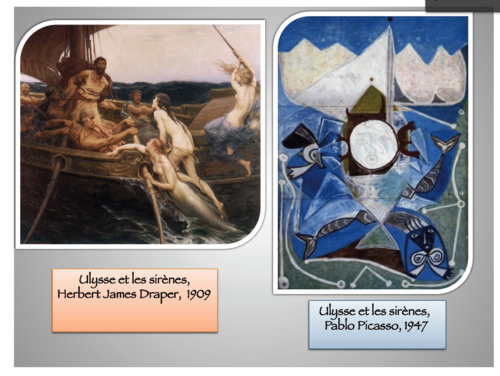
It was on the “Show Boat” radio program that my father and Hattie McDaniel (first Black female Oscar winner, for her role in the movie “Gone With The Wind”), performed the comedy skit, “Ulysses and the Siren”, which was a poem, written by Samuel Daniel 1562-1619 (who knew?).

Here is a picture of two versions of “Ulysses and the Siren”.

ulysees and the

Neither one the these pictures look anything like Eddie and Hattie.  Of course, looks don’t really matter when you are broadcasting over the radio, do they?  Hattie actually went on to be cast in the 1936 film version of “Showboat”.

These people worked together and I believe they looked out for each other.  During the 30s times were hard for everybody, but the entertainment industry was there to provide a bit of relief.  Radio was going strong.

Of course, there is always somebody with a different opinion.  One was a writer with the Knickerbocker News.  I found this article but I have not been able to print it all because the type just won’t act right, but she started out by saying “What that Eddie Green is doing in radio I don’t know.  I still can’t see his type of comedy.”  Good thing she was not in the majority.  Anyhow, they say even bad publicity is good, cause it means people are talking about you, you are causing a stir, people are noticing you.  In Eddie’s case it was a good thing.  Find what you do best and go out there and get noticed.  Have fun and spread the love.

I have a picture of Eddie and Hattie, after she won her Oscar.eddieandhattieFor those of you who don’t know, Hattie is the fifth person from the left, and Eddie is the second man from the left.  My mom is here also, first lady on the left.  She told me she could not remember whose house they were in at the time, but it was definitely in Los Angeles.  Thanx for stopping by.