
 Everyone can enjoy music. Any race or gender. It’s not normally about who is playing it. It really does not matter who is performing the music, only the notes matter. I think, however, what does matter is, who writes the notes and the lyrics. Who gets the recognition. I am happy that despite the fact that my father wrote his first song way back in 1917 his name is still listed as the writer. It’s pretty much a well known fact. And many, many people have recorded or performed Eddie’s song. Just recently a friend played it in a hotel where he works as a pianist. He was surprised how many people recognized the song, “A Good Man is Hard to Find” is still being played by someone, somewhere in the world.
The song was made popular in 1919 by a White woman, Marion Harris, the first widely known White woman to sing jazz and blues. Then Sophie Tucker (the Red Hot Mama) fell in love with the song and sung it night after night in her nightclub act. Alberta Hunter took it after that. Bessie Smith, Louie Prima, and on and on. It’s been a fox trot, it’s been played with a ukulele. It was sung by Frank Sinatra in a movie joined by Shelley Winters. However, until I wrote Eddie’s biography most people were unaware that the writer of “A Good Man is Hard to Find” was a Black man.
What I have known for a long time is that there are many songs written and/or performed first by African-Americans that became widely popular through White singers who wound up getting the kudos (think Elvis and “Hound Dog”).
 John Turner Layton, Jr., was an African-American songwriter, singer and pianist. Born 1894, he died in 1978. Turner Layton’s buddy, Harry Sterling Creamer, born 1879, died 1930, was also an African-American song lyricist. He co-wrote many popular songs in the years from 1900 to 1929. These men were talented, dedicated, and also patriotic as you can see by their first album. And like my father, Eddie, also appeared in vaudeville.
These two men wrote the song “After You’ve Gone” in 1918. Like Eddie’s song, Marion Harris helped make this song popular, as did Sophie Tucker. Edyie Gorme has sung the song, Tony Bennett and Frank Sinatra.
 “Way Down Yonder in New Orleans” was also a popular song with music by John Turner Layton, lyrics by Harry Creamer. Sung by The Andrews Sisters (1950) Freddie Cannon, Bing Crosby, Jan and Dean (1963!) among others. Yet, how many people are aware of the fact that these songs were written by African-American men? Where is their recognition?
Layton and Creamer were even commissioned to do a play. ” COBURNS PLAN MUSICAL SHOW: Mr. and Mrs. Coburn. it was learned last week, have practically completed negotiations for a new musical play which they plan to produce. The play is called “The Three Showers,” and the book, lyrics and music were written Jointly by Harry S. Creamer and Turner Layton. If George M. Cohan consents to fix up the book of “The Three Showers,” as is contemplated by the Coburns.”
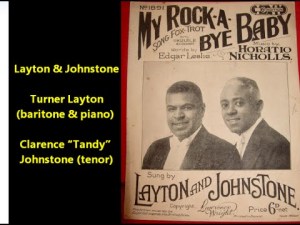 About 1924 Turner Layton went to Europe. He teamed up with a Mr. Clarence “Tandy” Johnstone and enjoyed a great deal of success. Per the Pittsburgh Courier, 1927: “Turner Layton, Clarence Johnstone Are Playing To Big Crowds In London.”
Like Eddie, Turner Layton was often mentioned in the Black newspapers even as late as 1950, Pittsburgh Courier, 1950: “The Turner Laytons with daughter Alelia vacationing in usual swank style on French Riviera. Turner Layton happy at relief of gas rationing . . . Rolls Royces do less than 8 miles to the gallon. ” The man had a Rolls Royce.
We hear the songs and even recognize the people who sing them and that’s cool. But the recognition of the fact that there is much widely popular music that was written by African-Americans is absent in America. There, I’ve said it. Which is why who wrote the music matters, today. Music is universal. As is the African-American contribution.
Hey, thanks, for stopping by.
Check out my book: Eddie Green The Rise of an Early 1900s Black American Entertainment Pioneer.
 My question is “didn’t Black people ever watch old time radio?” I have begun to realize the magnitude of commercialism and how it played into Blacks being ignored in this world in the early 1900s. While researching African-Americans and their relationship to Old Time Radio I did a Google search for “Old Time Radios”. The search engine game me dozens of images of families sitting around the radio listening to a program. Some actually were looking at the radio as if it was a television. However, none of these families were Black. I am trying to wrap my head around the idea that despite all the African-Americans in America at the time, there was little representation in the radio industry. According to J. Fred MacDonald “the industry in its so-called Golden Age offered only limited opportunities for black men and women to develop.” Even though there was a huge need for personnel.
 Of course, there were Blacks working in radio as janitors, or electrical assistants and even an announcer or two. They had to come in the “other” door, though. And there were Blacks performing on the radio, such as my father, Eddie Green, who became Rudy Vallee’s protege’ or Eddie “Rochester” Anderson from the Jack Benny program. My father was evidently so funny that Rudy Vallee would feature Eddie over and over. Then there were shows that were hugely popular with everybody (maybe not the NAACP), such as, Amos n Andy. People everywhere literally stopped what they were doing to listen to this program. Eddie was the lawyer, Stonewall in this program. There must have been some Blacks sitting in front of their radios, or if they did not have one a person could stand in front of their local storefront and listen to the broadcasts. Yes, I am beginning to really see how segregation kept Black people “out of the picture”, except in some rare instances. I mean we were THERE.
 Today, If you look up Old Time Radio (OTR), not the Beyonce’ concert, you will get a lot of information about all the White radio suspense, cowboy, comedy and horror shows.
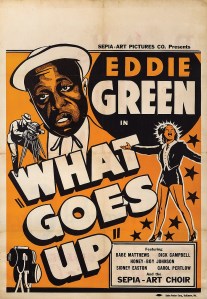 Well, it’s been two years since I published the biography on my father, Eddie Green. During the research period I searched and searched for a physical copy of this movie “What Goes Up“. Eddie wrote it, produced it, directed it and starred in it. The movie was made in Palisades, New Jersey in 1941. I am hoping to find it because, of course, it’s my father’s second movie and also because there is a member of the cast of this movie who has just celebrated her 101 years old birthday and she would love to see the movie one more time. She saw it when it first premiered in 1941 at the Apollo Theater in New York, of course, she and her mother. But not since then.
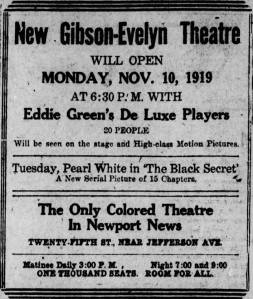 While touring as a “Boy Magician” over the years Eddie added songwriting to his list of accomplishments. He wrote “A Good Man is Hard to Find” which he used in 1919 when he took his own show on tour. The show included singing, dancing girls and comedy. While in St. Louis with this show he saw an ad in the local Variety paper for a comic. Eddie sent an outstanding reply and was invited to become a part of a vaudeville show in New York. His performances here and in Burlesque working at the 125th Apollo, earned him inclusion into a hit Broadway musical Hot Chocolates by 1929.
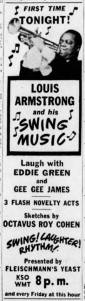
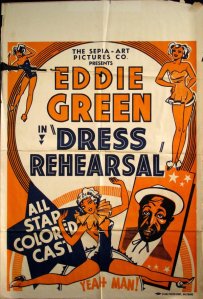 When I started this blog Eddie had almost been completely forgotten. Almost. Despite his many accomplishments in the entertainment world and the business world, despite the many friends he made and how widely he became known, beside myself, there were not a lot of people remembering that old comic, Eddie Green. I have written a biography about my father. (Eddie Green The Rise of an Early 1900s Black American Entertainment Pioneer, get it on Amazon). Since I wrote the book I have had someone tell me that I stopped the process of my father being erased from history. Wow.
 Hey, thanks, for stopping by.
 This photo absolutely suits my mood in regard to Memorial Day. I would probably rather “celebrate” Veteran’s Day seeing as I intended to write a post about my father, Eddie Green, and his experience as an African American who enlisted in WWI. Then it dawned on me that Eddie was not one who died in service. I was going to talk about how Eddie was working in a theater in Philadelphia before winding up at a Chicago Training Camp. I wanted to add information about how African Americans had to tear off a piece of their Registration Card to signify their race. After I realized I needed to re-direct my idea for a post, I stumbled across an article in the Pennsylvania York Daily Record newspaper. The article was posted on this date May 27, 2018 earlier in the morning. So I have chosen to share this information instead, as it will do nicely to get my point across.
 York County Afro-American veteran George A. Wood was killed in action September 29th 1918 during World War I. Private First-Class Wood is honored on the bronze memorial tablets flanking Gate 4 at the York Fairgrounds. His surname is incorrectly spelled “Woods” among the 197 York Countians honored on the World War I panels, fronting four columns, at the York County Administration Center, located at 28 East Market Street in York, PA. (Stephen H. Smith, York Daily Record, May 27, 2018.)


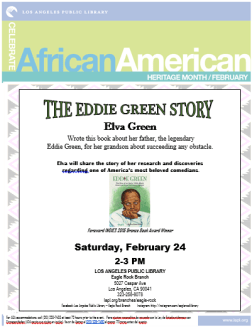 Hello again. Here is a poster announcing my next appearance at a local library here in Los Angeles, the Eagle Rock Branch Library to share my father’s inspirational story. When I started this book writing journey my thoughts never went further than getting the writing done and getting a publisher. The idea of being asked to give a presentation at a library never entered my mind. I simply knew that I wanted to put my father’s story down on paper and present it to my grandson. My doctor asked me the other day how I wrote the book-did I have any help? I realized that this is one of the first questions people ask. So this past week I sat down and wrote out what I did to get this book written. Once I took a good look at what entails getting a book written, I was in awe of myself. I am beginning to realize what a big deal this is.
 Here I am last week speaking about writing the biography of my father. I have pictures, we played a cd of a comedy skit with Lena Horne and I was happy to be there. Especially as there were two grammar school girls sitting in the front row. Paying attention. Sitting still. One little girl would take a photo I handed out, show it to her friend, have a little discussion and place the photo on the table. They even contributed to the discussion when I managed to touch on something currently relevant. I loved talking to them and assuring them that they too could achieve their dreams, like Eddie, if they learned as much as they could and believed in themselves.
 Of course I told these young girls that I started my research in the Central Library in Los Angeles. That I went to the library a lot when I was little, which I did. And, in fact, the Central Library is exactly where I began my research for my book. My mother actually found the first picture we had of Eddie on stage doing an Amos n Andy radio show back in the 1930s or 40s. This is Central Library.
 Central Library is beautiful. All of the information I found here about Eddie (and my mom) was housed in the basement level. So I went down this escalator many times. This is where I found the copyright entries for Eddie’s last movie. This is where I found old copies of Black newspapers that had so many articles about Eddie. And my mom. This is where I got carried away with reading those old newspapers. And how I found my aunt mentioned and my Nana. And my godfather. I even began genealogy research here. I made lots of copies here. I usually ate lunch in the building. And of course you can’t just visit one area of this library.
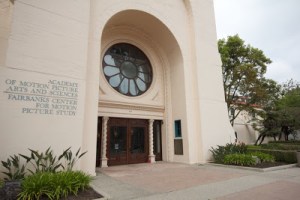 Along the way someone told me they had found information on Eddie at the Margaret Herrick Library in Beverly Hills and suggested I check it out. This is the library for the Academy of Motion Picture Arts and Sciences. It houses the Oscars library. So I went to this library. What an experience. First of all, I would have never thought of going to this library. Even though I knew my father was a filmmaker-I did not realize how big an impact Eddie had in the entertainment field. I must say here that at the time I did not have a car. I used public transportation. L. A. has good public transportation, but, some buses only run once an hour or once every 30 minutes. And visiting these libraries took me from the East to the West side of town. I visited the African American Museum in Exposition Park, the Mayme Clayton Museum in Inglewood, AND I spent hours at the Family History Library in West L.A. (a 2 hour bus ride one-way), I found so many books here on US history.
 The inside of the Margaret Herrick Library is gorgeous. One must leave one’s bags, coats and books in a little locker. When looking at photos or scripts of old papers, one must wear gloves and be very careful when handling delicate items such as old invoices. Oh, and you cannot just walk in, you have to have an appointment. The people that work in here are so nice. You tell them what you are looking for and they get it and bring it to you. I found Eddie’s movie scripts!! Posters of his movies!!! Invoices from Seiden Cinema in New Jersey for the film work they did for Eddie (with signatures). I even found the contract he made with Paramount when he was in the 1945 Duffy’s Tavern movie. Of course,, some of those items I could purchase, some not, but I could write down what I found and pay for copies. I made three trips to this library.
 Visiting libraries and museums was a big part of my journey. There were also conventions. I spent many hours online. There was a lot of reading, emailing, learning how to get with social media. Reading how-to books and articles. Reading other people’s biographies to study writing styles. Studying how to get a publisher. Biting my nails. After my mother passed in 2010 I used my grieving time to focus on the book. I was retired. Footloose and fancy-free. I had time to put into this book. Today, now that it is published I have time to share Eddie’s story in the libraries here in Los Angeles. This photo of Eagle Rock library is where I will be on the 24th of February 2018. I hope to get more kids involved. Because after all, I began this writing venture to try and motivate my grandson who grew up while I was in this process. But I also want to bring Eddie out of the shadows of time and share his many contributions to the entertainment industry and beyond.
 pininthetush