

Anything but tranquilizing, Right On, Maude! Hi there, well folks, I have begun writing my third book. I am awe struck that I have come this far as I only wanted to write one little book. I knew I could write one book. Today I am finishing my second book on The Jeffersons and I have started researching a third. I imagine that some of you beautiful people out there remember the 1970s tv sitcom, Maude. Maybe you watched it back then or you have seen reruns. I watched it, I liked Bea Arthur as Maude and Bill Macy as her husband, Walter. The reality of my life in the 70s though was that I was “doing my thing”. Remember “It’s Your Thing, Do What You Wanna Do”? Well I was partying hardy so even though I watched tv I barely remember most of the Maude episodes so I will be watching a lot of videos and I get to interview people who worked with the show. I do remember the theme song which, I just found out about a month ago, was recorded by the famous Donnie Hathaway!
 I know this is too interesting, but I just want to go back a bit to the beginning of my book writing online journey. I think it is amazing and right that the biography that I wrote about my father has a continuous connection to my second and third books. As if I am supposed to be writing these books. I started out by writing about my father who found his fame appearing as Eddie the waiter on the Duffy’s Tavern Radio Program from 1941-1950. They began taping in New York, moved to L. A. and then to Puerto Rico during these years. Duffy’s Tavern was a comedy and each episode (almost every one of them) a different guest appeared and became a part of the shenanigans. Way too many to list here, but a few were Bing Crosby, Dinah Shore, Billie Burke, Adolph Monjou, Charles Coburn, Boris Karloff, Larry Storch, Peggy Lee, Mickey Rooney, Ed Wynn and on and on. Ed Gardner, Jr. was the Bartender and Charles Cantor was the resident oddball guy who hung out at Duffy’s, by the name of Finnegan.
 In 1945 Duffy’s Tavern with made into a movie by Paramount. In the movie they used almost every star on the Paramount lot, plus Ed, Eddie and Charlie. Bing Crosby was in this movie as you can see from this poster. Eddie’s picture is no where on this poster. Maybe he wasn’t famous enough yet. But after being in the entertainment business since about 1901 he was gettin’ there. Anywho, since I have written the book I have received pictures from fans of Eddie. Pictures that are treasures of theirs and now of mine.
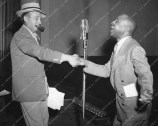 Sometime in the early 40s this picture was taken. This is an old copy from the internet. I now have an original in hand. This is typed on the back of the picture: Produced by the Armed Forces Radio Service. Program: Jubilee. Bing Crosby and Eddie Green “All Armed Forces Radio Service programs are stamped on flexible plastic transcription discs. In addition the the land-based broadcasting outlets ships of the United States Navy and Coast Guard in all oceans will receive the transcription of this show, which is not heard in the United States except in Army and Navy hospitals serving returned casualties.” Need I say more?
 Going on to my second book. While writing The Jeffersons I discovered that a friend of Eddie’s, Lillian Randolph, had appeared in a Jeffersons episode as Mother Jefferson’s sister. Lillian and Eddie had appeared together on The Great Gildersleeves Radio Program and also on the Amos n Andy Radio Program. Lillian’s real life sister was Amanda Randolph who had stared in Eddie’s third movie Comes Midnight. Lillian is the woman who donated her dee-vorce money in It’s a Wonderful Life.
Back to Maude. I started researching my third book about the Maude tv sitcom about a month ago. I have had the great benefit of being able to call on writers who wrote for Maude and who also wrote for The Jeffersons. (Mr. Moriarty was one writer who wrote 68 episodes according to Fandom). I’ve posted about this before but Mr. Bob Schiller and Mr. Bob Weiskopf not only wrote for Maude, they also wrote for All In The Family of which The Jeffersons was a spin-off and they wrote for Duffy’s Tavern Radio Show where it is quite possible they knew my father. It is all connected.
I was watching one of the Maude episodes, “The Kiss” when I realized Maude and Walter were so loud! I had found a newspaper article where the complaint about The Jeffersons in 1975 was that they were too loud. Well, this must have been a Norman Lear thing (I read that somewhere) because the characters in Maude talked really loud also. In “The Kiss” Walter tried to BS Maude about why she found him kissing the next door neighbor, Maude’s best friend. I wonder what I get to say about these episodes in my book? You’ll notice I said BS.
There is no set in stone title at this point. I’m wavering. Maybe God’ll get you for that, Walter or Right On Maude! (the 70s babee). I’ve got a year to figure it out. I love what I am doing. I love writing and research. I can get totally involved in it. My experience in this writing journey has far exceeded my imaginings.
I got an itch to do something and I did it and it has blossomed. I suggest to anyone else if you have something you think you can do or you have something you want to say, do it, put it down on paper, the sky’s is the limit but you gotta start the flight. And help will find you along the way.
Hey, thanks, for stopping by 🙂
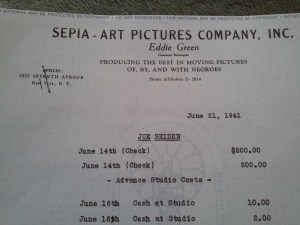 Well, here we are all quarantined together. A good time to take a look back into the past. The first picture on this post is a copy of a financial document from my father to Joe Seiden from about 1939. Eddie had his first movie studio in Palisades, New Jersey as did Seiden (Seiden Cinemas). Seiden edited Eddie’s films and helped with sound and the making of prints. Eddie made his first four films here from 1939-1941. What is now Fort Lee, New Jersey was, at one time, the “movie capital” before there was “Hollywood”. Fox, Universal, Biograph studios all began here. Oscar Micheaux was at Metropolitan Studios at this site. The last movie Eddie made here was “One Round Jones”, a movie about a nightclub owner who comes up with the idea to pay $50 to anyone who can go “one round” with his mystery fighter, who of course turns out to be Eddie.
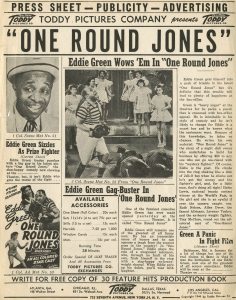 When I wrote the biography about my father I discovered one thing. The more I searched for information, the more I found. This has carried over until today. When I first received this press sheet I was overjoyed. I had to have permission to use it in the marketing of my book which was fine with me. What I didn’t realize was that this sheet held a font of information that would eventually hook me up with more information four year after publication of the book. My first example is in the lower portion of the 4th column of this article a Mr. Lorenzo Tucker is mentioned as part of the cast. I did not expand on this in the book, mainly because I had no idea exactly who he was and how he would pop up in future. About a month ago I heard from an Eddie Green fan who had some original photos of my father that he wanted to gift to me. One of the photos is of Eddie and Louis Jordan and a woman name June Richmond. Louis and June had starred in the 1947 movie Reet, Petite and Gone. I decided to research this movie and learned that Lorenzo Tucker appeared in this movie as the shyster lawyer, Henry Talbot.
 Reet, Petite and Gone is about an Old-time musical star Schyler Jarvis, now wealthy, who is dying; his last act is a visionary plan for the future happiness of his son, swing bandleader Louis Jarvis, and Honey Carter, daughter of his long-lost love. But crooked lawyer Talbot has a nefarious scheme to get his hands on the Jarvis money. There is also plenty of swing from Louis Jordan’s Bands. Lorenzo Tucker also appeared in 18 of Oscar Micheaux’s films. He eventually went totally off the movie track and became an autopsy technician for the New York City medical examiner, where he worked on the body of Malcolm X. That original photo that is being gifted to me shines more light. Lorenzo seems to have started out with my father’s movie studio.
 Then I noticed that Mr. J. Louis Johnson was also in the 1947 movie Reet, Petite and Gone. He played Senator Morton’s Butler. Well, J. Louis Johnson was a cast member in my father’s Sepia Art Pictures Company, Inc. in 1939. I did mention him in the book but I just did not see the connection. Mr. Johnson was in a lot of great movies. Mostly bit parts, but hey, he must have been a good actor because he worked with such stars as Clark Gable in Homecoming (1948), Lena Horne and Eddie “Rochester” Anderson in Cabin In The Sky (19400, and he had parts in Hitchcock’s Strangers On A Train and Orson Welles The Magnificent Ambersons (1942). But he was with Eddie before these others.
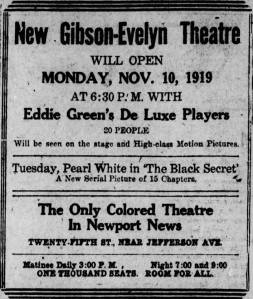 I’ve been doing what I like to do best-researching. I saw a story online about the 1918 Spanish Flu and it dawned on me that my father was alive back then. As a matter of fact, he was married to his first wife, had his first daughter, had signed up for WWI, had written a song and was on the road traveling down south with his “Deluxe Players”. The 1918 pandemic lasted from, I think, August of 1918 through December of 1920. Eddie began his first on stage vaudeville work in 1920. He was a comedian. The 1918 flu was targeting young adults. About half of the deaths were in the 20-40 range. Eddie was about 29. He had already experienced diseases and poverty being born in 1891 in Baltimore during a time of no indoor plumbing and rampant Leukemia in the East Baltimore slums. It’s one of the reasons he left home at nine years old and worked as a boy magician until someone suggested that he was so funny he really didn’t need a lot of props to entertain people. It seems that Eddie never got sick. Vaudeville and Burlesque were pulling people in. Eddie was performing in Tampa, Fla., in 1919 with his Deluxe Players when he applied for and got a job as a comedian in New York in 1920. The flu had hit Haskell County, Kansas In January 1918.
 The “Roaring Twenties”. Booze and parties. Eddie was appearing onstage in “All In Fun”, dancing and singing now along with his comedy. I read he and his partner were encored many times. So everyone must have been having a good time. Duke Ellington was coming along. Eddie opened a publishing business, a movie studio and wrote “King Tut’s Blues” because of the discovery of the tomb in 1923. And better things were yet to come. Even so, there was also the fact that in those early 1900 years racism was also a death sentence for Blacks. And Eddie was touring the country with Burlesque shows. In Blackface. And he was a hit everywhere he went. Fascinating when you think about it.
 I’m typing this on Super Bowl Sunday the second day of February. February has been designated Black History Month (or as Mr. Obama said: African-American History Month). We progressed over the years from 1926 when we celebrated Negro History Week. As a matter of fact there was a Negro Week at the 1940 New York World’s Fair. However, when Super Bowl Sunday rolls around on February 2, 2020 it’s all about football. Yea, it’s just one day. But the lead up is crazy. And do you know how much some of those tickets cost? This year I have noticed that people are focusing on civil and voting rights for Black Americans or lack thereof back in the day. What I want to do is celebrate Black Historical Americans. Especially those who may not receive much notice these days. Of course, I could just post about famous Black footballers like Ray Kemp. But I’m not really into football, so I would have to do a bit of extra research. Which is how I found this guy:
 Raymond Howard Kemp (April 7, 1907 – March 26, 2002) was an American football player and a charter member of the Pittsburgh Pirates football team (now called the Pittsburgh Steelers). He was also the first African-American player in the team’s history. It’s kind of amazing to me that this man was still alive in 2002 and I’ve never heard mention of him. I am not a big football fan but I have watched a few games and I have seen the Gayle Sayers movie (a heart-breaker). What I’m saying is that there are a lot of Black Americans in history who have made great contributions that we do not hear about. Even if they played football.
 What I know a lot more about is my father’s life. As the title of my book says, a Black American Entertainment Pioneer. Eddie Green. In this post I am sharing about Eddie in 1941. He was 50 years old, and had become a filmmaker, working his way up from a poverty-stricken childhood, through vaudeville, burlesque, the stage and many radio programs as a magician, a dancer and comedian. His household fame hadn’t come yet, but his name was always in the local Black newspapers. Eddie used a lot of young women in his movies as chorus girls. He would find his ladies at beauty contests. In 1941 there was a contest at the Renaissance Club in Harlem. Eddie presented the winner of the “Miss Glamourous” contest. Her name is Millicent Roberts. Millicent was 101 years old a couple of years ago. A living legend of Black History-when we had Black beauty contests. She also had a part in one of Eddie’s movies “What’s Going Up”.
 I celebrate Black history every day. Through my mother and my father. My mom’s got some Italian mixed in on her father’s side but she always identified as Black. (This sometimes caused her problems-in later life she told people she was a gypsy and they would not question her further.) Anyhow, I’ll be posting in celebration of Black History this month. Because there is a lot of good information out there about African-American history that needs to be shared. History that has been blended in with the stories of America that make for great reading.
 SURPRISE!!!! About two weeks ago it Snowed in the Antelope Valley in Sunny Southern California! Real Snow. In Lancaster, where it was hot as the blazes a couple of months ago. Snow in the Valley. I’ve seen snow before, in Manassas, Va. Not here. So all the neighbors were out taking pics and some of them made snowmen and snowwomen (guess how you could tell the difference). All I could think of when I went outside was “Merry Christmas!!!!” So I shouted it out. An early White Christmas. I love it! It hung around for about 3 days before it melted away. I took this pic with my old “free” government phone.
 I began researching and interviewing last December 2018. I am THIS close to having a rough draft for my publisher. I’ve spoken to cast and crew members, writers, directors and guests. I’ve spoken to those who cannot be done without – Administrative Assistants (I’ve been one so I know their importance). My self-imposed timeline to finish a rough for my publisher was the end of December 2019. It’s quite possible I may go a tad bit over. But everything about this book writing process is fun, except the proofing (:() Rather tedious, but necessary.
 So I’ve left my OG phone behind (now that I can afford an upgrade). I’m working hard on a new book about a TV sitcom that I loved and I’m looking way back into those yesteryears when you had to read what was on the screen. Which somehow seems to meld in to what we are doing today. Reading our screens. Anybody out there remember telephone party lines? Wishing you all a bunch of good Holiday Surprises!
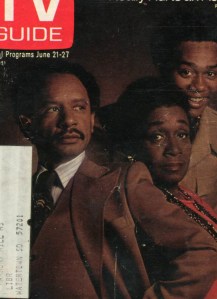 Hello friends. The fact that I have begun the process of writing a book about The Jeffersons tv sitcom is beginning to make it clear just how diligent I am going to have to be in getting my facts straight. Somehow it seems a lot more involved than corroborating the information I learned about my father when writing his biography. In researching the actors and their participation in their various shows, I have found out that one person will say what they think things were like, some will say what they heard, and some will assume. Getting the actor’s stories in their own words is difficult, especially if those actors are no longer with us.
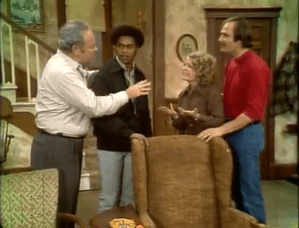 Today I decided to write about actor Mike Evans who played the character Lionel Jefferson, the son of the Bunker’s new Black neighbors. The Bunkers were the family from “All In The Family” or AITF, with Carroll O’Conner, as Archie and Jean Stapleton, as Edith. Mike Evans began portraying Lionel in this AITF in 1971 through 1975 before moving on up to “The Jeffersons”.
 Well, unlike George and Weezy I’ve moved on out of my old too expensive place “in” to a cheaper place. And what a relief it is. I’ve had to go backwards to move forward. Meaning I now have a bit more money to work with and I can be more comfortable while writing my second book and while I wait for my ship to come in. I’m sleeping with less stress as opposed to sleeping because of depression. And now I can focus on The Jeffersons. Getting back into doing research for a book helps balance me out.
 Jeff Barry, the co-writer of “Movin’ On Up” is a Songwriters Hall of Fame inductee. He has co-written songs for The Monkees, The Shangri-las, The Ronettes, and he co-wrote “River Deep, Mountain High” recorded by Tina Turner. Wow. He is also the recipient of the Ahmet Ertegün Award from the Rock and Roll Hall of Fame. He has a great online site, too. (Google Advanced Image Search)
 One of my Facebook friends said she liked the episode that featured Sammy Davis, Jr. I did not see that one, didn’t even know he had been a guest. The episode was titled “What Makes Sammy Run”. It aired January 1, 1984. I wonder how I missed THAT one. Sammy even recorded the Theme Song. Let’s see if I can post it here:

 Hazel Scott was a classical pianist, singer and actor. She was married to Adam Clayton Powell, Jr. (I was baptized by Rev. Powell). I wish I could have heard Eddie and Hazel on “The Bishop and the Gargoyle”. Hazel was a music prodigy and was given scholarships to Juilliard School from the age of 8.
 The Bishop and the Gargoyle was a 30-minute old-time radio crime drama from September 30, 1936 – January 3, 1942. Bishop and the Gargoyle focused on the combined crime-fighting efforts of a retiring bishop of a church and a convict called the Gargoyle. As a member of the parole board at Sing Sing Prison, the Bishop met and befriended the Gargoyle. In return, the inmate helped the bishop “to track criminals and bring them to justice”. I can’t even imagine how they decided to cast Helen and Eddie-a pianist and a comedian. Richard Gordon played the part of the Bishop. I could not find much on Mr. Gordon until I discovered a podcast by J. Widner-apparently Mr. Gordon was a character on many radio shows; in 1933 he played S. Holmes with Leigh Lovell as Dr. Watson.


 “I’ll Be Around” became a hit, and then a disk jockey played side B and “Paper Doll”, (written by Johnny S. Black) recorded in fifteen minutes, became a hit. It sold six million copies and became the group’s biggest hit 1943. “I’m gonna buy a Paper Doll that I can call my own”.
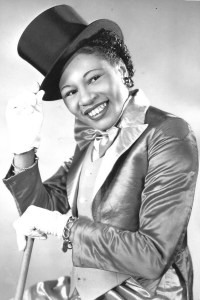
 Never having experienced this I tend to forget that Black entertainers of the early 1900s faced blatant racism constantly. Maybe even daily. It had to have been a constant stressor. Yet, actors like Gee Gee and my father, Eddie Green, lit up a room when they walked in. They were gracious off stage and dedicated to their craft on stage. These trailblazers have, because of their fortitude, become my heroes. I chose to write about Gee Gee James today because she and my father were once comedic partners. But like Eddie before I wrote my book, Gee Gee has pretty much been forgotten or over-looked. In this extremely bad copy you can see her from 1937: “Luis Russell, Eddie Green, Gee Gee James and Louie Armstrong, who on Friday night, over station WJZ, under the sponsorship of the Fleischman Yeast Company, made show world history.”—Photo by Continental News 1937
 pininthetush