
Hi there! Welcome and welcome back.
 During the past month I have gotten closer to beginning a second book and during my research on other star’s of the entertainment world I was reminded of a resentment I formed while writing the book on my father, Eddie Green. At one point in time Eddie was famous. It said so in the newspaper articles I found. In 1937 he opened his first Bar-Bee-Q shop in New York. According to the Pittsburgh Courier:
“Eddie Green, star of radio and stage and screen (RCA-NBC television program 1936) has entered another field with the opening of his swanky and cozy Bar-Bee-Q shop on Seventh avenue near 126th Street In the heart of the section frequented by sportsmen, actors and artists of all kinds. In the short space that it has been opened, this food emporium has become a rendezvous for celebrities of the theatrical world. Though well-known for his work on the stage and screen, Eddie Green is best remembered as the radio comedian who appeared for a number of weeks as the featured attraction on the full hour Sunday evening- NBC “Echoes of New York Town” program, sponsored by the light and gas companies of New York cities, and won a marked degree of success for his effort in this spot. Besides, his various guest appearances on any number of programs, including Rudy Vallee’s, Mr. Green just recently completed a week’s contract as star comedian (opposite Gee Gee James, of “Gibson Family” fame) of the Fleishmann Yeast Hour, which costarred Louis Armstrong. His portrayal of the characters selected for him to play, won the hearty approval of metropolitan radio critics.”
 Eddie’s Emporium was listed in the local newspapers under the Café section: Listed under the Cafe Section – Manhattan, under American food: Eddie Green’s Bar-Bee-Q 2149 8th Ave., New York Specializing in Southern Bar-Bee-Q. Finest South’n hospitality. E. Green. Host. Mind you, Eddie was born in Baltimore and spent most of his years in New York, but he loved “South’n” cooking. (8th and 116th Street today).
My point is that he was well-known in 1937. By 1939, he had started his own film production company and had made two movie featurettes, Dress Rehearsal and What Goes Up.
My resentment came about as I realized that Eddie’s name was in the newspapers right along with other stars who are still well-known today! What began as an inspirational story morphed into a vehicle to get Eddie out of the shadows and back into the spotlight where he belonged.
Newspapers ran ads like these (minus pictures):
 1941Buffalo Courier Express December 14 PLAZA THEATER – Michael Redgrave “SONS of the SEA”
 1941 Buffalo Courier Express December 14 SHEA’S BUFFALO – Bette Davis “NOW VOYAGER”
“RIDERS OF THE NORTHLAND” Serial, “OVERLAND MAIL” – Also Eddie Green, Famous Colored Radio Star, in Featurette, “What Goes Up”.
You will notice that he was the last on the bill after the “Serial” and his movie was not in upper-case letters. Even though it says he was Famous. But Eddie was a Black man and the movie was a featurette and this was 1941.
My resentment has faded over time, because as I look at what Eddie accomplished in his life despite any negativity I am proud of him as a person. He was a hard-working man. He loved what he did and he payed it forward in how he got along with others and in helping those less fortunate. He was able, in 1941, to share his profits:
Eddie Green to Play Host To 250 Poor Christmas Eve
“Eddie Green will play host to 250 of New York City’s poor on Christmas eve morning. Along with Arthur Oliver, manager, and about a dozen of the girl employees of Eddie Green’s Bar-Bee-Q, they will assemble at the Eighth avenue link of this popular chain of restaurants where they will pack and hand out Christmas baskets containing roasting chicken and all of the fixings that go to make up a good dinner. Tickets for these baskets have been distributed among quite a few responsible persons who in turn are giving them to families that they know to be in need.”
My father was a Good Man. I only got to know him through writing his biography. And I have been given great insight into what it really is to be “Famous”. I love you, Eddie.
Thanx, for stopping by.
 These days it is so difficult to write inspirational, motivating posts. Posts that bring smiles and laughter. Posts that are entertaining. The political climate sucks so bad right now it is impossible to ignore. I chose to watch an ad placed by President Trump recently. How disheartening. A Reuters headline read: “Sickening’: New anti-immigrant Trump campaign ad stokes outrage”. And it was sickening. And truly sad, to me. Sad and un-Presidential. Low. An article in the Politico talks about President Trump never being shy about branding female political enemies with “personal and demeaning” insults. How is this presidential? How can he even allow himself to communicate on such a level. He sits on the highest seat in the land, for Heavens sake. And I guess that is the point. He’s the President. He can pretty much do what he wants. Thank goodness he backtracked on that “consider it a rifle” statement about rocks being thrown by migrants towards U. S. military. The newspapers (Politico) printed that he has since said “I didn’t say shoot”.
 “The Brooks–Sumner Affair, occurred on May 22, 1856, in the United States Senate when Representative Preston Brooks (D-SC) used a walking cane to attack Senator Charles Sumner (R-MA), an abolitionist, in retaliation for a speech given by Sumner two days earlier in which he fiercely criticized slaveholders, including a relative of Brooks. Brooks beat Sumner severely on the head using a thick gutta-percha cane with a gold head. Brooks didn’t stop when his cane snapped; he continued thrashing Sumner with the piece which held the gold head. Brooks later boasted “[The pieces of my cane] are begged for as sacred relics.” Apparently, his constituents sent him hundreds of new canes. – “Caning of Charles Sumner”; Wikipedia”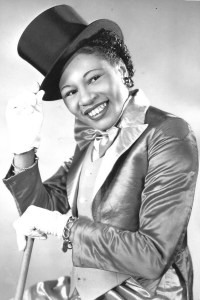
 Never having experienced this I tend to forget that Black entertainers of the early 1900s faced blatant racism constantly. Maybe even daily. It had to have been a constant stressor. Yet, actors like Gee Gee and my father, Eddie Green, lit up a room when they walked in. They were gracious off stage and dedicated to their craft on stage. These trailblazers have, because of their fortitude, become my heroes. I chose to write about Gee Gee James today because she and my father were once comedic partners. But like Eddie before I wrote my book, Gee Gee has pretty much been forgotten or over-looked. In this extremely bad copy you can see her from 1937: “Luis Russell, Eddie Green, Gee Gee James and Louie Armstrong, who on Friday night, over station WJZ, under the sponsorship of the Fleischman Yeast Company, made show world history.”—Photo by Continental News 1937
 Everyone can enjoy music. Any race or gender. It’s not normally about who is playing it. It really does not matter who is performing the music, only the notes matter. I think, however, what does matter is, who writes the notes and the lyrics. Who gets the recognition. I am happy that despite the fact that my father wrote his first song way back in 1917 his name is still listed as the writer. It’s pretty much a well known fact. And many, many people have recorded or performed Eddie’s song. Just recently a friend played it in a hotel where he works as a pianist. He was surprised how many people recognized the song, “A Good Man is Hard to Find” is still being played by someone, somewhere in the world.
 John Turner Layton, Jr., was an African-American songwriter, singer and pianist. Born 1894, he died in 1978. Turner Layton’s buddy, Harry Sterling Creamer, born 1879, died 1930, was also an African-American song lyricist. He co-wrote many popular songs in the years from 1900 to 1929. These men were talented, dedicated, and also patriotic as you can see by their first album. And like my father, Eddie, also appeared in vaudeville.
 “Way Down Yonder in New Orleans” was also a popular song with music by John Turner Layton, lyrics by Harry Creamer. Sung by The Andrews Sisters (1950) Freddie Cannon, Bing Crosby, Jan and Dean (1963!) among others. Yet, how many people are aware of the fact that these songs were written by African-American men? Where is their recognition?
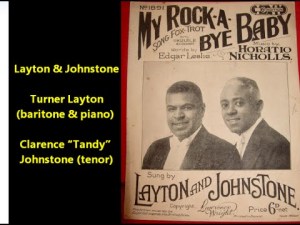 About 1924 Turner Layton went to Europe. He teamed up with a Mr. Clarence “Tandy” Johnstone and enjoyed a great deal of success. Per the Pittsburgh Courier, 1927: “Turner Layton, Clarence Johnstone Are Playing To Big Crowds In London.”
 Happy September 13th! No special reason, just feeling good today. I joined a couple of Facebook Blues Groups and found a whole ‘nuther group of folks who remember my father, Eddie Green, because of some of the songs he wrote. I love the Blues. I love music, period. Music is the one thing that can help me snap out of a funk. Haha, especially funky music. I have been listening to George Clinton and James Brown lately. And the Blues. The groups I found are basically into the Blues from the 20s, 30s and 40s. Down Home Blues. Blues. Butterbeans and Susie were a comedy team from 1917 until she died 47 years later. The typical act featured a duet, a blues song by Susie (often a “double entendre`” blues song), a cakewalk dance, and a comedy sketch. One of their more popular double entendre` songs was “I Want a Hot Dog for My Roll”, performed by Susie.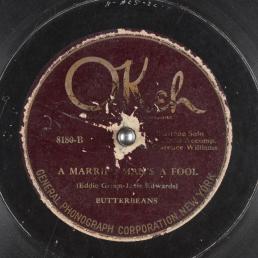
 My thoughts are swirling today. The anniversary of my mom’s death is coming up. She started out on this book writing journey with me but she did not see the published book, nor did she get to see even half of what I unearthed about Eddie’s life. Mom was 30 years his junior and was only married to him five years. During the time he was most famous. Of course, she had the real thing. Good thing Eddie didn’t believe that “A married man’s a fool” stuff. Mom was his 4th wife!
 My question is “didn’t Black people ever watch old time radio?” I have begun to realize the magnitude of commercialism and how it played into Blacks being ignored in this world in the early 1900s. While researching African-Americans and their relationship to Old Time Radio I did a Google search for “Old Time Radios”. The search engine game me dozens of images of families sitting around the radio listening to a program. Some actually were looking at the radio as if it was a television. However, none of these families were Black. I am trying to wrap my head around the idea that despite all the African-Americans in America at the time, there was little representation in the radio industry. According to J. Fred MacDonald “the industry in its so-called Golden Age offered only limited opportunities for black men and women to develop.” Even though there was a huge need for personnel.
 Of course, there were Blacks working in radio as janitors, or electrical assistants and even an announcer or two. They had to come in the “other” door, though. And there were Blacks performing on the radio, such as my father, Eddie Green, who became Rudy Vallee’s protege’ or Eddie “Rochester” Anderson from the Jack Benny program. My father was evidently so funny that Rudy Vallee would feature Eddie over and over. Then there were shows that were hugely popular with everybody (maybe not the NAACP), such as, Amos n Andy. People everywhere literally stopped what they were doing to listen to this program. Eddie was the lawyer, Stonewall in this program. There must have been some Blacks sitting in front of their radios, or if they did not have one a person could stand in front of their local storefront and listen to the broadcasts. Yes, I am beginning to really see how segregation kept Black people “out of the picture”, except in some rare instances. I mean we were THERE.
 Today, If you look up Old Time Radio (OTR), not the Beyonce’ concert, you will get a lot of information about all the White radio suspense, cowboy, comedy and horror shows.
 In the 1940s when my father, Eddie Green, was looking for women to dance as chorus girls or to star in one of his movies, he would put on beauty contests. Beauty contests were not exactly new in 1940, but they were definitely segregated. Which means that these contests only got media attention from the White owned newspapers. If you were to google “beauty contests” from the 1940s, you could find many images of the White ones, but none of the Black ones. This particular contest was for Miss Sepia America. Anyhwho, this is not a post about segregation. Or beautiful girls as it says in the first article from 1940. “Eddie Green Bringing Six Beautiful Girls to Affair At Claver (The St. Peter R. C. Claver Church, located in the Burrough of Brooklyn was hosting their annual post-season Basketball Game and Matinee Dance.) This is a post about communication, then and now.
 As it is next to impossible to read this article from 1941, I will type it out. From the Courier-Post (Camden, New Jersey) – 09 Oct 1941: “Each and every fine cat in Harlem is figgering on draping out in their most much of hard-hitting togs, donning their up-to-date sky pieces and collaring a broom down the midway to Harlem’s Renaissance Casino on the early black of Oct. 9. To dig the most mad lay-out of fine and mellow chicks Eddie Green’s gonna drop on them. Now Eddie is a square (and actually needs some prayer) when it comes to beating up his chops on a bid like this to you. So trilly up Harlem way and dig in on something to gumbeat about . . .Now if that spiel is too panicky for you to latch on, and you’re a Lane from Spokane, or a Home from Rome, may I simply say the date is the early black of Oct 9th. So be on hand to gim those gams…..Dig?”
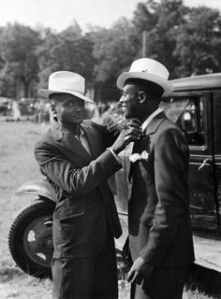 I do know what “fine cat” means (I’m not THAT square) and I know togs are clothes. And back in the 1940s men were always sharp (meaning they always made sure they looked good). If you were going to the Renaissance Casino you definitely had to look good because the Renaissance Casino, provided the backdrop for the area’s most elegant dances and exciting sporting and political events. In the 1940s it was also one of the few places Black people could go to have a good time. And of course I know the article must mean Eddie was bringing some of his beauty contestants for the fellows to ogle.
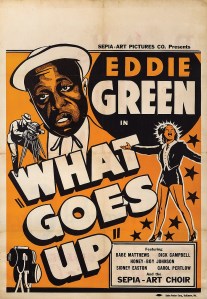 Well, it’s been two years since I published the biography on my father, Eddie Green. During the research period I searched and searched for a physical copy of this movie “What Goes Up“. Eddie wrote it, produced it, directed it and starred in it. The movie was made in Palisades, New Jersey in 1941. I am hoping to find it because, of course, it’s my father’s second movie and also because there is a member of the cast of this movie who has just celebrated her 101 years old birthday and she would love to see the movie one more time. She saw it when it first premiered in 1941 at the Apollo Theater in New York, of course, she and her mother. But not since then.

 pininthetush