I’m So Excited

th (6)I’m so excited, and I just can’t hide it
I’m about to lose control and I think I like it!


Hi, there!  I have been working diligently on the biography of my father, Eddie Green, for the past couple of weeks, because I am so close to finishing and I want to get the manuscript sent out for proofreading before I send it to a publisher. One year ago I bought my first laptop and started this project. AND THEN, last week, out of the blue, I received a message from a lady whose 90-plus year old Grandmother, whose name is Millicent, had been in one of the movies my father directed, produced and starred in, “What Goes Up.” The movie was made in Fort Lee, New Jersey in 1939.

Evidently, Millicent had for years been telling  the younger members of her family about those days, but no one really listened until one family member decided to investigate. She went on line and found my blog (yay!) after typing in Eddie’s name, and now I get to add a bit more information to my book, and I get to share a little of Millicent’s story (she played a chorus girl in the movie) with my readers. This is exactly the type of thing I wanted to happen, though I wasn’t sure it would.
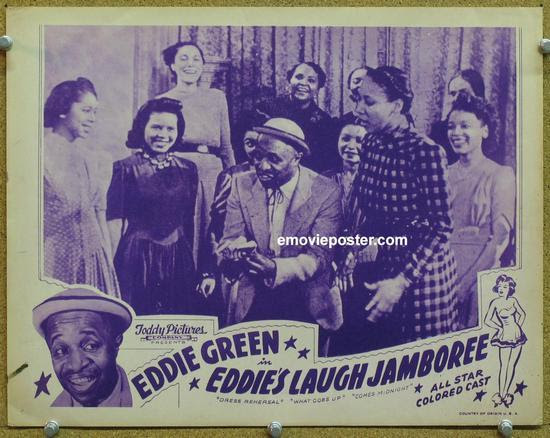
Millicent is the shorter woman in the front in the black dress.  I have had a copy of this photo for a long time, but had no idea who these women were. Now I know one of them.  Millicent and I live in different cities and have never met, but, boy, am I glad her relative found me.  (Laugh Jamboree was a Toddy Pictures production, though the movies, Dress Rehearsal, What Goes Up and Comes Midnight, were Eddie’s.)

Through her granddaughter, Millicent has provided me with more insight into Eddie as an entertainer and as a movie producer than she will ever know.  For instance, she says that Eddie was “all business”.  Well, in a Baltimore Newspaper article from around the same time that Millicent knew Eddie, the headline reads: ” As a Comedian, He’s Very Funny, As a Business Man, He’s Very Sensible and Comedy is a Business.” The article goes on to say “The fact that Eddie is so funny on the screen, stage and radio is due to the highly intelligent and efficient manner in which he conducts his work.”

The other thing about this contact with Millicent, is that, had my mother, Norma, still been alive today, she would have been 92 years old. For those that don’t know Eddie married my mom when he was 54 and mom was 22. So Millicent was a cast member in Eddie’s movie, about the same time Eddie first met my mom.  I love Millicent, I don’t know her, but that’s ok. I have a few more tidbits to share (Millicent was a beauty contest winner), but I will save them for another post.

Being able  to look back and “experience” the past through my book and this blog, brings me so much joy.  I mean, just because its 2015 does not mean past times are inconsequential. Past times, older people,  are extremely important to who we have become today, and well worth the attention, in my opinion.

Thank you, Sharon.

And, thank you, for stopping by.

Lyrics for “I’m So Excited” courtesy of The Pointer Sisters


.


A Symbol of Abundance

untitled (29)

The horn of plenty is a symbol of abundance and nourishment, commonly a large horn-shaped container overflowing with produce, flowers or nuts. The horn originates from classical antiquity, it has continued as a symbol in Western art, and it is particularly associated with the Thanksgiving holiday in North America and with harvest, prosperity and spiritual abundance.

This time last year, I had just started my blog.  I was a bit discouraged about the world situation at the time, as I still am today, however, this year I am experiencing more hope.  I have finished 90% of a goal that I set for myself, and I have stuck with this blog for a whole year.

My first post, Can’t is Not in My Vocabulary, explained how I came up with the bright idea to enlighten my grandson, in book form, on what a person can accomplish, by telling him about his grandfather, Eddie Green, a Black man born in poverty in 1891,  who rose to prominence despite many obstacles, and, I discussed how I would use my posts as a way to chronicle the writing of the biography about my father.

While doing the research for my book and verifying information for my posts, I discovered way more than I expected, not just about my father’s rise, but also about what motivates people, and about determination and how much work actually goes into achieving one’s goals, and how that work can be extremely rewarding. What I hoped to impart to my grandson, morphed into a desire to share inspiration to any person who feels they “can’t”. I want the experience of reading my posts to be as uplifting and inspirational as possible to those who could use a boost.

In America, Thanksgiving is traditionally a celebration of the blessings of the year. I am celebrating the achievement of my goal. I am celebrating the friendships I have acquired over this past year. I am celebrating the fact that people “follow” me. Yee haw! I am celebrating the fact that I am still just as gung ho about the research and the writing, as I was when I began this project.

I have a vague memory of my mom putting out her yearly Horn of Plenty for the Thanksgiving season, way back when I was a child, and it seems to me that, though I could not articulate this, I knew then that her well-used bamboo horn signified a never-ending source of good things. May you experience an abundance of thanksgiving.


ONLY IN A DREAM

images (9)

Time flies when you’re on a mission.

For the past week or so, my mission has been to get permission to use certain photos in the book I am writing, order the photos, re-read the book before I send it out for copy editing, and looking for a copy editor.  And for some reason, it seems like these things have to be done right away.  Which they don’t. I am not working on a schedule.  I don’t have a contract that says 4 books in 4 weeks.  I don’t HAVE a contract.  I started this project because I had a goal.  To bring my father, Eddie Green, out of obscurity to highlight his achievements as a Black man in the early 1900s, and to put the information in book form for my grandson.  Which is what I have done and what I am doing. I shared in an earlier post that, I look forward to my day because I can see the goal, and I am working towards that goal.  I am on track.  I need to remember that.

As I get closer to my book being a finished product, I realized that I have put next to nothing in this blog about my mother, Norma, Eddie’s fourth, I think, wife.  I have a chapter in the book on her, so I will just take from that for this post.

My mom, Norma, was born on November 17, 1923,  Her mother, Sinclaire was a very light skinned Black woman who chose to live as something other than Black, so by the time my mom entered school, Sinclaire was listing herself as Spanish on my mom’s school records.  My mom was born Norma Murcock, but by age sixteen, Sinclaire had remarried and mom’s last name became Amato. Norma began singing, violin and piano lessons very young, and began performing for audiences when she was seven, usually at the Second Baptist Church, or at the Murdock Music Arts Association, and as she got older, she would sing at weddings at the Wilfandel Club in the Historic Adams District in Los Angeles.

importfromphonejuly 145
Norma Amato, about 17

When mom was 18, an article appeared in a Los Angeles newspaper which helped me verify my mother’s heritage.  Here is a portion of the article:  “An assistant highway surveying engineer in the business world, Norma Amato, who sings fluently in Italian, French and Spanish, will render a selection. Norma Anne Amato, 18 years old daughter of Mr. and Mrs. Guiseppe (Joseph) Amato, who majored in music and graduated from St. Cecilia and Romona Convents was the young lyric soprano soloist featured by the Daughters of the American Revolution at their National Convention banquet in Los Angeles.”  Mom was studying to be an opera singer.

As time went on, Norma would appear in more articles:   “Miss Norma Amato is the protégé of Miss McDaniel of Gone with the Wind fame.”  The group picture here is Norma, Eddie, Louise Beavers, Miss Beaver’s dad, Hattie McDaniel and an unidentified woman,

eddieandhattie

In 1944 The California Eagle, printed this glowing tip: “Tip to Talent Scouts: Keep your ears on Norma Amato’s delightful thrushing. She has the kind of voice you hear only in a dream.”  imagesT553SX8Y

“Only in a dream.”  This was the path on which mom was working.

On November 17, 1944, Norma became 21 years old. At the time, she was still living with her mother, Sinclaire.  One year later, she was married to Eddie.

3rd set with new pictures 277

I am realizing a dream in real time.  Something anybody can do.

Thanks, for stopping by.

IT JUST KEEPS ON GETTING BETTER

 You’ve Screamed at Him on Duffy’s Tavern In Person – EDDIE GREEN!

duffyscastonstage

This headline was from an article in 1945.  Eddie was scheduled to appear at the Orpheum Theater, in Los Angeles, on May 1st, along with The King Cole Trio, and, Johnny Otis and his Orchestra.

In case you are new to my blog, Eddie, my father, is the Black gentleman with the big smile on his face, in the above photo.  Kinda like my smile.  The gentleman in the hat, is Mr. Ed Gardner, creator of Duffy’s Tavern, the gentleman next to him is Charles Cantor and the lady is Florence Halop.

In the seven years prior to 1945, Eddie had owned two barbeque restaurants in New York (specializing in southern bar-bee-Q), he had made four of his own movies, and, he was on The Executive Board of the Negro Actors Guild of America, Noble Sissle, President, along with Mrs. Noble Sissle, and W. C. Handy.

.

images (8)
Ben Bernie, 1938 Google Advanced Image Search

Eddie had also appeared on  the Ben Bernie Music Quiz radio program.  Ben Bernie was a jazz violinist, and a bandleader as well as a radio personality, who was born in 1891 (like Eddie.)  He originated the term “yowsa, yowsah, yowsah,” that became a national catchphrase, and which was used in the movie, They Shoot Horses, Don’t They?

York_they_shoot

I thought They Shoot Horses, Don’t They?, was very “deep” when I saw it, a movie about  a depression era dance marathon, with contestants desperate to win. I mean, these people stayed on their poor feet a long time.   Now, I am writing a book, years later,  about my father appearing on a radio program starring a man associated with this movie.  It just blows me away.  Small world.

Eddie had appeared on many radio programs, including a radio special titled, “All God’s Children,” with Paul Robeson. Eddie was even a guest on The Jell-O Program, starring Jack Benny.  In the following episode titled “Columbus Day,” (cause it was), Jack is talking on the phone to Rochester who needs $50 dollars to pay off some debts and he sends his friend, Columbus Smith (played by Eddie), to pick up the money from Jack.

jackbenny
Jack Benny Google Advanced Image Search
Knock, knock, knock.
BENNY:  Come in.
COLUMBUS:  Excuse me for intruding, Mr. Benny, but I got a note for you.
BENNY:  I’m sorry, I’m busy right now, come back later.
COLUMBUS:  I would advise you to take a quick gander at this communique.
BENNY: All right, what’s the note, what does it say?
COLUMBUS:  I’m only a carrier pigeon, we ain’t much on reading.
BENNY:  Oh, ok, let’s have it.
MARY LIVINGSTONE:  Who’s it from, Jack
BENNY:  It’s from, Rochester.  Listen to this, dear boss, please give bearer, Mr. Columbus Smith – Columbus?
COLUMBUS:  Yea, that’s me.
BENNY:  Oh.
MARY (to Columbus):  Happy Anniversary.
Loud laughter from the audience.

Eddie would find his greatest fame, however, through the popular radio show, Duffy’s Tavern. 

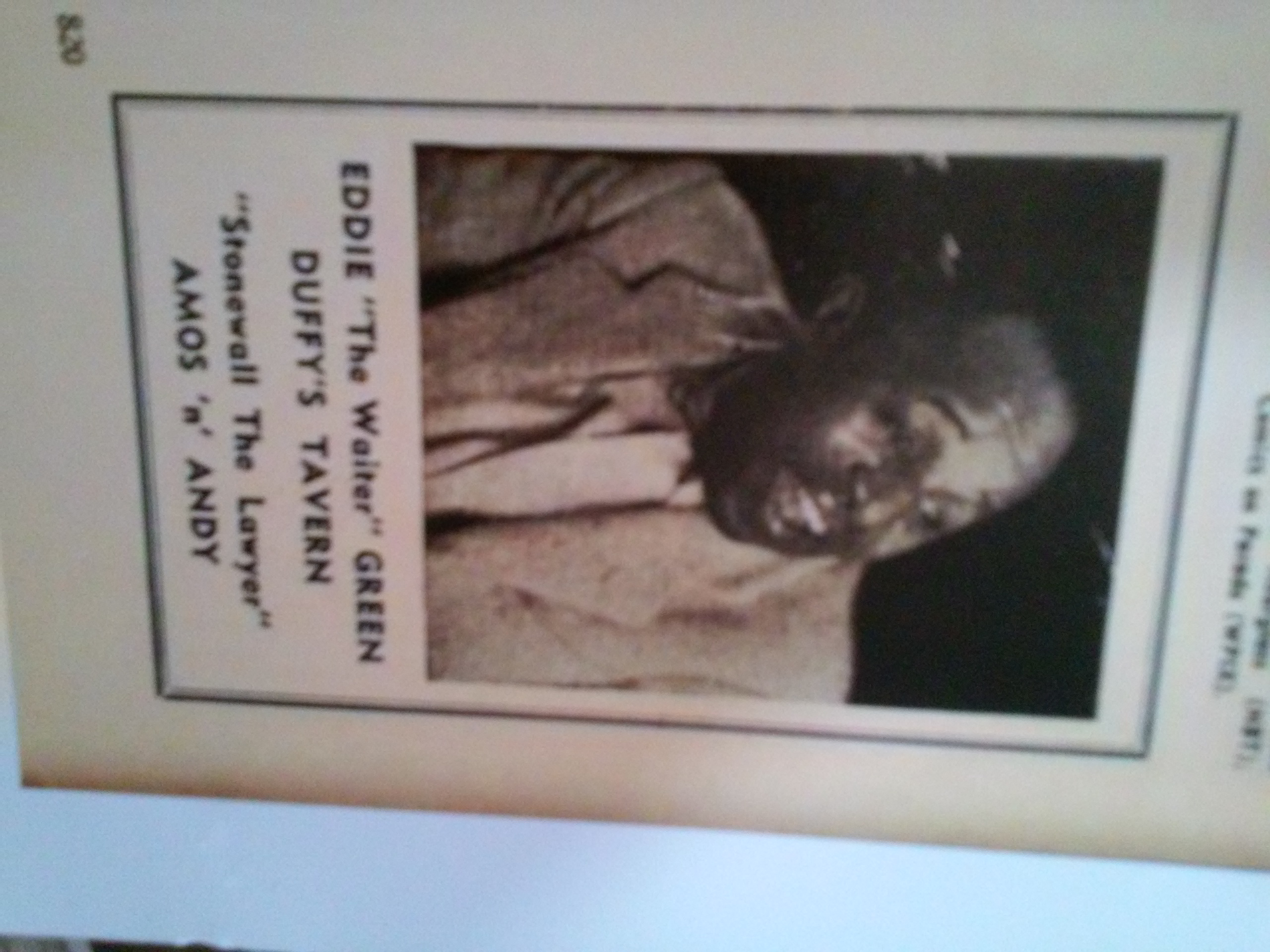
The show aired March 1, 1941. Once a week, Duffy’s Tavern entertained America’s citizen with the antics of Archie, the bartender, played by Ed Gardner, the creator of the show,  Eddie, the waiter played by my father Eddie Green, and the tavern regulars, Finnegan, played by Charles Cantor, and Miss Duffy, (the tavern owner’s daughter), played by Shirley Booth. Duffy of Duffy’s Tavern was never seen or heard, but the show would start off with Archie having a telephone conversation with his “boss”, Duffy.  The phone would ring, and Archie would answer:  “Hello, Duffy’s Tavern, where the elite meet to eat, Duffy ain’t here, Archie speaking, oh, hello, Duffy.”  Usually, the show featured a different celebrity guest each week.
Archie, the bartender, tended to misuse the English language and Eddie would usually call subtle attention to this fact:
Chapeau
Chapeau
EDDIE:  Mr. Archie, what happened to the sign?
ARCHIE:  What sign, Eddie.
EDDIE:  The “watch your hats and coats” sign.
ARCHIE:  There it is, only I rephrased the words so Clifton Fadiman would feel more at home here.  Read it.
EDDIE:  Maintain scrutiny of thy chapeaus and hats, umm, nice and confusing, ain’t it?
ARCHIE:  Yes, isn’t it?  It’s a quotation from Shakespeare.  Did you ever see any of Shakespeare’s
plays, Eddie?
EDDIE:  One, As You Like It.
ARCHIE:  Well?
EDDIE:  I didn’t like it.
Eddie would appear in every episode until his death in 1950, as well as appearing in the same role in the 1945 movie.
After Eddie got the role in Duffy’s Tavern, he was able to fulfill another dream of his, The Pittsburgh Courier reported “Eddie Green, comedian of radio and stage fame has opened a dramatic training school with services and classes for both amateurs and professionals.  The School is called Sepia Artists.”
Thank you for coming today.  I hope these stories of my father and his ambitions inspire you to go after your dreams, no matter how unattainable they may seem.

A REAL LAUGH RIOT

61FklgttwBL._SY450_ (2)

Otay.  Comes Midnight is the third picture my father made.  It is a story about two men (played by Eddie and Jimmie Baskette) who will receive $100 if they stay in Old Man Mose’s deserted house overnight in order to dig up his body and get the gold that has been placed under his body, and return it to the rightful owner.

It’s got really corny jokes in it such as:  1st person:  You know, old man Mose had a million dollars in gold ore.  2nd person:  Gold or what?

Supposedly, Eddie filmed this movie in a real haunted house in New Jersey.  The older residents of the neighborhood said they had heard weird groans and had seen a pale face pressed against the window.  One of the original cast members bowed out because he was too afraid to enter the house.

The movie had a great cast, though.

imagesK6TQ86AOJimmie Baskette, who you might remember as “Uncle Remus” or the man who sang “Zip A Dee Doo Da”.

imagesC02DE8VNAnd Amanda Randolph.  She was the first African-American performer to star in a regularly scheduled network television show, appearing in DuMont’s The Laytons.  Miss Randolph also   starred in “Beulah” in 1953.   She also appeared in 71 episodes of “Make Room for Daddy” with Danny Thomas. (Anybody out there remember at least one of these shows?)  I found the following information on the net, and it kind of upsets me:  Amanda Randolph appeared in a few Oscar Micheaux films.  The reason I get upset is also one of the reasons I am writing a book about my father.  Eddie made movies with the current  stars of his day, the same stars who appeared in Micheaux films and films produced by Whites, yet as far as the media goes, it is as though Eddie and his work with these actors has simply dropped through the floor.  I am a champion for my father.

The movie was a short, only twenty-one minutes, but it was a “real laugh-riot.”

Eddie, “Harlem’s favorite Hollywood comedian”  was quoted as saying this about his movie making skills:

“The first thing I try for,” he said, “is naturalness.  I write my own stories, building them around some incident that has been interesting, but not offensive.  Then I select the actors that I think are best suited to the parts, so that they need only be themselves.”

untitled (17)The movie had its first showing at the Brooklyn Apollo Theater at 1531 Fulton Avenue. The theater closed in 1965.

On Tuesday afternoon of July 30, 1940, if anyone was looking for a good short movie, according to the Television column, of The New York Sun, you could catch “Comes Midnight” at 3:55 p.m. that afternoon, right after the 3:48 p.m. film “Tour of the World’s Fair.”

Just before Eddie started making “Comes Midnight”, he went to Hollywood from New York to audition for the part of “Pork” in Gone With the Wind. He did not get the part, but, hey, nothing beats a failure but a try, right?

The update on my first try at writing a book is that I now have a 48,061 word manuscript, including title sheet, TOC, dedication, introduction, appendices and bibliography.  I’m done, basically, I know I am.  I am sending it piecemeal to my brother, who is helping me with editing, and, of course I am proofing also.  I will be looking for a “real” editor any day now.

I am still having fun.  And I thank you effusively for stopping by and hanging in.

RAISING MY HAND FOR LEFT-HANDERS DAY – And thoughts on Eddie

_69685453_obama_signing_afpHey!!! Today is left-handers day!

BABE_RUTHRemember Babe Ruth?  Left-handed.

I am left-handed.  When I was still in elementary school learning how to write, we had to have a writing pad to practice with.

images (2)

These pads were set up for right-handed people, because one was supposed to “slant” ones letters to the right.  And my mom was determined that when I wrote, first, I would not right with my left hand all twisted around (bad enough I was left-handed), and second, I would make those letters slant the right way.  My mother was right-handed and had beautiful hand-writing.  I still don’t think my writing slants correctly, but I do not write with my left hand curved around in a circle.  Only because I got hollered at if I did.  Anyhoo, my mom was just doing what she thought best, and I do not have a problem being left-handed.  Except when I have to sign one of those machines at the pharmacy after I slide my card-they are only made to turn to the left to make it easy for right-handed people to sign.

The other day I went to lunch with my daughter, Melony and my grandson, Edward, because Edward is moving to Nevada.  We had a ball.   As you can see, Edward is right-handed so I couldn’t sit too close to him as our elbows would crash together,  My original idea for writing a book about my father, Eddie Green, came to me when Edward was about six years old.  You can see how long he has been waiting for me to write this book.

meandedward

Of course, today, in regard to writing my book, I don’t actually write anything.images (3)

It has all been done on my trusty laptop.  And I think I am happy to say that I hope to be ready to hand over my manuscript for outside editing by the end of the month.  I think I am happy because I feel slightly queasy.  Although, this endeavor has never been about fame and fortune, only a way to share with Edward and others, that a person can achieve their goals against all odds.  Eddie did.

importfromphonejuly 132

More to come.  Thanks for stopping by.

I AM WRITING FOR POSITIVITY

bad-posture-cartoon-300x290

Hi there!!  The above picture is me working on the proofing and editing of the first draft of the book about my father, Eddie Green, Star of Stage, Screen and Radio from the 1920s through 1950.

darlene-blog-icon

It’s hard work!  And very time consuming!  And in the process of verifying information, I keep finding new information that just must go in the book!

For instance, I found my father’s 1917 WWI registration card and on the card where it says “Race”, Eddie wrote in “African”.  So I started reading about Africa and how Blacks first came to America and what happened after they got here, and I wound up on a site discussing Billie Holiday and her singing of the song “Strange Fruit.”  So I looked up “Strange Fruit” and found the story of the man who wrote the song.

Mr. Abel Meeropol (February 10, 1903-October 30, 1986), was a writer, teacher and song-writer.  Mr. Meeropol wrote this song after seeing a photo of the hanging of a black man because the photo affected him so profoundly, in regards to the inhumanity of racism.  Billie Holliday received the song through another source and recorded the song and Mr. Meerepool became well-known through this song.

Mr. Meerepol was a man of compassion.  He cared about people.   He was at the house of W. E. B. DuBois one evening and he met the orphaned sons of Julius and Ethel Rosenberg.  Mr. Meerepol and his wife got to know the boys and began to care for them and eventually adopted the boys.  Mr. Meeropol passed away due to complications of pneumonia at a Jewish Nursing Home in Massachusettes when he was 83 years old.

Mr. Meerepol was the type of person I would like to know.  His thought process is what attracts me and somehow ties in with what I have been trying to incorporate into my posts.  That even though there are awful things that happen in the life, there are people who genuinely care about others, no matter what their “color”.   It’s people working together.

Ok, then I was thinking about all the help I have had since I began my book project from people who don’t know me from Adam.  I have received legal help, help with radio scripts, cd’s, free books.  I talk with people in the U.K.  I have been feeling really grateful for the help I have received.  And just wishing the race question could be a little simpler.

So then I start thinking about what to put in my post today.  My last post dealt with Eddie’s first movie in 1939, so I decided to write about the fact that Eddie, while working in the “Hot Mikado”, and contemplating his next movie, was also in charge of “The Miss Sepia Beauty Contest” at the 1939 Worlds Fair.  But when I went on-line to get information, I could find nothing about Miss Sepia or Eddie at the World’s Fair.

5814421775_46ea0e10b6_b
The Perisphere NYWF 1939-40

However, at the New York Public Library there is archived information about:

39negr

All correspondence, speeches, exhibition material, pass and address lists, and financial records  relating to the planning and presentation of “Negro Week” at the New York World’s Fair, 1940, became the property of the growing Schomburg Collection in New York.

“Negro Week” consisted of festivals, exhibitions, song and dance recitals, choral and symphonic music, concerts, religious services, guest speakers and a children’s program.  Noted events during the week included a dramatic sketch of the “Life of Booker T. Washington” performed by the Rose McClendon Players and performances by the Karamu Dancers, Eubie Blake, W. C. Handy, James P. Johnson, Cecil Mack and Philippa Schuyler.  There were speeches by W.E.B. DuBois and L. D. Reddick relating to various aspects of black contributions to American culture.

There was also a beauty contest.  The Pittsburgh Courier printed “South Carolina Beauty Wins
“Miss Sepia America Crown”, with a picture and this blurb under the picture:  ” Helen Lewis, wins first prize honors in nation-wide beauty contest in New York.   The second photo presents “Miss (Sepia) America” and her running mates.   “New York is a great place,” Helen agrees in final photo, as she goes on sight-seeing tour with Eddie Green, master-mind behind contest.”

Back in the day, news about Black endeavors only made it into Black newspapers.  Things have changed.  We, people, make the changes together.

imagesThank you so much for stopping by.

NPR music, E. Blair npr.org 2012

Pittsburgh Courier, 1940


HANGING OUT AT THE WORLD’S FAIR

Hotmikado

Hello.  In the on-going saga of my research into my father’s life, as far as the book is concerned, I have completed my first draft.  So emotional…..I had to come to the end.  I cried for three days after I finished.  Going so thoroughly into Eddie’s life was almost like being there.  Of course, I still need to edit, add-on, delete, clean up the manuscript.  And I need to add the TOC and a Bibliography, etc.  But it is really happening!

In this blog, after showing you Eddie’s television debut in my last post, and after having already mentioned that Eddie opened a restaurant in Harlem in 1937, I am now at 1939.

“The  Hot Mikado” was a 1939 musical theatre adaptation of Gilbert and Sullivan’s “The Mikado”, with an African-American cast. Mike Todd originally produced it after the Federal Theatre Project turned down his offer to manage the WPA production of “The Swing Mikado” (another all-black adaptation of “The Mikado”).  In this production, Eddie played, Koko, the High Executioner (formerly a tailor).

Eddie Green
Eddie Green

The musical was first produced at the Broadhurst Theatre from March 23, 1939 to June 3, 1939, running for 85 performances. The original cast included Bill “Bojangles” Robinson as The Mikado; Frances Brock as Pitti-Sing; Rosa Brown as Katisha; Maurice Ellis as Pooh-Bah; Eddie Green as Ko-Ko; Rosetta LeNoire as Peep-Bo; James A. Lilliard as Pish-Tush; Bob Parrish as Nanki-Poo; Gwendolyn Reyde as Yum-Yum; Freddie Robinson as Messenger Boy; and Vincent Shields as Red Cap.

The musical was then produced at the 1939–1940 New York World’s Fair for two seasons and was reportedly one of the most popular attractions at the fair.

The video below, which I found on-line and which is extremely rare, is a silent filming of portions of the performance at the World’s Fair.  Eddie enters first as Ko-Ko, the Lord High Executioner, and then you see him standing next to Bill “Bojangles” Robinson, the “Mikado”.  Eddie appears in a few more places in the film.  As Ko-ko, Eddie performed a number of songs, including “Titwillow”, though this was not caught in the film.

“Titwillow”  occurs in a scene with the love interest, Katisha.  “Katisha wonders why death refuses to come and bring peace to her broken heart (she sings “Alone and Yet Alive),  and Ko-Ko springs into action, telling her that he’ll die on the spot if she doesn’t accept his love. Katisha claims no one has ever died of a broken heart, so Ko-Ko responds with the tragic tale of TitWillow, a little bird who wasted away due to blighted affection.”

My mom, Norma, told me about Eddie singing this song in a play, but never did I think I would actually see a portion of this play with my own eyes.  Picturing Eddie singing “Titwillow”, is not easy to do, but according to the Brooklyn Eagle on July 9, 1939:  “Anyway, he gets a hilarious twist into Ko-Ko that Messrs. G. and S. never thought of, and when he swings “Titwillow” usually comes close to stopping the show.”

Eddie was living in Harlem, by now with wife number three, or four, and he already had a grown daughter.  He had met my mother, through friends in Hollywood as he travelled a lot by then from New York, to L. A., but his home at the time was 138th Street in New York.  After the “Hot Mikado” Eddie would begin making his own films.

I love sharing this information.  It may be too old-timey for a younger generation, but keeping the achievements of those who came before us alive, allows the younger generation a chance to see from whence they have come and, also, to see how far they can go, especially with the knowledge, technology, and, yes, opportunities available today.

Hey, comments are welcome, keep comin’ back, and thanks, for stopping by.


Wikipedia


A Hodgepodge of Family and Historical Information


EDDIE GREEN OPENS
HARLEM RESTAURANT  August 7, 1937

Eddie Green, star of the radio.
stage and screen, has entered another
field with the opening of his
swanky and cozy Bar-Bee-Q shop on
Seventh avenue near 126th street In
the heart of the section frequented
by sportsmen, actors and artists of all
kinds. In the short space that it has
been opened, this food emporium has
become a rendezvous for celebrities of
the theatrical world.

The above is a quote from the New York Age newspaper, August 7, 1937.

Pop_ch3b_2_200
Paul Whiteman

In the Brooklyn Eagle, 1939 it says:  Eddie “Is one of Harlem’s busiest citizens.  Outside of theater and radio work, owns and operates two barbeque emporiums.  Serves nothing but spareribs.  Says Paul Whiteman is his best customer at the one on 7th Avenue.


Eddie came from East Baltimore’s alley house area where he was born in 1891, and worked himself up to owning two restaurants in Harlem.

I watched the funeral for B. B. King today and the Rev. Herron Wilson, said, in his eulogy, talking about life and death and conduct,  “It’s not where you come from, it’s where you’re headed.”  So far, Eddie is headed in a good direction.

Eddie, at this time, was married to a lady by the name of Constance from Newark, New Jersey, happily married according to the newspaper.  He hadn’t met my mother, yet.

I decided to insert her into this post since they would meet soon, and because mom was pursuing her own career in the entertainment field at about this same time.

Found this particular article today, just by chance, so I thought I could put it here as a bit of background on my mom’s home life.  In 1933, when my mom was ten years old, she found out that the man who she thought was her father, was not.  In those days, everybody’s business got in the papers, I guess just like today.  This is what happened with my mom’s mother, Sinclaire and her husband, Alfonso Murdock:

WHITE MAN NAMED CORRESPONDENT
IN SENSATIONAL DIVORCE SUIT
Californian Accused Wife of Remaining Away From
Home On Pretext of Caring For Sick Friends

LOS ANGELES, CaL, June 8.—(ANP)—Declaring that
his wife had remained away from home weeks at a time residing
in San Bernardino, Cal., Alfonso Murdock, pioneer
and widely known in social circles, was granted a divorce
Wednesday by Judge Harry F. Sewell, from Sinclaire White
Murdock.

Mr. Murdook testified that his
wife would come home only to get
fresh clothes and return to San
Bernardino. He said that he
thought at first that his wife was
caring for a sick friend and did
not learn different until he went
there and made the discovery that
his wife was attending different
places in company with Joe Amato,
white.

This was the prelude to me learning who my mother’s biological father was.  In fact, my mother was not 100% certain before she died and I have only verified who Amato was within the last few years.  That he was indeed white, an Italian gentleman that her mother had been seeing on the side for years and that he was my mother’s father.    Sinclaire eventually took the name Amato for herself and my mom.   At ten years of age my mother wasn’t quite sure what had transpired, except that Murdock was gone and never wanted to see them again and Joe became a permanent fixture.  And she had to change her last name from Murdock to Amato.

Sinclaire, my grandmother, was a “pillar” of the church.  She taught violin and piano.  She taught my mother.  Here is an article from the Los Angeles California Eagle:

Music loving Southlanders
crowded to capacity the auditorium of the Zion Hill Church
when Professor William T. Wilkins.
director of the well-known
Wilkin’s Piano Academy presented his show.
With the appearance of Professor Wilkins on
the stage there came a deafening
round of applause … he was
ably assisted by Mme. Sinclair White Amato, violin virtuoso,
whose several violin pupils were
also a part of the splendid programme . . . too many numbers
to mention each one in detail; but
many received an unusual
amount of applause. I refer to the violin playing of little Norma
Anne Amato . . . .
In 1937 Eddie was in the news in New York, and mom was beginning to be mentioned in the news in Los Angeles.  Mom was 14.  Eddie was 46.  They would not meet for another three years.

My mom was also in pursuit of a career on the stage as an opera singer and as she got older she began to sing and play the piano at weddings at a place called the Wilfandel Club in the Historic West Adams District, while in serious operatic study.

And here we have an extra bit of Black History-because of course I had to look up the Wilfandel Club and I found that the architect was Mr. Paul R. Williams. PAUL_R._WILLIAMSC_A.I.A._-_NOTED_ARCHITECT_-_NARA_-_53569_Straightened

Paul Revere Williams,  (February 18, 1894 – January 23, 1980) was an American architect based in Los Angeles, California. He practiced largely in Southern California, and designed the homes of numerous celebrities, including Lon Chaney, Bill “Bojangles” Robinson and Frank Sinatra. He also designed many public and private buildings, such as The Kenneth Hahn Hall of Administration and the Los Angeles County Courthouse and the First African Methodist Episcopalian (FAME) church in Los Angeles.  Who knew?  Mom did, she mentioned to me a few times how unfortunate it was that Paul Williams did not get the recognition he deserved for his works.

l
Wilfandlel Club on Adams Blvd.


The thing about this research I am doing is that I can in almost every instance link Eddie up with all the folks I mention.  And I found an article that does just that in this instance also:

At the 68th Anniversary celebration of  the Los Angeles California Eagle , on April 3, 1947, Paul R. Williams was the main speaker and Eddie Green, of “Duffy’s Tavern”, was the emcee for a sparkling floor show featuring Mabel Fairbanks, ice-skating star, the Basin Street Boys, and Phil Moore, singer and composer.

In 2010 when my mom died, she lived on Adams and St. Andrews Place, within walking distance from the Winfandel Club’s building, which still stands.

Thank you so much for dropping by.


STAYING FOCUSED ON THE GOOD STUFF

“A Good Man Is Hard to Find”, written by Eddie Green and popularized by the singer Bessie Smith in 1927.

Hi there!  I missed out.  I wanted to watch “Bessie” with Queen Latifah on HBO, May 16th, but my landlady cancelled our cable, boo hoo.  I received a comment today about “Bessie”, so of course I had to see if I could find it on the net.  For this post, however, I decided to post a video of Bessie Smith singing the song my father wrote way back in 1917.

There were also a few other people who recorded the song, for instance:

A GOOD MAN IS HARD TO FIND
By Eddie Green
Marion Harris – 1919
Wilbur C. Sweatman’s Jazz Orchestra – 1919
Viola McCoy – 1927
Eddie Condon & His Band – 1940
Butch Stone – 1942
Frank Sinatra – 1951
George Lewis – 1953
Big Maybelle – 1956
Brenda Lee – 1959
Also recorded by: Trinity; Di Anne Price; Bix Beiderbecke; Fats Waller; Rosemary Clooney; Les Brown;
Champion Jack Dupree; Barbra Streisand; Frances Faye; Hank Thompson; Lizzie Miles; Louis Prima;
Carol Channing; Nancy Wilson; Ralph Sutton; Juanita Hall; Kid Ory; Judith Durham; Dorothy Loudon;
Bob Wills, to name a few.

I should be finished with the first draft of my book about Eddie at the beginning of June.  I have the feeling that this year will be a good time for this book to become available.  To my knowledge, Eddie’s song has been performed in two recent movies, “Bessie” and “Blue Jasmin” (a Woody Allen movie).  I love the fact that this song has endured and remained relevant all these years.  Eddie died in 1950, so he was only aware of a few of these people performing the song.   While he was alive  he knew a few of the people on the above list, like Fats Waller and Frank Sinatra.  Oh yeah, and Sophie Tucker, he knew Sophie, she used Eddie’s song as her “torch” song (if you are too young to remember Sophie Tucker, look her up, she was what they called a “real hot mama” back in the day.

My father continues to provide the inspiration that helps me stay focused on this book-writing process, as do those who read my posts and those who comment.    Eddie has shown me that there are obstacles in life, Eddie had them as a Black man living his life in the early 20th century through 1950, but he never stopped moving forward,  he went on to write 29 more songs, to perform on Broadway and radio, and even to write, produce and star in his own movies, as I have mentioned in previous posts and will elaborate on in future posts.  I am experiencing a sense of optimism through tracing Eddie’s life and I hope I am able to pass this feeling on.  Thanks so much for stopping by.

1