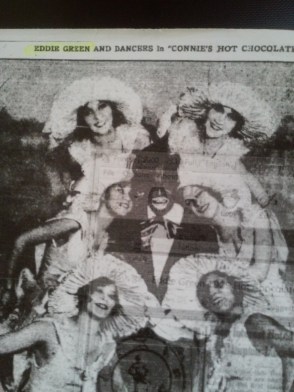
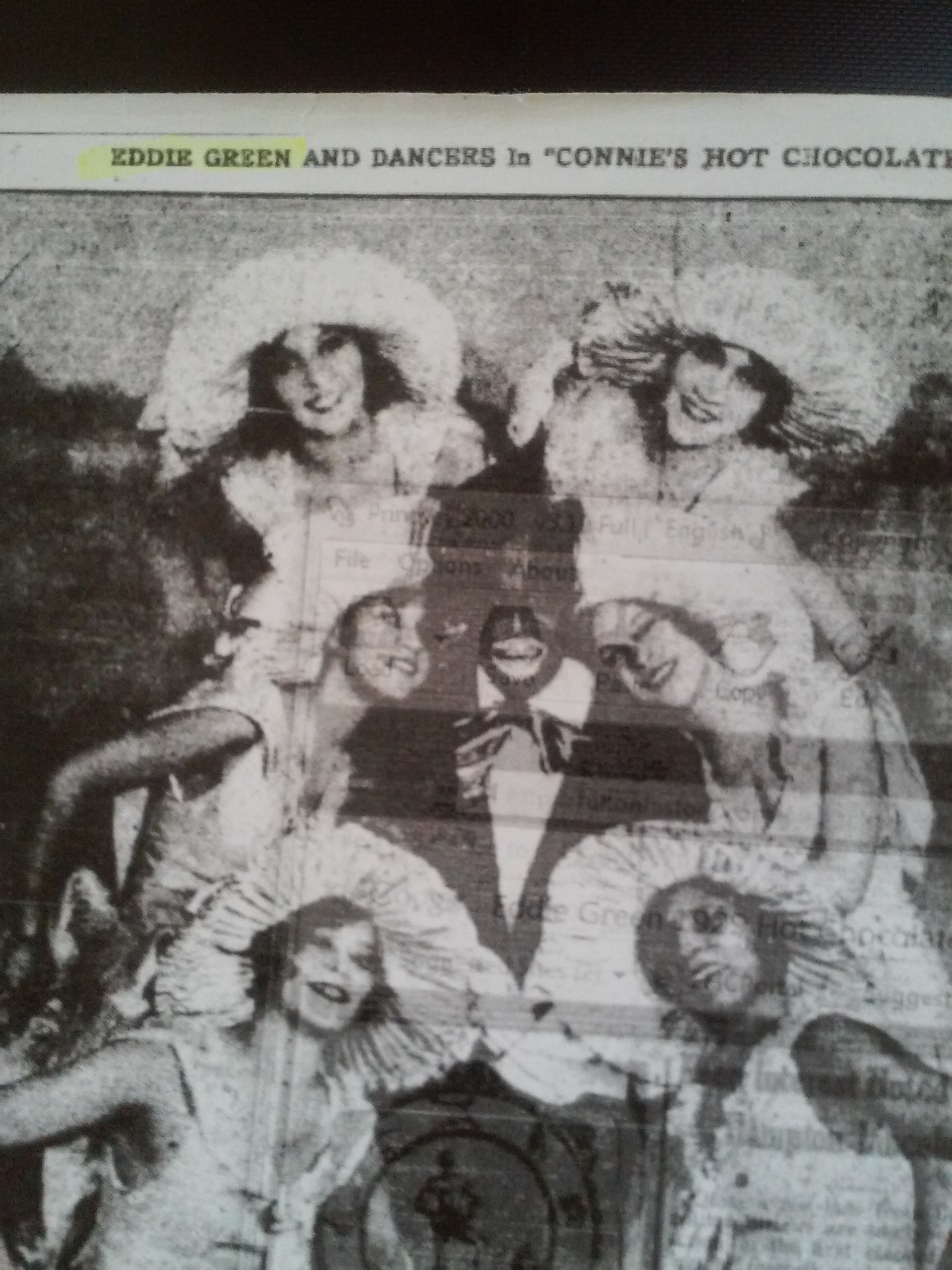
 Introducing Eddie Green and Dancers in “Connie’s Hot Chocolates”, in its fourth month at the Hudson Theater in New York, 1929.
When I was young, about ten years old, my mom told me that my father said that he had never performed in blackface. The way she said it, sounded to me like she was saying, he would not stoop so low. But, maybe, he told her he would never perform in blackface again, as he had already been there and done that, because clearly Eddie did perform in blackface as the above picture shows. I found this picture while searching the net and I was shocked. Like Mr. Fallon says, I was like “Eww!” Which is where my mindset was about this type of performing. Whether it stems from societal influences or parental influences, I realized, at that time, that I was embarrassed for Eddie. And, I did not know how I was going to be able to present this to the public.
Hm. Obviously, I had a problem. One minute I am so proud of my father and the next I want to hide a portion of his life. I had to take a good look into my thought processes. I had to educate myself about the business of performing in blackface. So I started reading.
I learned that way back in the 1700s actors were performing in blackface-supposedly as an exaggerated, humorous imitation of blacks as they were perceived in those times. I learned that minstrelsy became wildly popular as time went on, with troupes performing in circuses in the US and the UK, and that a circus was not considered complete without at least one minstrelsy act. I learned that at one time blacks were not allowed to perform in blackface on stage with whites. It was exclusively a white thing. I learned that though whites performing in blackface was basically about making a black person seem ridiculous, it also assured that a black person had no opportunity of performing on stage and, maybe, becoming famous. This, as I now know was to change.
I learned that George M. Cohan, young author and actor, who became famous, appeared in blackface in 1891. he played in his father’s production of “The Molly Maguires”; and he was co-proprietor and part producer of Cohan and Harris’ Minstrels, the first performance of which was at the Apollo Theatre, Atlantic City, N. J., July 27, 1908.*
I learned the by the 19th century, blacks were allowed to appear on stage with whites only if they wore blackface. They painted their lips white and their costumes were usually gaudy combinations of formal wear; swallowtail coats, striped trousers, and top hats. I learned that Bert Williams popped up, and of course, became famous. Mr. Williams was the most popular blackface comedians of his day,and, was also the highest-paid in 1912, working for Ziegfeld Follies after signing a 3-year contract for $62,400 or $1.5 million today. ( Strausbaugh 2006, p. 136) I learned that It was through blackface minstrelsy that African American performers first entered the mainstream of American show business.*
I went back to some of the articles I have found in which Eddie’s performances were reviewed. In an article of Stage and Screen it says: “Eddie Green, late star of “Plantation Days, as he was billed on the program, was also exceptionally good. His was a blackface number, dancing and singing and his droll manner won fave. His talking song “Previous” was enjoyed. He also did some clever dancing.” The Utica Herald says “Eddie Green scores a hit with his softshoe dancing.” A blurb in The Billboard from 1921 says, Eddie “Simp” (his nickname to those who knew and loved him) Green, the acrobatic dancer is singing his own songs with “The Girls De Looks” Burlesque Show. Eddie is a good business man and has his own publishing business. . . . He is contracted with the show for the next two years.”
Today, my personal perception of Eddie’s life as a performer has changed drastically. My father was not degrading himself by doing blackface, he was presenting himself as the actor that he was in the makeup expected for the roles he played. He had a plan. He knew where he was going and what it was going to take to get there. What to some was disgraceful, provided Eddie with a stepping stone to a better life. He constantly received kudos. I discovered new information from these articles, also. Mom never told me that Eddie was an acrobatic dancer? A softshoe dancer? Really. Eddie was exceptionally good at whatever he put his hand to. That is the point.
Eddie wrote a letter to The Billboard in 1920 to let his fellow actors know about the most convenient place to get a room, the Hotel Francis, opposite the New York City Depot. The editor of The Billboard had this to say about that letter: “The following letter from Eddie (Simp) Green. . . . is beyond doubt the most unselfish communication that has come to us since the department has started, . . . Eddie Green writes something besides letters. He wrote “A Good Man is Hard To Find”, “Algiers”, and the “Blind Man’s Blues. He also has written himself into a class of regular fellows with the above letter.”
A class of regular fellows. A good man. A man of many talents. My father, of whom I am proud.
p.s. I forgot to mention, is he surrounded by beautiful women, or what?
*Excerpts from Monarchs of Minstrelsy (1911)
by Edward Le Roy Rice (1871-1940)

 pininthetush