
 On September 10, 1942 Eddie Green, my father, opened a dramatic training school in this building at 2352 Seventh Avenue, New York City. The school, called Sepia Artists offered services and classes for both amateurs and professionals. The Pittsburgh-Courier newspaper referred to Eddie in it’s article about the school as a comedian of radio and stage fame. I think it was a short-lived endeavor because in 1943 Eddie filed for bankruptcy. Before this from 1939 through 1941 Eddie was making movies and planning plans, so he had some money.

In fact, there must have been enough money to hire this gentleman, Chauncey Northern. According to an article just before Christmas of 1939, Mr. Northern a recognized voice specialist and coach joined Eddie’s motion picture company as head of it’s music department. In this capacity he would have charge of the arranging of voices for Eddie’s Sepia-Art Pictures choir which would be a permanent feature of the organization, New York Age, December 23, 1939. The article goes on to say that Mr. Northern’s studio was located in Carnegie Hall and that his studio was the mecca of many of the great artists of today.
In researching Chauncey Northern I learned that he was one of the first black opera singers (a tenor) to appear on the Italian stage, making his debut in the 1920’s at the Teatro Politeana in Naples and that he studied at the Juliard School of Music. I did not spend much time trying to find info on Mr. Northern while I was writing the book about my father, but today while trying to come up with a blog post I decided to dig a little further.
it’s amazing what can be found if you are really paying attention. I learned that in 1924 he wrote the music for the University of Hampton’s Alma Mater, one of the top historically black universities in the world.
 An interesting fact is that this tree, The Emancipation Oak, stands near the entrance of the Hampton University campus and is a lasting symbol of the university’s rich heritage and perseverance. The peaceful shade of the young oak served as the first classroom for newly freed men and women, eager for an education. Mrs. Mary Peake, daughter of a freed colored woman and a Frenchman, conducted the first lessons taught under the oak located on the University’s campus. Classes continued with the The Butler School, which was constructed in 1863 next to the oak. One day in 1863, the members of the Virginia Peninsula’s black community gathered to hear a prayer answered. The Emancipation Oak was the site of the first Southern reading of President Lincoln’s Emancipation Proclamation, an act which accelerated the demand for African-American education. And Chauncey Northern was a part of this history. And Eddie was a part of his history. And I am a part of their history. Awesome.
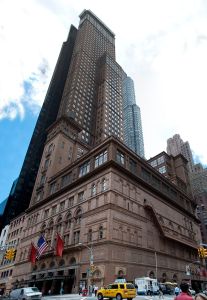 After Mr, Northern’s debut in Naples, he remained in Europe until 1937, when he returned to the United States and established the Northern Vocal Arts School at Carnegie Hall, where he taught until his death in 1992. The main hall of Carnegie Hall was home to the performances of the New York Philharmonic from 1892 until 1962. The building also contains the Carnegie Hall Archives, established in 1986, and the Rose Museum, which opened in 1991. Until 2009 studios above the Hall contained working spaces for artists in the performing and graphic arts including music, drama, dance, as well as architects, playwrights, literary agents, photographers and painters. The spaces were unusual in being purpose-designed for artistic work, with very high ceilings, skylights and large windows for natural light. In 1906 both Mark Twain and Booker T. Washington spoke here. Chauncey Northern had his studio here!
Today a person has to dig to find out information on Mr. Northern, just like I had to dig to get my information on Eddie, even though he was a major player in entertainment. Most of the information of pioneering Black people can only be found in Black newspaper archives. However, I did find a Facebook page for a woman who knew Mr. Northern and who is still active today. Hopefully she will “friend” me. If not, she has a web site. History is fascinating. I love research. I can go back in time to 1939 and I can travel the world, visit universities and meet new people right here with my laptop.
Hey, thanks, for stopping by.
Info on Chauncey Northern and Carnegie Hall courtesy of the World Wide Web
For the Biography of Eddie Green Visit t hen click “Shop Now”: https://www.facebook.com/elvagreenbookpage/
 An internet map. If my father was alive today he would be over the moon about the internet. According to the old Los Angeles California Eagle newspaper Eddie said it “was thrilling to talk to people all over the world”, and he said this way back in 1946 when asked about his hobby ham radio.
 This is an example of a ham radio set-up. Eddie had one in our basement on 2nd Avenue in Los Angeles in the 40s. When Eddie and my mom “motored” across the U.S. Eddie could also broadcast from his automobile. Mom said that he spent a lot of time in that basement talking to people from all walks of life. Eddie’s call letters were W2AKM. He got his ham radio license in 1925. A newspaper reporter saw his set-up at home and called it a private radio station!
 By 1939 Eddie had a ham radio set-up at this theater, the Broadhurst on 44th Street in New York where he was performing as KoKo, The High Executioneer in Mike Todd’s Hot Mikado, as well as a set-up in his apartment at 120 W. 138th Street in New York (W2AKM—Edward Green, 120 W. 138 St., N. Y. City. Radio Amateur Call Book Magazine). During this same time the 1939 World’s Fair was happening and Eddie spent a lot of time commuting between Harlem and Flushing Meadows just so he could spend time at the communications exhibits. I read that he had been cited by the government for his work with ham radio, and had written a few articles, but I could not find any actual corroboration.
 Eddie continued this hobby until his passing in 1950. By the time he was doing Amos n Andy shows he would communicate with Freeman Gosden (Amos) in Beverly Hills, another ham operator, with engineers at NBC and with others around the country. I imagine he would be happy to know that according to an estimate made in 2011 by the American Radio Relay League, two million people throughout the world are regularly involved with amateur radio. This is not a good picture but I put it in because Eddie’s call letters for his station are the teeny pin on his lapel in the bottom right hand corner.
 I have a few newer followers to this blog. So I am posting a bit of information, some of which is in my book, for the newer people, though I have added new information in this post that I have only found today. I have also included a YouTube video, so there should be something for everybody. Say Hi to this guy Eddie Green, my father. I began this blog in order to chronicle my research into and my writing of his biography. A rags-to-riches story of a man who was a composer, Broadway and movie star, an Old Time Radio icon and filmmaker. The book has been published and has even won a Foreword INDIES 2016 Bronze Book Award (yay!!). I am in the process now of visiting libraries and Rotary Clubs and other venues to give presentations. I have been interviewed on podcasts and a National Radio program, and on YesterdayUSA. And I am continuing to post on this blog, one reason being that I am still learning new information about my father, another is that I continue to make good friends as well as good contacts. And I continue to discover that there are lots of people in this world who knew of my father and wanted to learn more.
 In 1944, the song was revived by Tin Pan Alley songwriters Hy Zaret and Lou Singer in a more bluesy format as “One Meat Ball”, and the recording by Josh White became one of the biggest hits of the early part of the American folk music revival. The song has been performed by The Andrews Sisters, Bing Crosby, Jimmy Savo, Lightnin’ Hopkins, and others. Hy Zaret lived to be 99 years old, dying in 2007.
 When I began writing the biography on my father, Eddie Green, I wanted to use a quote from Langston Hughes in the foreword but had to forget that idea as I could not get permission. I can, however, use a portion of an article Mr. Hughes wrote which mentioned my father. James Mercer Langston Hughes (February 1, 1902 – May 22, 1967) was an American poet, social activist, novelist, playwright, and columnist. He was one of the earliest innovators of the then-new literary art form called jazz poetry. Hughes is best known as a leader of the Harlem Renaissance in New York City from the mid-1950s to the mid-1960s.
 In the Hughes article (not the one pictured here) he was writing about “sympathetic outlets to new Negro playwrights”. He wanted to stimulate growth of a real Negro theater. He believed that while White playwrights could be skilled or sincere they could not catch “the little graduation that give a negro life its drama.” He links the comedy stage thus: “Perhaps comedy is the pitfall of the theater. Exaggeration of racial types the overstressing of eccentricities of regional speech frequently dominate comedy especially in music halls”. He goes on to say, “Nevertheless just as out of serious plays has come a Robeson, so from the minstral vaudeville musical stage have come some very talented Negro comedians, Bert Williams, Pigmeat, Jackie Mabley, Eddie Green.” (New York Age May, 1953). Notice in the article to the left Eddie, Jackie, and Pigmeat are all listed as appearing with the sixteen Apollo Rockettes back in the early 1900s.
 Here is a compilation of some of the scenes from Eddie’s movies in 1939. In a 1940 Baltimore article written by Lillian Johnson she headed the article with: As a Comedian, He’s Very Funny; As a Business Man, He’s Very Sensible and Comedy is a Business. Lillian said “The fact that Eddie is so funny on the screen, stage, and radio is due to the highly intelligent and efficient manner in which he conducts his work.”
 Ok, so here I was a short while ago, ready to go into a radio sound-proof booth to be interviewed by Mr. John L. Hanson of the NPR radio program In Black America. An honor. Well, for your listening enjoyment you can click on this link he sent me and listen for yourself (my daughter says I sound so good over the air.) http://kut.org/post/elva-diane-green-her-father-eddie-green-pioneering-black-filmmaker-and-songwriter.
 And I have my father, Eddie Green as an example of how to get things done. When he wanted to get somewhere, he did. In his words: “It was during the year 1929. I was living in New York and trying every kind of theatrical job that was available. I had already played all kinds of Vaudeville, Burlesque, musical comedy and a few small radio programs “In the meantime, I was so busy working here and there and doing a bit of writing on the side that I did not notice my own advancement.” When Eddie wanted to open his own movie studio he did: From the local newspaper “Upon returning to the West Coast, Eddie announced the opening of his new film company, Sepia Productions, Inc., with himself as President.”
 I have been studying the whys and wherefores of the Declaration of Independence. Studying what was meant by using the words Life, Liberty and the Pursuit of Happiness. On Wikipedia one can read about what others who came along after the signing of the Declaration think about what the word happiness meant to those signers. Happiness these days is alluding me. Not because of the worlds difficulties, though these difficulties add to my sadness. But because of my grandson. His personal grown-man problems. Mainly due to his pursuit of happiness.
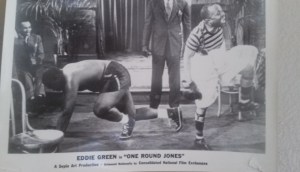 I suppose that is one reason Eddie became a comedian. He was pursuing his own happiness. Here he is being happy. (He is the silly guy in the stripped shirt). This is a scene from his movie One Round Jones (1941). The Press Sheet reads: One Round Jones is the story of a night club owner who undertakes to build his business by offering $50 to anyone who can go one-round with his “mystery fighter.” Of course, Eddie is the goat. He climbs into the ring shaking like a dish of Jell-O but when he climbs out he’s got the money and the other fighter’s girl.”



 pininthetush