


Welcome. June is Black Music Month. In 2017 I wrote an article for an online magazine Unlikely Stories Mark V BlackArtMatters – this post uses a portion of that article.
My father, Eddie Green, wrote many songs in the early 1900s. His 1921 writings included “You Can Read My Letters, But You Sure Can’t Read My Mind,” “You’ve Got What I Like,” and “The World’s All Wrong.” Miss Sophie Tucker, known as “The Red-Hot Mama”, became interested in Eddie’s songs and commissioned special band arrangements for “The World’s All Wrong,” and “You Can Read My Letters, But You Sure Can’t Read My Mind,” she also had Eddie write a special version of “You’ve Got What I Like” for one of her performances.
Eddie collaborated with Cuney Conner, a music writer and musical director who wrote the music for “The World’s All Wrong.” The song is about a man who has been searching for his sweetheart and finds her at her dress rehearsal where she appears as a chorus girl. He tries to talk her into coming back to him but she wants nothing to do with him, until he happens to tell her that he has come into an inheritance. The upshot of the song is that it is not the world that is wrong but the people in it.
The words to the “The World’s All Wrong” can be found in the Margaret Herrick Library in Beverly Hills, California. The Margaret Herrick Library houses a world-renowned, non-circulating reference and research collection devoted to the history and development of the motion picture as an art form and an industry. This song is included in the library’s archives because Eddie used it in one of his movies, Dress Rehearsal (1939).
Eddie’s very first song was, however, destined to become a hit, “A Good Man is Hard to Find” written in 1917, is still being recorded one hundred years later. “A Good Man is Hard to Find,” was copyrighted by Eddie on December 28, 1917. His song writing style was relevant to the times in which he was living and in 1917 the blues was becoming a major part of the music scene. “A Good Man is Hard to Find” was written in a bluesy style, probably so that it would better relate to the general public. Not being psychic, Eddie could not possibly have known to what heights this song would reach. He had written one of the Jazz standards of the Roaring 20s.
Eddie sold his song in 1918 to Pace & Handy. W. C. Handy, musician, met Harry H. Pace at the Solvent Savings Bank in Memphis. Pace was the valedictorian of his graduating class at Atlanta University and a student of W. E. B. Du Bois. By the time of their meeting, Pace had already demonstrated a strong understanding of business. He earned his reputation by recreating failing businesses. Handy liked him, and Pace later became the manager of Pace & Handy Sheet Music. His published musical works were groundbreaking because of his ethnicity, and he was among the first blacks to achieve economic success from publishing. By January 1919, Pace & Handy were advertising to supply performers with knock-out material, in the way of current songs, one of which was the 1,000,000 copy hit, sure-fire applause getter “A Good Man is Hard to Find.”
In 2017 at my book signing, my niece gave Eddie and I the great honor of singing “A Good Man Is Hard To Find” in the style of Bessie Smith. Unfortunately, I have not been able to figure out how to get Kristina’s version on this blog, but here is Bessie’s. Stay tuned for Kristina’s version and thanks, for stopping by.

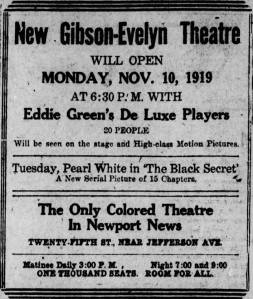 While touring as a “Boy Magician” over the years Eddie added songwriting to his list of accomplishments. He wrote “A Good Man is Hard to Find” which he used in 1919 when he took his own show on tour. The show included singing, dancing girls and comedy. While in St. Louis with this show he saw an ad in the local Variety paper for a comic. Eddie sent an outstanding reply and was invited to become a part of a vaudeville show in New York. His performances here and in Burlesque working at the 125th Apollo, earned him inclusion into a hit Broadway musical Hot Chocolates by 1929.
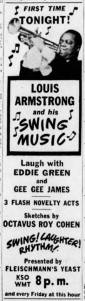
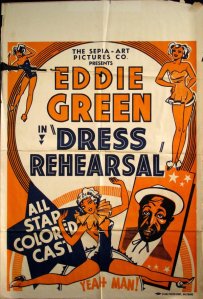 When I started this blog Eddie had almost been completely forgotten. Almost. Despite his many accomplishments in the entertainment world and the business world, despite the many friends he made and how widely he became known, beside myself, there were not a lot of people remembering that old comic, Eddie Green. I have written a biography about my father. (Eddie Green The Rise of an Early 1900s Black American Entertainment Pioneer, get it on Amazon). Since I wrote the book I have had someone tell me that I stopped the process of my father being erased from history. Wow.
 Hey, thanks, for stopping by.
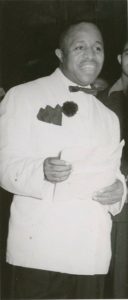 I like to think I am like my father. He was a happy man. He had a great smile. He loved to make people laugh. He was a good friend, with a helpful attitude. And he liked people, period. He was a family man, too. He was married 4 times. Had two daughters, one in 1911 and then me in the 40s. He told the Brooklyn Eagle in 1939 that “the depression doesn’t worry him. He’s happily married (3rd wife), Daughter Hilda is grown up and starting to follow him in show business. He’s got his work, his radio to tinker with and he’s the proud possessor of the first television set in Harlem.” At the time of this interview he was appearing in Mike Todd’s Hot Mikado. As Koko he sang “Titwillow” (Stars Over Broadway, Star Tone (M) ST 214 (Eddie Green with orchestra conducted by William Parson) The Brooklyn Eagle article said he had a “perpetual beaming smile.”
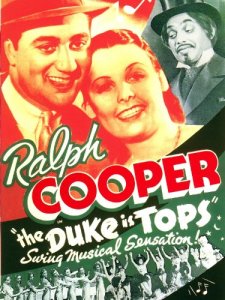 Like my father, Eddie Green, Cooper was also a filmmaker. Meaning he wrote, directed and starred in his own movies. In the late 1930s he was making movies during Oscar Micheaux’s filmmaking time (Micheaux began making films in 1915). He wrote, directed, produced or starred in at least fifteen films. My father began making his films in 1939, right about the time Cooper left filmmaking. In 1937, Cooper formed Million Dollar Productions with black actor George Randol and white producers Harry Popkin and his brother Leo Popkin to produce race films.
 Ralph and my father appeared on the same bill during those early days; their names are kind of close to the bottom of the ad as they had not “blown up” yet. But they must have met backstage. Maybe Eddie talked to him about making movies someday. Both Eddie and Ralph were successful in their chosen pursuits. Through their own talent and hard work. When it was truly a struggle for a Black man to get ahead. I salute my father and Ralph Cooper and their own special uniqueness in bringing a little entertainment into the lives of others.
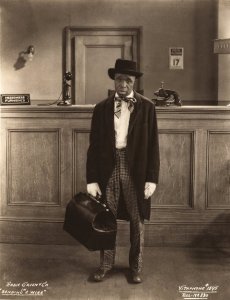 According to today’s news, a new Black female movie director who has just finished directing Madeleine L’Engle’s “A Wrinkle In Time”, has been chosen to direct Jack Kirby’s “New Gods” for Warner Bros. I have been following her rise, and when I read the words Warner Bros., my father flashed into my mind because he did a Warner Bros. Vitaphone Film.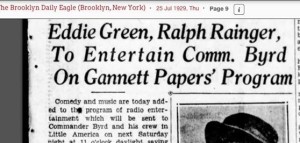
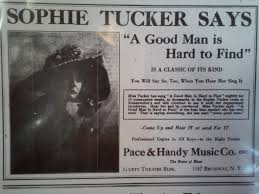 On March 7th I had the best time doing a book talk at a local library here in Los Angeles. There was a nice group of people, snacks and tea and I was prepared. But, I was a bit nervous. I think I was worried about how “cute” I was, or not. I said “uh” a lot. After I shared the Toastmaster tips I was not following I got a laugh and I felt more at ease. I spoke for almost an hour. I passed photos around. One thing I have noticed is that once the audience begins to hear my father’s rags-to-riches story they become truly interested. They are amazed in some instances and sad in others. And they laugh. His story is inspiring. I love it. I have begun to want to be a Cheerleader for Trailblazers, not only Eddie, but others. I find that keeping in mind those that paved the way is a motivating factor for future endeavors. One of the things I talked about was that Eddie wrote the song “A Good Man is Hard to Find” way back in 1917. During the early 1920s Sophie Tucker loved this song so much she sang it in her nightclub act every night for ten weeks.
 Depending on who was talking about it, the song was listed as a Blues song or a Fox Trot or as Jazz. Sophie did a Blues version. As you can see by this poster she was a red hot mamma, so you can imagine how she must have sang that song. After my talk at the library, a few of the people stayed around to talk with me. One of them was a gentleman who just happened to be a big Sophie Tucker fan and an Eddie Green fan. When I got home he had posted this message on my Facebook Book Page: “Dear Miss Green, I attended your talk at Memorial Library yesterday afternoon and enjoyed it very much. I am going to order the book from Amazon and look forward to reading it. Good luck to you and thank you for bringing Eddie Green back to life.” Now, of course, he did not know it but basically this is exactly what I was hoping to do with my book. Bring Eddie back to the fore of the public’s mind because of his many achievements during his lifetime which people have forgotten. What a treat to have spoken with this man.
 The gentleman also told me a story I had never heard before about Sophie Tucker and Alberta Hunter. Alberta Hunter was an American jazz singer and songwriter who had a successful career from the early 1920s to the late 1950s. He saw Alberta Hunter on a late night talk show probably in the 60s or 70s. She was discussing the night she decided to sing “Sophie’s” song-A Good Man is Hard to Find-on stage. And so she did. With Sophie Tucker sitting right there in the audience. So there!! They each participated in making the song a big hit. The gentleman who told me this story also said he looked and looked for a Sophie Tucker recorded version and finally found it just by happenstance. And here he was now talking to the daughter of the man who wrote the song. This is one of the reasons I love doing these talks. I get to meet and connect with people who know about my father or want to know. Since Eddie died when I was three this is so special for me.
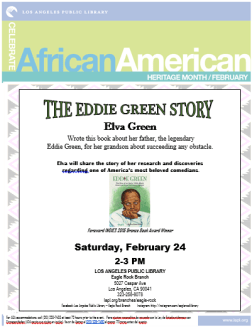 Hello again. Here is a poster announcing my next appearance at a local library here in Los Angeles, the Eagle Rock Branch Library to share my father’s inspirational story. When I started this book writing journey my thoughts never went further than getting the writing done and getting a publisher. The idea of being asked to give a presentation at a library never entered my mind. I simply knew that I wanted to put my father’s story down on paper and present it to my grandson. My doctor asked me the other day how I wrote the book-did I have any help? I realized that this is one of the first questions people ask. So this past week I sat down and wrote out what I did to get this book written. Once I took a good look at what entails getting a book written, I was in awe of myself. I am beginning to realize what a big deal this is.
 Here I am last week speaking about writing the biography of my father. I have pictures, we played a cd of a comedy skit with Lena Horne and I was happy to be there. Especially as there were two grammar school girls sitting in the front row. Paying attention. Sitting still. One little girl would take a photo I handed out, show it to her friend, have a little discussion and place the photo on the table. They even contributed to the discussion when I managed to touch on something currently relevant. I loved talking to them and assuring them that they too could achieve their dreams, like Eddie, if they learned as much as they could and believed in themselves.
 Of course I told these young girls that I started my research in the Central Library in Los Angeles. That I went to the library a lot when I was little, which I did. And, in fact, the Central Library is exactly where I began my research for my book. My mother actually found the first picture we had of Eddie on stage doing an Amos n Andy radio show back in the 1930s or 40s. This is Central Library.
 Central Library is beautiful. All of the information I found here about Eddie (and my mom) was housed in the basement level. So I went down this escalator many times. This is where I found the copyright entries for Eddie’s last movie. This is where I found old copies of Black newspapers that had so many articles about Eddie. And my mom. This is where I got carried away with reading those old newspapers. And how I found my aunt mentioned and my Nana. And my godfather. I even began genealogy research here. I made lots of copies here. I usually ate lunch in the building. And of course you can’t just visit one area of this library.
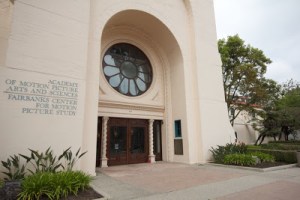 Along the way someone told me they had found information on Eddie at the Margaret Herrick Library in Beverly Hills and suggested I check it out. This is the library for the Academy of Motion Picture Arts and Sciences. It houses the Oscars library. So I went to this library. What an experience. First of all, I would have never thought of going to this library. Even though I knew my father was a filmmaker-I did not realize how big an impact Eddie had in the entertainment field. I must say here that at the time I did not have a car. I used public transportation. L. A. has good public transportation, but, some buses only run once an hour or once every 30 minutes. And visiting these libraries took me from the East to the West side of town. I visited the African American Museum in Exposition Park, the Mayme Clayton Museum in Inglewood, AND I spent hours at the Family History Library in West L.A. (a 2 hour bus ride one-way), I found so many books here on US history.
 The inside of the Margaret Herrick Library is gorgeous. One must leave one’s bags, coats and books in a little locker. When looking at photos or scripts of old papers, one must wear gloves and be very careful when handling delicate items such as old invoices. Oh, and you cannot just walk in, you have to have an appointment. The people that work in here are so nice. You tell them what you are looking for and they get it and bring it to you. I found Eddie’s movie scripts!! Posters of his movies!!! Invoices from Seiden Cinema in New Jersey for the film work they did for Eddie (with signatures). I even found the contract he made with Paramount when he was in the 1945 Duffy’s Tavern movie. Of course,, some of those items I could purchase, some not, but I could write down what I found and pay for copies. I made three trips to this library.
 Visiting libraries and museums was a big part of my journey. There were also conventions. I spent many hours online. There was a lot of reading, emailing, learning how to get with social media. Reading how-to books and articles. Reading other people’s biographies to study writing styles. Studying how to get a publisher. Biting my nails. After my mother passed in 2010 I used my grieving time to focus on the book. I was retired. Footloose and fancy-free. I had time to put into this book. Today, now that it is published I have time to share Eddie’s story in the libraries here in Los Angeles. This photo of Eagle Rock library is where I will be on the 24th of February 2018. I hope to get more kids involved. Because after all, I began this writing venture to try and motivate my grandson who grew up while I was in this process. But I also want to bring Eddie out of the shadows of time and share his many contributions to the entertainment industry and beyond.
 NORMA and EDDIE choose the name “ELVA” for their new daughter. Elva Green. This was of course a few years ago. Well, more than a few. I got the idea for this post because Kanye and Kim are trending on twitter because of their newest child’s name. I like to show my blog’s younger readers that famous couples have been trending in the news for years. Readers of today’s news have come up with all sorts of reasons K and K chose the name that they did for their child. And this reminded me that most of my life I have wondered how my father chose my name. Despite the fact that my name contains only 4 letters, people have mispronounced it always. Evelyn, Eva, Elvis, Alva, Elba. When I was a kid, the other kids called me Greenie stickum caps (I think some of you older folks might remember those).
 When my father was still alive, mom would put me in our Buick and drive me to see the street sign that read Elva Ave. It was located in Compton, California. I remembered looking at the sign out of the passenger window. So I thought I was named after that street for a long while. As an adult I wondered why that name was chosen for a street in Compton. In my lifetime I have met less than ten women named Elva. And none of them were Black. There were a lot of Black people in Compton when I was a child. I researched a bit and discovered Elva has roots in Scandinavia-I think it means “running brook”. Compton was named after a settler who travelled from Pittsylvania, Va., where Scot and Irish had settled.
 Well, here is the announcement in the newspaper about me and my name and my proud daddy. And my mom, the former Norma Amato. The name my father gave me has taken me around the world. I am proud of my name as I am sure Kim and Kanye’s daughter will be of her name.
 Articles like this one here are only to be found in the Black newspapers of the day-once I found out what those were all I needed was the time and patience to go through the archives. This article happens to mention the same program as the first article. The first article mentions a Clarence Robinson and his “Christmas Carols” show. I wanted to get some information about these folks before I typed this post. Well, typing in Clarence’s name into the internet to get some background on him got me nada. So I typed in “Apollo”.
 You’ll notice that Eddie was on this same bill with Jackie “Moms” Mabley. I discovered Moms Mabley when I was about sixteen. She cracked me up. Turns out that at the height of her career, she was earning US$10,000 a week at Harlem’s Apollo Theater. One of her regular themes was a romantic interest in handsome young men rather than old “washed-up geezers”, and she got away with it courtesy of her stage persona, where she appeared as a toothless, bedraggled woman in a house dress and floppy hat. I heard her talk about “George” and that white suit “I bought you”. She was too funny. And my father had once been on the stage with her. Remarkable.
 And this is Ralph Cooper, the originator and master of ceremonies of Amateur Night at the Apollo Theater in Harlem. Ralph, also known as “The Dark Gable” (so handsome) was an American actor, screenwriter, dancer and choreographer. Starred in “The Duke is Tops with Lena Horne” in 1938. Ralph was also a producer and a director and starred in at least ten movies. He was working in this capacity just ahead of Eddie who started his movie making career in 1939. Mr. Cooper was with us until 1992. I would have loved to have met him.
 pininthetush