

Welcome! The one thing I have found over the last few years is that writing about and/or researching my father, Eddie Green, always makes me feel good, even if I am feeling low, focusing on Eddie makes me feel better. Writing his biography gave me a chance to “meet” him, since I was so young when he died. And I still love what I have found out about him as a man, a performer, a friend, a good husband to my mom, and a loving father to me. My shining example.
Eddie came from p o v e r t y. He chose to be an entertainer, and because he liked what he did and was good at what he did, he entertained when and where he could. He rolled with the times and he became successful. Circumstances in the early 1900s propelled him into action. And his outgoing, good guy personality made him a pleasure to work with, and helped bring him to fame.
 In the late 1930s and early 1940s Eddie was on the Amos n Andy radio program. His role started out as LaGuardia Stonewall Jackson, but after the well-loved ex-Mayor of New York, Fiorello LaGuardia died, the name was shortened to Stonewall Jackson. The radio program featured two White men as Amos n Andy. Freeman Gosden was Amos and Charles Correll was Andy. The fact that Eddie, a Black man, had a role on this program was a big deal. Ernestine Wade, pictured above, was eventually hired to play Sapphire and would go on to have the same role on the TV program. The radio program became awesomely popular. The listening audience was estimated at over 40 million, almost one-third of Americans living at that time. Eddie had also begun “Duffy’s Tavern” and the money was coming in.

Not everyone was crazy about the fact that Gosden and Correll chose to use a “Negro dialect”, or that they seemed to appear as “lazy” and “shiftless” Black men. And when the program went to TV in 1951, the NAACP were not happy to see this played out on the screen. Even though the TV program used only Black actors. Spencer Williams played Andy and Tim Moore played George “Kingfish” Stevens. (These men actually took lessons from a White person on how to talk in “Negro dialect”). Due to protests the TV program was cancelled in 1953, putting some good actors out of work, but reruns were shown until 1966.
When asked if I would think about writing an article on “Should we forget Amos n Andy?” I did begin to think about it. This is a precursor.
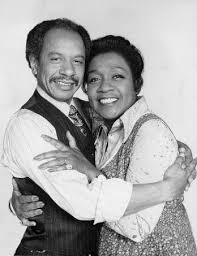 In doing the research for my second book about The Jeffersons TV sitcom, I ran across a quote from Sherman Hemsley, he said he did not pay attention to racial discrimination and he said that: “I used to like ‘Amos and Andy.’ I loved them. I don’t see anything embarrassing about that show. Some people have to hide from things. I remember when people used to hide from kinky hair and things like that. “Everybody you talk to is a reflection of yourself—you’ve got to learn to see yourself in everybody.”
As for myself as a child I thought the Amos n Andy show was funny. It was always on TV at our house. So was the Mickey Mouse Club (I totally had a Mouseketeer hat), and Boxing and probably Ed Sullivan. I even had a Daniel Boone hat with the long tail. It was all about being entertained. Frankly, I believe that everything we lay eyes on and/or hear will always be in our memory banks. I give props to all of those people who choose to do what they love, bypassing the bad criticism and contributing some good to this life.
Hey, thanks, for stopping by.
 Happy September 13th! No special reason, just feeling good today. I joined a couple of Facebook Blues Groups and found a whole ‘nuther group of folks who remember my father, Eddie Green, because of some of the songs he wrote. I love the Blues. I love music, period. Music is the one thing that can help me snap out of a funk. Haha, especially funky music. I have been listening to George Clinton and James Brown lately. And the Blues. The groups I found are basically into the Blues from the 20s, 30s and 40s. Down Home Blues. Blues. Butterbeans and Susie were a comedy team from 1917 until she died 47 years later. The typical act featured a duet, a blues song by Susie (often a “double entendre`” blues song), a cakewalk dance, and a comedy sketch. One of their more popular double entendre` songs was “I Want a Hot Dog for My Roll”, performed by Susie.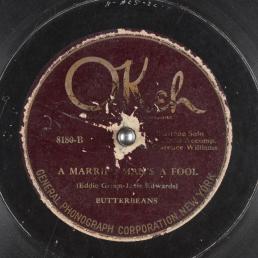
 My thoughts are swirling today. The anniversary of my mom’s death is coming up. She started out on this book writing journey with me but she did not see the published book, nor did she get to see even half of what I unearthed about Eddie’s life. Mom was 30 years his junior and was only married to him five years. During the time he was most famous. Of course, she had the real thing. Good thing Eddie didn’t believe that “A married man’s a fool” stuff. Mom was his 4th wife!
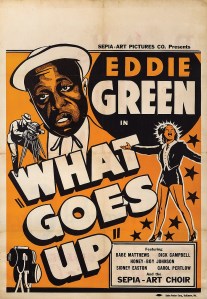 Well, it’s been two years since I published the biography on my father, Eddie Green. During the research period I searched and searched for a physical copy of this movie “What Goes Up“. Eddie wrote it, produced it, directed it and starred in it. The movie was made in Palisades, New Jersey in 1941. I am hoping to find it because, of course, it’s my father’s second movie and also because there is a member of the cast of this movie who has just celebrated her 101 years old birthday and she would love to see the movie one more time. She saw it when it first premiered in 1941 at the Apollo Theater in New York, of course, she and her mother. But not since then.
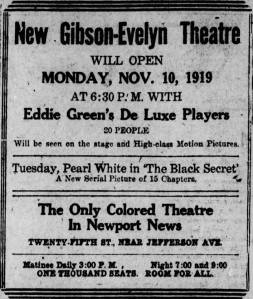 While touring as a “Boy Magician” over the years Eddie added songwriting to his list of accomplishments. He wrote “A Good Man is Hard to Find” which he used in 1919 when he took his own show on tour. The show included singing, dancing girls and comedy. While in St. Louis with this show he saw an ad in the local Variety paper for a comic. Eddie sent an outstanding reply and was invited to become a part of a vaudeville show in New York. His performances here and in Burlesque working at the 125th Apollo, earned him inclusion into a hit Broadway musical Hot Chocolates by 1929.
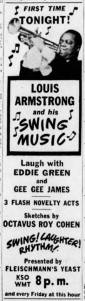
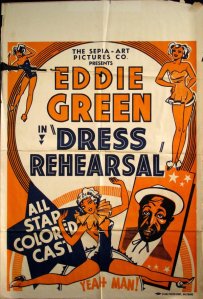 When I started this blog Eddie had almost been completely forgotten. Almost. Despite his many accomplishments in the entertainment world and the business world, despite the many friends he made and how widely he became known, beside myself, there were not a lot of people remembering that old comic, Eddie Green. I have written a biography about my father. (Eddie Green The Rise of an Early 1900s Black American Entertainment Pioneer, get it on Amazon). Since I wrote the book I have had someone tell me that I stopped the process of my father being erased from history. Wow.
 Hey, thanks, for stopping by.
 When I began writing the biography on my father, Eddie Green, I wanted to use a quote from Langston Hughes in the foreword but had to forget that idea as I could not get permission. I can, however, use a portion of an article Mr. Hughes wrote which mentioned my father. James Mercer Langston Hughes (February 1, 1902 – May 22, 1967) was an American poet, social activist, novelist, playwright, and columnist. He was one of the earliest innovators of the then-new literary art form called jazz poetry. Hughes is best known as a leader of the Harlem Renaissance in New York City from the mid-1950s to the mid-1960s.
 In the Hughes article (not the one pictured here) he was writing about “sympathetic outlets to new Negro playwrights”. He wanted to stimulate growth of a real Negro theater. He believed that while White playwrights could be skilled or sincere they could not catch “the little graduation that give a negro life its drama.” He links the comedy stage thus: “Perhaps comedy is the pitfall of the theater. Exaggeration of racial types the overstressing of eccentricities of regional speech frequently dominate comedy especially in music halls”. He goes on to say, “Nevertheless just as out of serious plays has come a Robeson, so from the minstral vaudeville musical stage have come some very talented Negro comedians, Bert Williams, Pigmeat, Jackie Mabley, Eddie Green.” (New York Age May, 1953). Notice in the article to the left Eddie, Jackie, and Pigmeat are all listed as appearing with the sixteen Apollo Rockettes back in the early 1900s.
 Here is a compilation of some of the scenes from Eddie’s movies in 1939. In a 1940 Baltimore article written by Lillian Johnson she headed the article with: As a Comedian, He’s Very Funny; As a Business Man, He’s Very Sensible and Comedy is a Business. Lillian said “The fact that Eddie is so funny on the screen, stage, and radio is due to the highly intelligent and efficient manner in which he conducts his work.”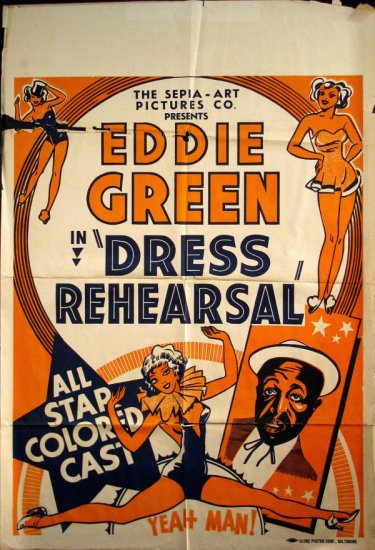


 If it wasn’t for Edward, I may not have written a book about my father.
 Ok, let’s see, how can I put this? I AM A PUBLISHED AUTHOR. Eddie Green The Rise of an Early 1900s Black American Entertainment Pioneer is now available for public consumption. Of course, I let family members know first and now I am announcing to my wonderful blogging family. Woo hoo!!!
 pininthetush