

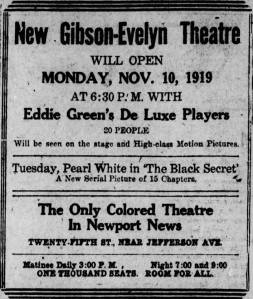
 I’ve been doing what I like to do best-researching. I saw a story online about the 1918 Spanish Flu and it dawned on me that my father was alive back then. As a matter of fact, he was married to his first wife, had his first daughter, had signed up for WWI, had written a song and was on the road traveling down south with his “Deluxe Players”. The 1918 pandemic lasted from, I think, August of 1918 through December of 1920. Eddie began his first on stage vaudeville work in 1920. He was a comedian. The 1918 flu was targeting young adults. About half of the deaths were in the 20-40 range. Eddie was about 29. He had already experienced diseases and poverty being born in 1891 in Baltimore during a time of no indoor plumbing and rampant Leukemia in the East Baltimore slums. It’s one of the reasons he left home at nine years old and worked as a boy magician until someone suggested that he was so funny he really didn’t need a lot of props to entertain people. It seems that Eddie never got sick. Vaudeville and Burlesque were pulling people in. Eddie was performing in Tampa, Fla., in 1919 with his Deluxe Players when he applied for and got a job as a comedian in New York in 1920. The flu had hit Haskell County, Kansas In January 1918.
Thinking about it now, I never really thought about the chaos that was going on in the world during those years.
How did people continue to think up gags and write songs that weren’t sad and forlorn. Eddie wrote “A Good Man is Hard to Find” in 1917. In my book I wrote that maybe he was actually talking about the fact that the armed services were drafting men to fight in WWI. In 1920 he wrote “Don’t Let No One Man Worry Your Mind”, but this was probably for lovers. Anyhow, the flu was still raging and Eddie still had to entertain if he was going to earn money.
I read that in order to maintain morale, World War I censors minimized early reports of illness and mortality in Germany, the United Kingdom, France, and the United States, which may have contributed to the spread. However, papers were free to report the epidemic’s effects in neutral Spain, such as the grave illness of King Alfonso XIII, and these stories created a false impression of Spain as especially hard hit, and may have given rise to the name “Spanish” Flu.
Military pathologists eventually reported the onset of a new disease with high mortality that they later recognized as the flu. Their overcrowded camps and hospitals were an ideal site for the spreading of a respiratory virus. When soldiers were sent home there was a second wave of flu victims in 1918.
It was discovered that what we now call social distancing was paramount in surviving that flu. The French colony of New Caledonia succeeded in preventing even a single death from influenza through effective quarantines. And the world went on. And got better.
 The “Roaring Twenties”. Booze and parties. Eddie was appearing onstage in “All In Fun”, dancing and singing now along with his comedy. I read he and his partner were encored many times. So everyone must have been having a good time. Duke Ellington was coming along. Eddie opened a publishing business, a movie studio and wrote “King Tut’s Blues” because of the discovery of the tomb in 1923. And better things were yet to come. Even so, there was also the fact that in those early 1900 years racism was also a death sentence for Blacks. And Eddie was touring the country with Burlesque shows. In Blackface. And he was a hit everywhere he went. Fascinating when you think about it.
I believe I inherited my father’s ability to see the better side of life-to be able to focus on positivity and to help others to experience joy. Yes, tragedy and despair and horror exist, I know-but I refuse to let it take me all the way down. As Miss Celie said: “This life be over soon” anyhow. And as my brother, Lance, used to say “You only go around once, so you might as well do it with Gusto”. (Yes, he stole it from a beer commercial-LOL).

Hey, Love you all, please, keep coming back.

 My father liked two things for sure: Pretty women and he liked being happy. From the first time he went out on the road with his first song in 1919, through his movie making days in 1939, ’40 and ’41 his ensemble included chorus girls and comedy. He even incorporated dancing girls, tap dancers, singers and comedic skits in his last 1949 movie that depicted Blacks and how they dealt with life after the Atom Bomb. For those new to this blog you can see his last movie on YouTube-it’s titled Mr. Adam’s Bomb. A young lady (Margaret Westfield) sings a song called “You can Always Believe Your Heart” which Eddie wrote. I am still looking for information on Ms. Westfield.
 Eddie became a household name as Eddie, the waiter in the radio program Duffy’s Tavern, during the last ten years of his life. Everyone loved Eddie. February is Black History Month. I am going to inundate social media with “fun Eddie stuff”. I want to get him as much exposure as possible. I want to get as many people as I can to experience Eddie’s good nature and for them to get a few laughs as well. I think our world could use uplifting right now. Eddie’s life story is truly inspiring. I will also be pushing the biography I have written about him, “Eddie Green The Rise of an Early 1900s Black American Entertainment Pioneer“, it’s much more fun that that “other” book everyone is talking about these days.
 In this still from Eddie’s 4th movie you can see that Eddie (in the striped shirt) liked being silly (which is why, I am sure I like silly jokes: What kind of flower is that on your face? Tulips!!! Hahahahaha!) There were even chorus girls in this movie.
 When I began writing the biography on my father, Eddie Green, I wanted to use a quote from Langston Hughes in the foreword but had to forget that idea as I could not get permission. I can, however, use a portion of an article Mr. Hughes wrote which mentioned my father. James Mercer Langston Hughes (February 1, 1902 – May 22, 1967) was an American poet, social activist, novelist, playwright, and columnist. He was one of the earliest innovators of the then-new literary art form called jazz poetry. Hughes is best known as a leader of the Harlem Renaissance in New York City from the mid-1950s to the mid-1960s.
 In the Hughes article (not the one pictured here) he was writing about “sympathetic outlets to new Negro playwrights”. He wanted to stimulate growth of a real Negro theater. He believed that while White playwrights could be skilled or sincere they could not catch “the little graduation that give a negro life its drama.” He links the comedy stage thus: “Perhaps comedy is the pitfall of the theater. Exaggeration of racial types the overstressing of eccentricities of regional speech frequently dominate comedy especially in music halls”. He goes on to say, “Nevertheless just as out of serious plays has come a Robeson, so from the minstral vaudeville musical stage have come some very talented Negro comedians, Bert Williams, Pigmeat, Jackie Mabley, Eddie Green.” (New York Age May, 1953). Notice in the article to the left Eddie, Jackie, and Pigmeat are all listed as appearing with the sixteen Apollo Rockettes back in the early 1900s.
 Here is a compilation of some of the scenes from Eddie’s movies in 1939. In a 1940 Baltimore article written by Lillian Johnson she headed the article with: As a Comedian, He’s Very Funny; As a Business Man, He’s Very Sensible and Comedy is a Business. Lillian said “The fact that Eddie is so funny on the screen, stage, and radio is due to the highly intelligent and efficient manner in which he conducts his work.”









 pininthetush