We Are Family-Connected

My family is connected with an important part of history. In the book I have written about my father I included a chapter on my mother, Norma. I don’t write about her often, except on Mother’s Day and when the date of her death comes around or the date of her birthday, which is on November 17th. This is Norma about 4 years before she married my father. But the history I want to write about started with my maternal grandmother.
 

My mother’s mother was born in 1896, her name was Sinclaire White. In 1912 Sinclaire got a mention in The Crisis magazine for her skills as a violinist. The second photo here is the cover of that 1912 issue.  The lady on the front is not Sinclaire. I only ever saw one picture of my maternal grandmother and I do not remember her as she died when I was a year old. My siblings never knew her or even saw a picture. Nor was she ever talked about as we grew up. As a violinist she was magnificent. Later in life she taught violin. Inside this magazine in the MUSIC AND ART section is this article about my grandmother:

” Miss Sinclair White of Chicago, Ill., who graduated June 18 from the Chicago Musical College, took part in the commencement program, playing the first and second movements of Sitt’s concertina in A minor. Miss White, who is a violinist, was the winner of the diamond medal awarded in the “teachers’ certificate class.” Accompanied by her mother she leaves shortly for Russia, where she is to have the advantage of five years’ study.”

At the time The Crisis was a very influential magazine. Published by W. E. B. DuBois who was also a co-founder of the NAACP. William Edward Burghardt “W. E. B.” Du Bois (February 23, 1868 – August 27, 1963) was an American sociologist, historian, civil rights activist, Pan-Africanist, author, writer and editor. Due to current racial issues he and the NAACP have been in the news more often, lately. I love his picture. It’s possible Sinclaire knew DuBois.

By the 1930s Sinclaire was living in Pasadena with her husband and my mother. She was now Sinclaire White Murdock and she was the head of the Sinclaire White Murdock Music Arts Association. The meetings would proceed with musical selections and a reading of stories such as, “The Immortal Story of Enoch Ardin,”, by Sir Alfred Lord Tennyson. Sometimes, the meetings were held in the Second Baptist Church; other times meetings were held at the Sojourner Truth Home in Los Angeles.

Sojourner Truth (1797 – November 26, 1883) was an African-American abolitionist and women’s rights activist born into slavery in Swartekill, Ulster County, New York. We didn’t talk much about Sojourner Truth when I was growing up, but they obviously recognized her in Pasadena back in the day and Sinclaire had the good sense to hold her meetings in a building named after a woman who would become  a force in 2017. As of today Truth’s statue will stand on the Empire State Trail in Ulster County.

My family history is very much Black history. Though for some reason Sinclaire listed herself as Spanish in my mother’s school records.

My family history is also Italian as Sinclaire also married Guiseppe Amato (or Joe) and had my mom, Norma. Joe’s parents emigrated from Italy to New York in the early 1900s.  Joe became a barber and gave my brother’s their first haircuts. It’s more difficult to find Italian records but that is on my to do list.

I love my family. And I love connecting with you, too.

Thanks, for stopping by. And, KCB.

https://www.facebook.com/EddieGreenBook/

https://www.facebook.com/elvagreenbookpage/



Dove, You Totally Blew It!!

Going slightly off topic here today. Trending is a the subject of a Dove advertisement. Black people are not happy with this ad, on Twitter. There is a video that goes with the ad but at first all I saw was this picture. For the life of me I could not figure out why people were upset. I saw one Black woman in two shots and one White woman in two shots. Black woman before Dove and after Dove. White woman before Dove and after Dove. I thought it was a stupid ad. I stared at it for five minutes trying to figure out why folks were angry. Then I decided to look further and I found the video. And cracked up. The video shows the Black lady in the act of taking off her shirt and changing into a White woman. I laughed out loud because how Dove came up with this idea in this day and age shows how truly out of touch these people are. It’s laughable. Of course they may not see themselves as out of touch. Dove is an old company with perhaps old ideas, still. If they ever wanted to lose business this ought to do it.


What I realized about myself, though, is that the ad did not make me angry. At first I didn’t even get it. I was clueless. When I did get it I still was not angry, just shocked that their ad department thought it up. I realize that I do not react angrily at seemingly racist episodes. As a Black woman I am not constantly seeing racism. Or Black and White. I see people. And being a light-skinned Black person has meant that I experience rude remarks from other Black people. Some call me High-Yellow as in “Oh you high-yellow, you’re too good to speak too me!”. So I got used to it and got over it. I’m just me. Living life. Sometimes struggling and sometimes not, just like a million other people. Besides, one look at the members of my family shows you we represent every skin color, so we fit in everywhere. This picture is my brother (Brad), my niece (from my late brother’s (Lance) first wife, me, my brother (Brian) and my daughter (Melony). Both of my brothers have had to fight over the fact that they look White. But we all look beautiful. Colorful.

Here is my sister and her two daughters (Donna in the middle, Alex and Brittney). Everyone in the family used to tease Donna because she looked so different from us. Hispanic. Her dad even had a name for her that I cannot use in today’s world without backlash. All three of these ladies are beautiful, too.


Here is my late brother’s daughter and grandsons from his second wife. So cute!! She sang on video at my Book Soup book signing. We all have issues, so I did not get to meet this part of my family until last year.


Ah, my cousin, Little Jim. Gone now. Did I have a major crush on him. He has beautiful grand-kids that unfortunately never met him. He was the family hero. Sharp dresser. Fine.
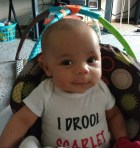


This is my new favorite. Kellan. My cousin Roddy’s grandson. Ain’t he cute!


In the 1940s my father was Eddie, the waiter on the radio program “Duffy’s Tavern”. This program was named to the Honor Roll of Race Relations  by the Schomburg Collection of Negro Literature for distinguished effort for improving race relations. Meaning Eddie, as the only Black actor on the show was not portrayed in a demeaning manner. He was on the show because he was good. When Eddie began making movies he used the best cameraman in the business because, he said, “there is a wide variety of skin colors and tints in the colored race”.

Well, there is a wide variety of skin colors and tints in the human race. I would like to believe that someday our focus on color will stem from the need to get just the right camera shot.

Thanx, for stopping by. Hug someone soon.


To purchase my book Eddie Green The Rise of an Early 1900s Black American Entertainment Pioneer:

https://www.facebook.com/elvagreenbookpage/

https://www.bearmanormedia.com

https://www.amazon.com/Eddie-Green-American-Entertainment-Pioneer/dp/1593939663


NPR Author Interview-Yes!

Ok, so here I was a short while ago, ready to go into a radio sound-proof booth to be interviewed by Mr. John L. Hanson of the NPR radio program In Black America. An honor. Well, for your listening enjoyment you can click on this link he sent me and listen for yourself (my daughter says I sound so good over the air.)  http://kut.org/post/elva-diane-green-her-father-eddie-green-pioneering-black-filmmaker-and-songwriter.

I was a bit nervous but once I started talking I was ok. I have interviewed before on Yesterday USA and on podcasts, so I am getting better. For people newer to my blog, when I began writing this book being interviewed was the last thing I thought about. Even calling myself an “author” wasn’t a necessity. I simply wanted to get the book out there so that it could inspire others and so Eddie could receive the acknowledgement he deserves as an entertainment pioneer. It dawned on me after the book was published that I, the author, the birther of the book now had to spread the word so people would find and read the book. Not just that, I had to let people know who I am. Elva Diane Green looks good on the cover but it does not make me a recognized author. So began the next leg of my writing journey. Promotion.

I am rather introverted. Unless I think I have some information you need to fix your life. You know, I am good at giving advice whether you ask for it or not. But normally I am not the one to walk up and shake your hand and introduce myself and exchange pleasantries. No. So for me to be an “author” who has written and published a book is something I have had to grow into. For instance, my publisher’s “writer’s guide” says: Hand your cards out everywhere, put them on people’s windshields, leave them at libraries, give them to everyone you meet or pass in the market. Unfortunately, half of the time I forget I even have cards. Cards that I spent time making up. Cards that I spent money on. So I have had to leave my cards out where I can see them at all times, stuff them in my pockets so they will make me uncomfortable.

Anywho, the fact that I started this writing journey using WP as a place to express myself has been one of the best ideas I have had. The fact that I have gained a following of supportive, interested, friendly people has absolutely helped me stay on track. (tears!). I now have an Amazon Author Page that will increase my reach. I tweet (but twitter is more radical than I really like), I have a Facebook Page for the book and a Facebook Page for me and the book.

And I have my father, Eddie Green as an example of how to get things done. When he wanted to get somewhere, he did. In his words: “It was during the year 1929. I was living in New York and trying every kind of theatrical job that was available. I had already played all kinds of Vaudeville, Burlesque, musical comedy and a few small radio programs “In the meantime, I was so busy working here and there and doing a bit of writing on the side that I did not notice my own advancement.” When Eddie wanted to open his own movie studio he did: From the local newspaper “Upon returning to the West Coast, Eddie announced the opening of his new film company, Sepia Productions, Inc., with himself as President.”

So, onward and upward. Thanks so much for stopping by.

Buy now: https://www.bearmanormedia.com OR  https://www.facebook.com/elvagreenbookpage/


The “Pursuit” of Happiness

I have been studying the whys and wherefores of the Declaration of Independence. Studying what was meant by using the words Life, Liberty and the Pursuit of Happiness. On Wikipedia one can read about what others who came along after the signing of the Declaration think about what the word happiness meant to those signers. Happiness these days is alluding me. Not because of the worlds difficulties, though these difficulties add to my sadness. But because of my grandson. His personal grown-man problems. Mainly due to his pursuit of happiness.
I realized today that the Declaration does not say “and Happiness”, it says “and the Pursuit of Happiness.” Meaning this is something we are seeking, or looking for, then we are working toward it, or chasing it, or wooing it.

In a 1940 Baltimore article of my father, Eddie Green, it says: Eddie doesn’t go often (to the movies) as he doesn’t care for pictures about death or suffering. It even makes him sad to see a comedian trying so hard for a laugh which never seems to make any headway with the audience.

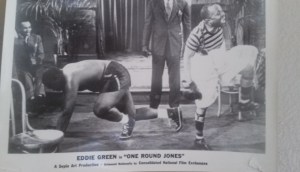
I suppose that is one reason Eddie became a comedian. He was pursuing his own happiness. Here he is being happy. (He is the silly guy in the stripped shirt). This is a scene from his movie One Round Jones (1941). The Press Sheet reads: One Round Jones is the story of a night club owner who undertakes to build his business by offering $50 to anyone who can go one-round with his “mystery fighter.” Of course, Eddie is the goat. He climbs into the ring shaking like a dish of Jell-O but when he climbs out he’s got the money and the other fighter’s girl.”

According to my mom (the lady he married after his wife of 1941), Eddie was an easy-going, fun-loving man. He was a funny man. Life was good for him. No matter what. He climbed out of the slums of East Baltimore in 1900 and his life just got better and better. He was a happy man. He really was a good role-model.

In pursuit of some happiness today I realized that I have a unique sense of humor, ’cause that “You Suck” picture I posted made me laugh out loud. I will just have to continue to work toward Happiness, maybe I can find some more “You Suck!” pictures. Or maybe if I post more often, it does make me feel good to communicate with friends.

Thank you, for stopping by and KCB.

https://www.facebook.com/EddieGreenBook/

https://www.facebook.com/elvagreenbookpage/


Love is Always Relevant

Hi there. This is me sitting in the “green” room at an NPR station (National Public Radio) waiting to go on the air for an interview with In Black America. I will let you know when it will be aired. My daughter, Melony, is my photographer. So the interview was about my father, Eddie Green and my experiences with researching and writing this book. But I started out with this photo for a specific reason which I will get to further on.

Racism exists. Unfortunate but true. When I started this blog I had no intention of using this space as a place to address racism. The intent was to share what I see as my father’s rags-to-riches story in the absolute presence of racism. To show how Eddie dismissed the obstacles and became a favored comedian, actor, composer and filmmaker in the early 1900s. I hoped to be able to inspire others with his story. Besides, I think our troubles today are more about hate as opposed to all about race.

Given recent events here in America, and given that my father was a Black man I feel a need to I chime in with my two cents on the issue of color. Which for me as a light-skinned Black woman is a bit different in how I have been treated through my life.

In 1917 when Eddie signed up for WWI his Registration Card listed the following:


Name Edward Green
Race African
Birth Date 16 Aug 1891
Birth Place Maryland, USA
Street Address 1405 Tenpin alley
Residence Place Baltimore, Baltimore (Independent City), Maryland, USA

If you notice his race is listed as African even though he was born in Baltimore. On the card it is listed on the bottom half of the left side of the card, which is also torn as a way to identify the Blacks from the Whites. Since then he’s been colored, and he’s been a Negro. He died before he could become Black or African-American.

No matter. Eddie went on his merry way and became successful. Successful on stage, with other greats like Jackie “Moms” Mabley, “Pigmeat” Markham, the sixteen Apollo Rockettes and actor Ralph Cooper (whose nickname was “The Dark Gable”).  “Moms” Mabley was still Jackie at that time and James Baskette had yet to become “Uncle Remus”.


Then there was Tam O’Shanter. He did a one man show about an Irish poem writen by Robert Burns, a Scottish poet and lyricist. He recited the poem on stage. I would have loved to see that.  This was in 1930. I don’t think Eddie had any problem being African. Or Negro. When he became a filmmaker his letterhead read Of, By and With Negroes. But Eddie was an entertainer and an artist. He wanted to be in show business. As a person. Eddie worked well with everyone according to the articles I found. He was likeable.


Eddie found fame through Duffy’s Tavern. Seen here with the crew about 1942 or so, left to right, Charles Cantor,  Eddie, Ed Gardner (Archie) and creator of the show, Florence Halop and Alan Reed. Eddie began with the first radio episode in 1941 and as Eddie, the waiter became a household name. Two tapings a day for east and west coast during the season until 1950.


Now, back to me. My mother, Eddie’s fourth wife, was light-skinned. Her father was Italian. I did not grow up with the same color issues as Eddie. My Black friends called me “High-Yellow” when I was a kid and one or two still call me that today. When I was young my friends would laugh at me and say I danced like a White person. Yes, they meant it as an insult. There is so much emphasis on being Black today I have begun to feel left out. There is a lot of talk about “melanin”. Twitter got upset because a light-skinned Black woman was chosen the winner of a Black beauty contest. There is a sense of displeasure there. Where’s the love?

Anywho, don’t be surprised as I begin a slow transition into sharing thoughts and feelings that are important to me today, while I also continue to show my father’s life and times as being relevant and inspirational in today’s world.

With love. Thanx, for stopping by.

Visit me at https://www.facebook.com/elvagreenbookpage/


This is So Cool.


This is going to either make me or break me. Which is really not the point here. The point is to show the necessity of yesterday. (thanks, Ben)

Last month a new CD dropped featuring old time black-face cartoon figures. And they were featured in a purposely seemingly demeaning way. The song seems to say that the Black person’s role (even the more affluent Black person) today is not much different than it was then, in some people’s eyes. Seems pessimistic to me. The song went Platinum in a week. One week.

The book I have written about my father has been a hard sell to some Blacks today because of the era in which my father lived. Some people do not see, and do not want to see, the relevance of yesterday’s all-black cast movies or old time radio, or vaudeville as it applies to progress. As for myself, I understand. Seeing my father in blackface has taken some getting used to. It’s still kind of embarrassing to admit my father was a blackface comedian. And if I am embarrassed what do I expect from others?

As you can see in the photo “From Broadway to Okeh”, Eddie performed In Connie’s Hot Chocolates as a blackface comedian. The sketch that he wrote and performed was so funny the Okeh record label recorded it and him.

According to Wikipedia, “it was through blackface minstrelsy that African American performers first entered the mainstream of American show business. Blackface served as a springboard for hundreds of artists and entertainers—black and white—many of whom later would go on to find work in other performance traditions. White audiences in the 19th Century wouldn’t accept real black entertainers on stage unless they performed in blackface makeup. blackface in vaudeville also provided opportunities for Blacks who performed in blackface. From the early 1930s to the late 1940s, New York City’s famous Apollo Theater in Harlem featured skits in which almost all black male performers wore the blackface makeup and huge white painted lips, despite protests that it was degrading from the NAACP. The comics said they felt “naked” without it.”

Eddie’s rise to stardom included not just his talent but his willingness to take the difficult road ahead of him. He climbed the ladder from the bottom rung to success. And he did it well. He became successful because whatever he did he did it the best way he knew how. He was an Actor.

Eddie’s career choice led to a very successful life. Once he appeared in the first public television broadcast as that Harlem Funster, Eddie Green along with his partner George Wiltshire (the first two Black men to appear on television in 1936), his career shot up from there. you can buy the book to read about the rest.

Suffice it to say that by 1948 Eddie was doing swell, the next photo is Eddie from an article announcing his fifth movie, Mr. Adam’s Bomb and my mom, the former Norma Amato, aspiring opera star who married Eddie in 1945.

On June 26, 1948 there was an article in the New York Age newspaper about my father and his thoughts on television:

Eddie Greens Firm Aids Show Business Through Television. The fast growing field of television offers a fertile one for Negro performers, is the opinion of radio comedian, Eddie Green, who revealed that because of this fact his motion picture firm has interested advertising agencies in having their sponsors products sold to the millions who view television via the singing and dancing route.
Designed to catch and hold the attention of the millions who want entertainment on video, Green asserted that instead of the hackneyed manner of selling national consumer goods to the public, his firm will “Deliver the message in a way to keep viewers from turning the dial”. Organized two months ago in Los Angeles with the famed comedian as president, Sepia Productions has already lined up five three-minute skits which they plan to lease or sell outright to ad agencies.
Backstage at the Strand Theatre here, where he’s a member of the “Duffy’s Tavern” radio show,  Green said that colored performers have their niche in the television picture and they should demand that their agents establish contacts with those that handle the shows in order not to be left out in the cold when the infant industry attains maturity. He pointed out that the decline of vaudeville witnessed many good Negro acts going out of business and little hope for the birth of new talent was anticipated until television offered vast potentialities.

I hope to be able to create a more optimistic view of our pioneers efforts and achievements from back in the day and how they benefit us today. This may be a long shot, but I want to make their achievements “cool”. As in “yea, that’s cool”. And then if my book were a CD there’s got to be enough optimists out there to make it go platinum!!

Hey, thanx, for stopping by, please KCB.

https://www.facebook.com/elvagreenbookpage/


The Necessity of Yesterday

With this post I have unintentionally gone way off topic. But I needed something to strike me funny today. My intention was to type a post using a phrase stolen from my publisher: The necessity of yesterday. We were discussing the difficulty of getting today’s younger people interested in reading about the entertainers of the 20s, 30s, 40s.

I want to figure out a way to show progress not just in cars or technology but in people, most especially in Black people who still experience difficulty in progressing in America.  I believe that seeing from whence they came will enable Blacks to recognize their own progress and see how the past has contributed in a good way. And Black people have progressed, do progress and are progressing in entertainment.

So I went online to get ideas for where we were yesterday and where we are today. The necessity of yesterday. So I looked up “the good ol days” as a way to get ideas of “yesterday”. Well, I found a few fond memories of yesterday, but not a lot. I found more “the good ol days sucked” images. And, the really sad part is that I found very few “good ol days images” featuring Black people. The images I found with Black people in them “truly sucked”. And I felt sadder than when I started this post.

I want to be able to show the younger Black people of today that the images some Black actors chose to portray back in the day contributed immensely to what Black actors can do today. Had there been no “yesterday”, (the 20s, 30s, 40s) Black actors suffering the slings and arrows of life in the entertainment industry, (and in life in general) there could not be the many, many successful Black people on the screens today.

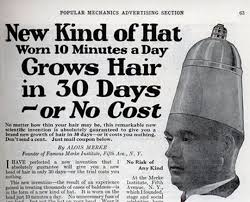
Somehow I would up looking at weird advertisements from those days, cocaine cough syrup, Bourbon toothpaste. Then I saw the “new kind of hat” that grows hair!! And I burst out laughing or as they say to I LOL’d. Whenever I laugh I know that all is not lost. Life is still laugh out loud funny. I mean, look at that hat! Would you wear that hat? But I guess somebody had to try it first.

Hey, thanx for stopping by and may something make you LOL.

Alberta Hunter and The Influence of Old Timers

This is the first lady that I heard sing my father’s song “A Good Man is Hard to Find” on a Los Angeles Jazz radio station in 1988. A friend recorded it to a cassette for me. The song I have placed in this post is different but connected. See, I started to write this post about the difficulty in getting today’s public interested in radio artists from the 20s, 30s, and 40s, unless they are older people or people who are into entertainment nostalgia.  And how difficult it has been to get today’s Black people interested in Black entertainers from the same era. Because there are people today (like my younger brother Brian) who have contempt for the “Rochesters” or “Fettchits”. Those slow-talking, yes, sah Blacks, thus making it harder to market the biography I have written about my father who was successful during the early 1900s. They are not proud of these old timers. But I think the fact that these entertainers persevered and succeeded during a time of great hardship for Americans and particularly Black people makes a powerful statement of tenacity that ought to be passed on and on. For instance, our kids today are listening to songs that contain profanity and outright sexual lyrics. But guess what? They need to know that this is not new, they are simply re-stating the same ideas that began back in the 20s with songs like the one below from youtube. Only a bit more subtle.


Yes, Alberta Hunter! 1895-1984. We now have the internet and cable and smartphones and no longer sit around the radio waiting for Amos n Andy or The Hit Parade or Duffy’s Tavern (with Eddie Green as Eddie, the waiter), or The Shadow, but we ought to remember these pioneers and their determination to follow and achieve their dreams. Black or White.

Then, this morning, my focus for this post began to include Racism. I read an article. On March 31, 2017 someone left a noose in the National Museum of African-American History and Culture in Washington, D. C. The world may have moved on technology-wise, but racism and hatred are still with us. For my Black brothers and sisters this may very well prove to be a reason for not wanting to look back at what some see as negative Black images from the 20s, 30s or 40s. Or maybe they see these as simply by-gone days. But remember, these Black entertainers who came before us witnessed lynchings and still chose to pursue their entertainment dreams. Through courage and determination these old timers left legacies of courage and success. They prove that perseverance, love of life and the desire to provide happiness to others can and will stop negativity from overtaking this world, that the desire to harm others can be lessened and a greater desire to help others can be achieved.

Hey, thanks for stopping by and please share this book info with others.

https://www.facebook.com/EddieGreenBook/


Today’s Most Looked Up Word Is…


eddiegreenandgrandmanorma

Trying to write positive posts that are relevant to today’s interests has become a bit difficult for me. For inspiration, I turn to Merriam Webster’s Dictionary for the most looked up word of the week. Word #7 has been racism for a while now. Word #1 has been fascism for a couple of weeks. Word #9 empathy and Word #12 is love.

It makes me sad to see that the #1 word is fascism according to Webster’s. Why is that word so much on people’s minds as opposed to the word love? Uh, never mind, don’t answer that question. As for empathy, I have experienced this feeling this past week or so because a mom recently lost her 14 year old son during a heavy rainfall incident in California.  I am a mom and I can imagine how she must have felt. I think this world could use more empathy. As for the word racism, my opinion is that this word will continue to be among the top ten words people look up in the dictionary.

Racism is an old word. It exists where you might not think it exists. My father and my mother experienced this in the late 1890s through the 1950s. Eddie, born in 1891 in Baltimore, Maryland experienced racism from infancy as a Black person in America. One thing about it though, Eddie did not let the harsh treatment of Blacks hamper his rise to success. His career began as a boy magician, he became a filmmaker, a Broadway and movie star, an old time radio icon and a composer. He remained courteous and he was known as a gentleman. He was proud of who he was as a man and he became one of the most beloved comedians of his time until his death in 1950.

My mother’s experiences were different. My grandmother was a very light skinned Black woman who chose to pass herself off as White. Spanish to be exact. My grandfather was Italian. My mother lived most of her life unsure about her heritage. She too was very light skinned. As an adult she chose to identify as Black. Unfortunately, sometimes in order to get a job my mother would apply as White and then would lose the job when it was discovered she was actually Black. Through the years after mom married a second time, her sister-in-law (a Black woman) who sold real estate would take mom with her to meet clients hoping the clients would see mom as White and would therefore be more interested in purchasing the property that was for sale.  In later life mom told everyone who asked that she was a gypsy.

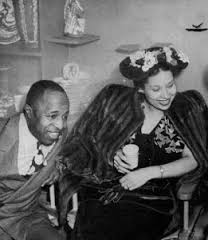
Within my own family racism existed. When my father Eddie would come to my grandmother’s house in Pasadena, California to visit my mother, Norma, my grandmother would make Eddie come in through the back door, because of course anybody could see that Eddie was Black. As you can see from the picture above this did not stop Eddie’s progress. He married my mother during the latter half of 1945. By then he had become a household name and mom reaped the benefits as you can see by her ensemble. Love carried the day. Of course, in those days the places one could go as a seemingly interracial couple were limited. But they were happy.

Eddie died in 1950. We were living in Puerto Rico. We returned to the US on a ship called the SS Puerto Rico. First class. In 2014 I was in a library and a gentleman who helped me locate the Passenger List of this ship was amazed that in 1949 our family sailed First Class on a ship. He was amazed because it was unusual to see Black people sailing First Class back in the day. It is still amazing people today. I do not call this racism, but a by-product of racism. A thought process stuck somewhere in the unconscious.

I guess if the word love was #1 it would seem that folks needed more information on what love is. Sometimes I think we do.

Thanks, for stopping by. KCB


Black History Month Grips Nation


eddieedgardner
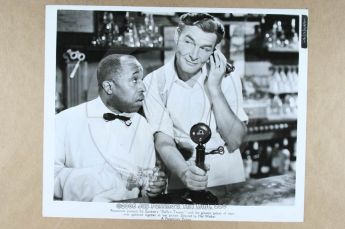
Eddie Green & Ed Gardner in Paramount’s Ed Gardner’s Duffy’s Tavern (1945)

From a 1950 article in the Chicago Defender newspaper regarding Eddie Green: “Radio was his forte. He became the lovable Eddie of Duffy’s Tavern and his quick answers to Ed “Archie” Gardner’s problems won him thousands of ardent fans”.

In honor of Black History Month I am promoting  my father as one of the pioneers of black history who so far has not gotten as much attention as say a Frederick Douglas, orator, writer and social reformer, or a William Grant Still, the first Black American composer to have an opera performed by the New York City Opera, though Eddie was a filmmaker, writer and director of his own movies and he was also a composer of twenty-nine songs, one being “A Good Man Is Hard to Find”. And I am promoting him because in the early 1900s he had thousands of ardent fans. Eddie has earned his place in America’s Black History.

I am glad we have a Black History Month. When I worked for the VA I was glad when they celebrated Hispanic History because bands came out and played and people brought books about their culture and everyone had a good time. Any celebration is good as far as I am concerned. Everyone should celebrate who they are.

Now, truth be told, until this year I have never studied the origins of Black History Month. I would acknowledge Jackie Robinson and George Washington Carver (the only black person I remember reading about when I was about eight years old), and I know I am black and before you knew it the month was over. I have written a book now about my father and in doing the research on this book I found a new interest in Black history.

My father was thirty-five years old in 1926 when the precursor to Black History Month, Negro History Week, was started.  On February 7, 1926, Carter G. Woodson initiated the first National Negro Week. Every club, society, church or school was entitled to the Negro History Week pamphlet free of charge.

By 1935 the New York Age newspaper printed this headline Negro History Week Grips Nation “Negro History Week literature has been distributed in batches of thousands throughout the country, and it may still be obtained from Dr. C. G. Woodson.” This idea was hot!! Fast forward to 1976 and as part of the United States Bicentennial, the informal expansion of Negro History Week to Black History Month was officially recognized by the U.S. government. Forward to now, where is the Black History Month Grips Nation headline? So I wrote it.

I know that Eddie would want me to celebrate Black History Month because here in America we have added the history of a Black President to what was once celebrated as Negro History Week.

Thank you so much, for stopping by.

http://www.bearmanormedi.com (Eddie Green The Rise of an Early 1900s Black American Entertainment Pioneer)