I have been studying the whys and wherefores of the Declaration of Independence. Studying what was meant by using the words Life, Liberty and the Pursuit of Happiness. On Wikipedia one can read about what others who came along after the signing of the Declaration think about what the word happiness meant to those signers. Happiness these days is alluding me. Not because of the worlds difficulties, though these difficulties add to my sadness. But because of my grandson. His personal grown-man problems. Mainly due to his pursuit of happiness.
I realized today that the Declaration does not say “and Happiness”, it says “and the Pursuit of Happiness.” Meaning this is something we are seeking, or looking for, then we are working toward it, or chasing it, or wooing it.
In a 1940 Baltimore article of my father, Eddie Green, it says: Eddie doesn’t go often (to the movies) as he doesn’t care for pictures about death or suffering. It even makes him sad to see a comedian trying so hard for a laugh which never seems to make any headway with the audience.
I suppose that is one reason Eddie became a comedian. He was pursuing his own happiness. Here he is being happy. (He is the silly guy in the stripped shirt). This is a scene from his movie One Round Jones (1941). The Press Sheet reads: One Round Jones is the story of a night club owner who undertakes to build his business by offering $50 to anyone who can go one-round with his “mystery fighter.” Of course, Eddie is the goat. He climbs into the ring shaking like a dish of Jell-O but when he climbs out he’s got the money and the other fighter’s girl.”
According to my mom (the lady he married after his wife of 1941), Eddie was an easy-going, fun-loving man. He was a funny man. Life was good for him. No matter what. He climbed out of the slums of East Baltimore in 1900 and his life just got better and better. He was a happy man. He really was a good role-model.
In pursuit of some happiness today I realized that I have a unique sense of humor, ’cause that “You Suck” picture I posted made me laugh out loud. I will just have to continue to work toward Happiness, maybe I can find some more “You Suck!” pictures. Or maybe if I post more often, it does make me feel good to communicate with friends.
Hi there. This is me sitting in the “green” room at an NPR station (National Public Radio) waiting to go on the air for an interview with In Black America. I will let you know when it will be aired. My daughter, Melony, is my photographer. So the interview was about my father, Eddie Green and my experiences with researching and writing this book. But I started out with this photo for a specific reason which I will get to further on.
Racism exists. Unfortunate but true. When I started this blog I had no intention of using this space as a place to address racism. The intent was to share what I see as my father’s rags-to-riches story in the absolute presence of racism. To show how Eddie dismissed the obstacles and became a favored comedian, actor, composer and filmmaker in the early 1900s. I hoped to be able to inspire others with his story. Besides, I think our troubles today are more about hate as opposed to all about race.
Given recent events here in America, and given that my father was a Black man I feel a need to I chime in with my two cents on the issue of color. Which for me as a light-skinned Black woman is a bit different in how I have been treated through my life.
In 1917 when Eddie signed up for WWI his Registration Card listed the following:
Name Edward Green
Race African
Birth Date 16 Aug 1891
Birth Place Maryland, USA
Street Address 1405 Tenpin alley
Residence Place Baltimore, Baltimore (Independent City), Maryland, USA
If you notice his race is listed as African even though he was born in Baltimore. On the card it is listed on the bottom half of the left side of the card, which is also torn as a way to identify the Blacks from the Whites. Since then he’s been colored, and he’s been a Negro. He died before he could become Black or African-American.
No matter. Eddie went on his merry way and became successful. Successful on stage, with other greats like Jackie “Moms” Mabley, “Pigmeat” Markham, the sixteen Apollo Rockettes and actor Ralph Cooper (whose nickname was “The Dark Gable”). “Moms” Mabley was still Jackie at that time and James Baskette had yet to become “Uncle Remus”.
Then there was Tam O’Shanter. He did a one man show about an Irish poem writen by Robert Burns, a Scottish poet and lyricist. He recited the poem on stage. I would have loved to see that. This was in 1930. I don’t think Eddie had any problem being African. Or Negro. When he became a filmmaker his letterhead read Of, By and With Negroes. But Eddie was an entertainer and an artist. He wanted to be in show business. As a person. Eddie worked well with everyone according to the articles I found. He was likeable.
Eddie found fame through Duffy’s Tavern. Seen here with the crew about 1942 or so, left to right, Charles Cantor, Eddie, Ed Gardner (Archie) and creator of the show, Florence Halop and Alan Reed. Eddie began with the first radio episode in 1941 and as Eddie, the waiter became a household name. Two tapings a day for east and west coast during the season until 1950.
Now, back to me. My mother, Eddie’s fourth wife, was light-skinned. Her father was Italian. I did not grow up with the same color issues as Eddie. My Black friends called me “High-Yellow” when I was a kid and one or two still call me that today. When I was young my friends would laugh at me and say I danced like a White person. Yes, they meant it as an insult. There is so much emphasis on being Black today I have begun to feel left out. There is a lot of talk about “melanin”. Twitter got upset because a light-skinned Black woman was chosen the winner of a Black beauty contest. There is a sense of displeasure there. Where’s the love?
Anywho, don’t be surprised as I begin a slow transition into sharing thoughts and feelings that are important to me today, while I also continue to show my father’s life and times as being relevant and inspirational in today’s world.
With love. Thanx, for stopping by.
Visit me at https://www.facebook.com/elvagreenbookpage/
This is going to either make me or break me. Which is really not the point here. The point is to show the necessity of yesterday. (thanks, Ben)
Last month a new CD dropped featuring old time black-face cartoon figures. And they were featured in a purposely seemingly demeaning way. The song seems to say that the Black person’s role (even the more affluent Black person) today is not much different than it was then, in some people’s eyes. Seems pessimistic to me. The song went Platinum in a week. One week.
The book I have written about my father has been a hard sell to some Blacks today because of the era in which my father lived. Some people do not see, and do not want to see, the relevance of yesterday’s all-black cast movies or old time radio, or vaudeville as it applies to progress. As for myself, I understand. Seeing my father in blackface has taken some getting used to. It’s still kind of embarrassing to admit my father was a blackface comedian. And if I am embarrassed what do I expect from others?
As you can see in the photo “From Broadway to Okeh”, Eddie performed In Connie’s Hot Chocolates as a blackface comedian. The sketch that he wrote and performed was so funny the Okeh record label recorded it and him.
According to Wikipedia, “it was through blackface minstrelsy that African American performers first entered the mainstream of American show business. Blackface served as a springboard for hundreds of artists and entertainers—black and white—many of whom later would go on to find work in other performance traditions. White audiences in the 19th Century wouldn’t accept real black entertainers on stage unless they performed in blackface makeup. blackface in vaudeville also provided opportunities for Blacks who performed in blackface. From the early 1930s to the late 1940s, New York City’s famous Apollo Theater in Harlem featured skits in which almost all black male performers wore the blackface makeup and huge white painted lips, despite protests that it was degrading from the NAACP. The comics said they felt “naked” without it.”
Eddie’s rise to stardom included not just his talent but his willingness to take the difficult road ahead of him. He climbed the ladder from the bottom rung to success. And he did it well. He became successful because whatever he did he did it the best way he knew how. He was an Actor.
Eddie’s career choice led to a very successful life. Once he appeared in the first public television broadcast as that Harlem Funster, Eddie Green along with his partner George Wiltshire (the first two Black men to appear on television in 1936), his career shot up from there. you can buy the book to read about the rest.
Suffice it to say that by 1948 Eddie was doing swell, the next photo is Eddie from an article announcing his fifth movie, Mr. Adam’s Bomb and my mom, the former Norma Amato, aspiring opera star who married Eddie in 1945.
On June 26, 1948 there was an article in the New York Age newspaper about my father and his thoughts on television:
Eddie Greens Firm Aids Show Business Through Television. The fast growing field of television offers a fertile one for Negro performers, is the opinion of radio comedian, Eddie Green, who revealed that because of this fact his motion picture firm has interested advertising agencies in having their sponsors products sold to the millions who view television via the singing and dancing route.
Designed to catch and hold the attention of the millions who want entertainment on video, Green asserted that instead of the hackneyed manner of selling national consumer goods to the public, his firm will “Deliver the message in a way to keep viewers from turning the dial”. Organized two months ago in Los Angeles with the famed comedian as president, Sepia Productions has already lined up five three-minute skits which they plan to lease or sell outright to ad agencies.
Backstage at the Strand Theatre here, where he’s a member of the “Duffy’s Tavern” radio show, Green said that colored performers have their niche in the television picture and they should demand that their agents establish contacts with those that handle the shows in order not to be left out in the cold when the infant industry attains maturity. He pointed out that the decline of vaudeville witnessed many good Negro acts going out of business and little hope for the birth of new talent was anticipated until television offered vast potentialities.
I hope to be able to create a more optimistic view of our pioneers efforts and achievements from back in the day and how they benefit us today. This may be a long shot, but I want to make their achievements “cool”. As in “yea, that’s cool”. And then if my book were a CD there’s got to be enough optimists out there to make it go platinum!!
With this post I have unintentionally gone way off topic. But I needed something to strike me funny today. My intention was to type a post using a phrase stolen from my publisher: The necessity of yesterday. We were discussing the difficulty of getting today’s younger people interested in reading about the entertainers of the 20s, 30s, 40s.
I want to figure out a way to show progress not just in cars or technology but in people, most especially in Black people who still experience difficulty in progressing in America. I believe that seeing from whence they came will enable Blacks to recognize their own progress and see how the past has contributed in a good way. And Black people have progressed, do progress and are progressing in entertainment.
So I went online to get ideas for where we were yesterday and where we are today. The necessity of yesterday. So I looked up “the good ol days” as a way to get ideas of “yesterday”. Well, I found a few fond memories of yesterday, but not a lot. I found more “the good ol days sucked” images. And, the really sad part is that I found very few “good ol days images” featuring Black people. The images I found with Black people in them “truly sucked”. And I felt sadder than when I started this post.
I want to be able to show the younger Black people of today that the images some Black actors chose to portray back in the day contributed immensely to what Black actors can do today. Had there been no “yesterday”, (the 20s, 30s, 40s) Black actors suffering the slings and arrows of life in the entertainment industry, (and in life in general) there could not be the many, many successful Black people on the screens today.
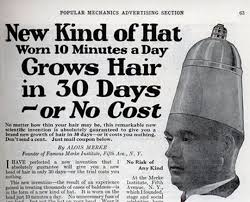
Somehow I would up looking at weird advertisements from those days, cocaine cough syrup, Bourbon toothpaste. Then I saw the “new kind of hat” that grows hair!! And I burst out laughing or as they say to I LOL’d. Whenever I laugh I know that all is not lost. Life is still laugh out loud funny. I mean, look at that hat! Would you wear that hat? But I guess somebody had to try it first.
Hey, thanx for stopping by and may something make you LOL.
Lizzie Miles version of my father’s song. I love this version.
One hundred years ago in August my father, Eddie Green, would have been 27 years old. On June 5, 1917 he signed up for WWI. In the same year he copyrighted his first song “A Good Man is Hard to Find”. Twenty-eight years later when he was 55 he married my mom who was 22 at the time. After a long and fruitful career as an entertainer and entrepreneur Eddie died in 1950. If he were still alive in August he would have been 127 years old.
I have since written a book about Eddie, had the book published, done a few interviews, had an article written about myself and the book; won an award-WooHoo!!! Winner, winner, winner! And I am looking forward to more interviews and writing an article on my father which will garner more exposure.
I did a presentation at a local library and when I mentioned the title of Eddie’s first song the ladies in the room began to talk out loud: “It’s still like that today!” “You better believe it.” My brother, who was in the room, kind of cringed and the ladies apologized but they were all laughing.
This incident and the fact that this song was used in a 2014 Woody Allen movie, the HBO movie “Bessie”, and the award, show me that my father is still relevant today, 127 years after he was born.
Bestselling author, Dean Koontz said, “I really believe that everyone has a talent, ability or skill that he can mine to support himself and to succeed in life.”
I permanently posted this quote onto my blog, and I said in my first blog post from November 12, 2014:
“I found this quote while doing some research for a book I will eventually complete. I began my research in about 1998 because my then small grandson’s favorite words seemed to be “I can’t”. Usually in regard to why he did not finish his homework. His homework was always too hard. I came up with the bright idea to enlighten him on what a person can accomplish by telling him about, and by writing a book for him about my father, his grandfather, who was a black man born in poverty in 1896 and who rose to prominence despite many obstacles. What I hoped to impart to my grandson morphed into a desire to share inspiration to any person who feels they “can’t”. A desire to talk about what motivates people, about determination and about how much work actually goes into achieving one’s goals, and how that work can be extremely rewarding.” Or maybe even Awarding.
Well, the book has been completed. Eddie Green The Rise of an Early 1900s Black American Entertainment Pioneer was published in July of 2016. On June 24, 2017 I and my book became the 2016 Foreword INDIES WINNER in the Performing Arts & Music (Adult Nonfiction) category!! Me!!
Mr. Howard Loy, Executive Editor said in a congratulatory article: These were the publishers and authors enabling alternative voices. Many in publishing might disagree with me, but I believe there is no such thing as too much information. Stories, true stories, need to be written down and preserved for many reasons.” He says to me, “Congrats Elva on being a winner!” Me!
For those of you considering writing a book. When I learned I was a winner, I was excited and I wanted everyone to learn about it right away. Of course, things take time. You’re waiting for a personal email, a personal tweet with a picture of your book and your name in big letters. But the convention at which the awards were held was 3 days long. The awards were held on the 2nd day. And there were a lot of awards.
Saturday and Sunday passed. I went from being excited, to being amazed. The research I did, the many public transportation trips I made, all the time I spent on the net and at museums, all of the people that were involved, the fact that people thought my book was worthy of an award was and is mind-blowing.
On Monday I crashed. I cried Monday night, Tuesday morning. I slept all day. I watched old detective shows and fell asleep and woke up and went to bed. Slept late Wednesday, Thursday got up to pay the rent, buy some chili fries and an Orange Bang (large) and I slept. I could not blog until today. I think this may happen to a lot of writers. I tend to think of myself as a person who wrote a book, period. But as my brother Brad keeps telling me, I am a writer. Me.
So, I am finally sharing my GOOD NEWS. I am a WINNER, WINNER, WINNER. You have all helped me in one way or another. You have definitely helped me keep going. And this is only the beginning. Today I heard from the Award committee and my publisher will send out a press release in July. Stay tuned!! I am totally thanking the Universe today. And if you feel so inclined, write a book and tell us about your journey.
Thanx, for stopping by.
LIKE my page: https://www.facebook.com/elvagreenbookpage/
This is not a political article, though I have been influenced in part by the fact that our 44th President, Mr. Barack Obama was a proponent of the use of personal initiative. There is a belief in some circles that personal initiative and hard work is enough to overcome obstacles confronting young black men. Others pooh-pooh the “bootstrap” approach. They believe that better living conditions, better education opportunities are also necessary to help a young man achieve his potential. Both are good points.
There is also a modern day belief that Black men born into poverty are good candidates for being drawn into a life of crime other than a life of legitimate success. Some modern day beliefs are that “soundbites” in the news contribute to the mindset that Black men (when arrested in t-shirts and low-cut jeans) are seen as a threat. (Blacks in the News: television, modern racism and cultural change By Robert M. Entman-journalism quarterly, pg 35.)
In 1910, when my father was coming of age Blacks made up only thirteen percent of the population but twenty-seven percent of those were in prison. In the South in 1910, Blacks comprised 30 percent of the population yet made up 60 percent of those incarcerated (US Census Report 1910).
This racial incarceration gap could have had many causes, including discrimination in arrest and sentencing, differences in family background, lack of job opportunities for blacks, higher urbanization rates of blacks, and differences in educational attainment. (Access to Schooling and the Black-White Crime Gap in the Early 20th Century US South: Evidence from Rosenwald Schools. Katherine Eriksson December 31, 2014.)
When my father, Eddie Green, left home at the age of nine in 1900, the presence of structural racism, the after effects of slavery, the lack of education for Black people, and the lack of healthcare was not a problem for him. The constant objections of White Americans to African-Americans was, evidently, not a problem to him. The lack of job opportunities and differences in family backgrounds was not an issue. He had discovered he could thrive on his own without resorting to criminal acts but through his own talents and his ability to take care of business. He had been raised right. HE HAD ACQUIRED PERSONAL INITIATIVE-THE ABILITY TO ACT AND OVERCOME DIFFICULTIES.
For a child born into poverty that life-style is normal. An infant does not realize poverty. I believe Eddie’s mother provided his early nurturing. Eddie did not have a close connection with his father. I hold the idea that Eddie received love and attention mostly from his mother. Eddie had a love for his mother that he spoke of to my mother.
He learned his work ethics from watching his mother washing countless loads of other people’s clothes and he was hurt by this. He saw that no matter how hard his father worked nothing got any better. But he also knew hard work was necessary to survive.
He learned confidence in his ability to take care of himself, he acquired fearlessness, otherwise how could he have gone out into the mean streets alone. His situation at home prepared him for the streets because what could be worse.
Emotionally, he became the “comedian.” With his comedic talent eventually tending dry humor. He would later become known as a “droll” comedian. Drollery according to the dictionary is a natural aptitude for using words and ideas in a quick and inventive way to create humor.” Evidently Eddie tapped into this natural aptitude early enough to boost his rise to success.
Eddie taught himself to read and discovered books on magic. He found that he liked performing magic tricks and that he was good at it. It was a way to take a person out of the mundane and into a world of fantasy and wonder. He had also determined that he could thrive by traveling through the city offering to perform as a “Boy Magician”.
More than likely Eddie would have read about or heard about successful Black magicians such as William Carl, who in 1890 was billed as the King of the Magicians with a minstrel troupe called Boston’s Merry Musicians, or Alonzo Moore (c.1870-c.1914) who joined Billy Kersands’ Minstrels in 1904.
Eddie had grown up, also, during the time of great African American role models. Men like W. E. B. Dubois, a Black historian and sociologist, who was at the forefront of the civil rights movement, or Frederick Douglass who was also born in Maryland, a slave and who became a social reformer and statesman.
When Eddie left home at the age of nine, he was a good, self-confident, eager, willing, forward-looking, honest and talented young person. He left with the love of his mother cradling him. His circumstances had not made him angry but became a source of determination to have a better, happy life. When money permitted he moved his mother into Gotham City to be close to him. Over the years he would become successful as a Broadway and movie star, a filmmaker, a composer and as an Old Time Radio icon. By the time of his death he had risen to become one of America’s most beloved comedians.
As a testament to his feelings about being Black, this is what Eddie wrote to a radio program titled “The Negro Hour” in 1938 regarding their theme music: “Or you might even pick a suitable stanza from the pen of our poets (Dunbar and others), set it to music. Brilliant forceful music, and thus have a theme song that tells the world, “Here comes an upright, fearless, man”
As a testament to his early learning which I am certain came from his mother, he told the radio announcers this: You must remember that you are gentlemen addressing ladies and gentlemen and if for no other reason than that, a gentleman never raises his voice”.
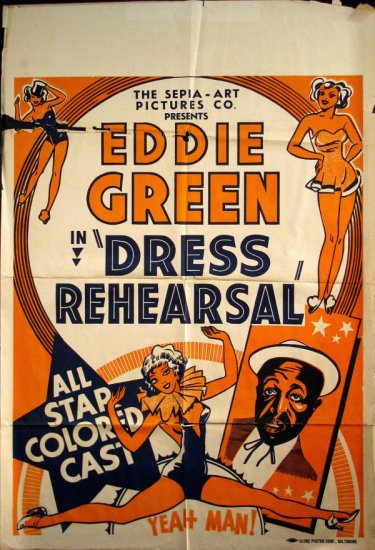
Eddie Green’s All-Colored Flicker Telecast By Nat’l Broadcasting Co (NBC). Well-Known Radio and Stage Comedian Adds Another Television “First” As Dress Rehearsal Shows.
NEW YORK, Dec. 21., 1939—History was made here Saturday afternoon, Dec. 16, when the National Broadcasting Company (NBC) picked the Sepia-Art Pictures Company’s featurette, Dress Rehearsal, featuring Eddie Green, to broadcast over their television station here in New York City. Not only is Dress Rehearsal the first ever Negro motion picture to be broadcast by television but it is to its credit that this picture was written and produced in its entirety by Negroes. Eddie Green was the first negro performer to appear on television. This first official broadcast took place July 7, 1936. Mr. Green breaks precedent by starring in the first film of this kind to be sent over the air. The Pittsburgh Courier Theatrical News section
Hi there. The above article from 1939 mentions Sepia Art Pictures Company which is the movie production company my father owned in what was then known as Palisades, New Jersey. Eddie was among the very few Black people to own his own movie production company. As it says in the article, back then his “flickers” were all-colored or Negro. In order to be up-to-date I used Black in the photo caption. No matter the word used Eddie was a Pioneer of the entertainmet industry. This particular movie opened at the Apollo Theater in New York and was immensely popular. Hence the NBC television broadcast.
Like Eddie I have my own “First”. I am now an INDIES Award Nominee for 2017. This deserves it’s own post, so stay tuned for more.
Thanx, for stopping by. KCB
You can find my book Eddie Green The Rise of an Early 1900s Black American Entertainment Pioneer at http://www.bearmanormadia.com.
The two pictures posted here today have brought me much joy recently. The head and shoulders shot is my father Eddie Green with his Amateur Short-wave Radio Operator pin on his lapel, circa 1940, and the other is a still from a Warner Bros. 1929 Vitaphone film titled “Sending a Wire”. That’s Eddie as a customer trying to send a telegram. The headshot is located at the New York Schomburg Center for Research in Black Culture in the Eddie Green Photo Collection. I got the still from The Vitaphone Project where the employees are endeavoring to preserve old Warner Bros. films.
Eddie was born in Baltimore in 1891. So a few days ago I posted these photos on a Baltimore Old Photos website group. I have been blown away by the response I have received from Baltimore residents. As I type this I have received over 600 replies (likes, comments, reactions) and they are still coming in. Of course I have responded to each comment so I’ve been reluctant to leave my computer because I want to answer immediately. So far placing these photos in the Baltimore site had nothing to do with the biography I have written on my father. The people who are reacting to these pictures are simply people who love their city. They love their city history. Judging by the faces on their posts (I guess they are avatars) these are young people, middle age, older folks, and different ethnicities. To me this is a proud community.
I absolutely do not like to fly but it looks like I am going to have to visit my father’s birthplace. I would love to experience the atmosphere. There has got to be a lot of love in that city. I posted a blurb from my book that said Eddie Green was “a feather in the hat of East Baltimore” according to the local newspaper from 1925. Wait until they get the word that I have written a book about him. From the comments I have received Baltimoreans will be happy to learn more about one of theirs.
I am trying not to get too excited here because life is about ups and downs, but I am having so much fun. Since I started this blog however the process has been up all the way. I’ve written my book, had it published, and gained followers and friends. Because of my desire to see my father’s story brought back to the fore of people’s minds in order that they might see an example of reaching one’s goals no matter how many obstacles there are, and because Life has shown me that this is what is supposed to happen, I feel this path I am on is only going to bring me and others more happiness. How it will bring happiness to others is that people who visit my site can be encouraged to pursue their dreams and they will feel fulfilled in doing so.
Hi. To those of you new to this blog, welcome. As this blog is meant to chronical my writing of a book about my father, I have to let you know that in the past 3 years I have written and published my book. You can of course read through prior posts to get an idea of the story, or you can start here. The picture I have posted is from the radio program that brought fame to my father Eddie Green. Taken in the early 1940s This is a shot from the radio program Duffy’s Tavern. The gentleman on the left is the creator and star of the show Ed Gardner (who is cast as Archie.) The gentleman on the right is my father, Eddie Green, who is cast opposite Ed as Eddie the waiter.
Duffy’s Tavern was one of the most popular radio programs during the years 1941-1950, after which time the program was switched to television. Eddie was a part of this show from the beginning until 1950 when he passed away. In 1941 when he was signed on to this program, Eddie had written a best selling song in 1917, plus twenty-nine more songs, he had performed on Broadway, owned Bar-b-que restaurants, appeared on television in the first ever RCA/NBC variety test broadcast to the public, worked with Bill “Bojangles” Robinson and Louis Armstrong and had written, directed, produced and starred in four all-Black cast movies. He was on the rode to fame.
In 1943 Eddie was fifty-one years old, and at the beginning of the year he filed for bankruptcy. He owed the government $445.00. Probably had something to do with the fact that Eddie had used his own money to start his Sepia Art Pictures movie company and some of his actors had stared accepting roles with the White owned studios who could pay much more than Eddie. And I think a business deal went awry (meaning “a friend” absconded with some money.) You could still hear him on the weekly Duffy’s Tavern radio program and on other radio programs, too.
In 1945 the money started rolling in again when Paramount decided to make a movie version of Duffy’s Tavern using the regular radio crew in the movie. The movie was titled Ed Gardner’s Duffy’s Tavern, directed by Hal Walker, starring a number of Paramount stars such as, Bing Crosby, Alan Ladd, Dorothy Lamour, Barry Fitzgerald, Veronica Lake and William Bendix, to name a few. Oh, and also Ed Gardner, as Archie, Eddie Green, as Eddie the waiter, and Charles Cantor as Finnegan. The next few years saw Eddie’s continued rise to becoming a popular, beloved comedian.
By writing the biography of my father my hope was to bring his inspiring story out of the dark and into the light of awareness, as a way to provide propelling motivation to others. Eddie said that he found the best way to achieve success, is to find something you like to do and do it the best you know how.
One other thing, Eddie and Ed Gardner became very good friends over the years. Today a Green and a Gardner are still friends, me and Ed’s son. We’re pen pals!
Thanx, for stopping by. KCB
Photo courtesy of Martingramsblogspot and Ed Gardner, Jr.

 I have been studying the whys and wherefores of the Declaration of Independence. Studying what was meant by using the words Life, Liberty and the Pursuit of Happiness. On Wikipedia one can read about what others who came along after the signing of the Declaration think about what the word happiness meant to those signers. Happiness these days is alluding me. Not because of the worlds difficulties, though these difficulties add to my sadness. But because of my grandson. His personal grown-man problems. Mainly due to his pursuit of happiness.
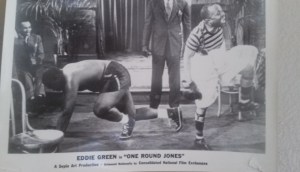 I suppose that is one reason Eddie became a comedian. He was pursuing his own happiness. Here he is being happy. (He is the silly guy in the stripped shirt). This is a scene from his movie One Round Jones (1941). The Press Sheet reads: One Round Jones is the story of a night club owner who undertakes to build his business by offering $50 to anyone who can go one-round with his “mystery fighter.” Of course, Eddie is the goat. He climbs into the ring shaking like a dish of Jell-O but when he climbs out he’s got the money and the other fighter’s girl.”






 pininthetush