We Are, Each One, Absolutely Unique

Ralph Wilhelm Cooper, 1908-1992. Actor, dancer, screen writer, emcee, choreographer (Shirley Temple-Poor Little Rich Girl). Ralph Cooper spent five years acting and directing in Hollywood and while there folks began calling him the “Dark Gable” because of his “handsome, rugged good looks and his charm and wit”. * I would like to say instead of giving him a nickname that reminds people of a White man, can we just say that this man was Ralph Cooper, a handsome, charming Black man who was very active in the world of entertainment in the 1920s, 30s and 40s. And beyond.
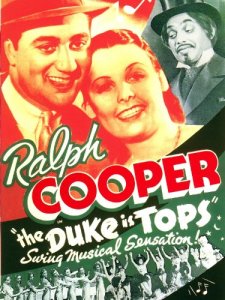
 

Like my father, Eddie Green, Cooper was also a filmmaker. Meaning he wrote, directed and starred in his own movies. In the late 1930s he was making movies during Oscar Micheaux’s filmmaking time (Micheaux began making films in 1915). He wrote, directed, produced or starred in at least fifteen films. My father began making his films in 1939, right about the time Cooper left filmmaking. In 1937, Cooper formed Million Dollar Productions with black actor George Randol and white producers Harry Popkin and his brother Leo Popkin to produce race films.

And that’s not all. Ralph Cooper was a founder and emcee of the legendary Amateur Night at the Apollo Theatre in 1935. ** He worked as a human rights arbitrator under New York Governor Nelson Rockefeller in the ’60s. And in 1984 was a consultant on the movie The Cotton Club, with Gregory Hines and Richard Gere.

Ralph and my father appeared on the same bill during those early days; their names are kind of close to the bottom of the ad as they had not “blown up” yet. But they must have met backstage. Maybe Eddie talked to him about making movies someday. Both Eddie and Ralph were successful in their chosen pursuits. Through their own talent and hard work. When it was truly a struggle for a Black man to get ahead. I salute my father and Ralph Cooper and their own special uniqueness in bringing a little entertainment into the lives of others.


I am looking forward to using my blog as a place to be a cheerleader for the trailblazers who deserve to be remembered for their unique contributions to Life.

Thank you so much, for stopping by.

*MsLadySoul  **Margot Miflin, 1990

My Book: Eddie Green, The Rise of an Early 1900s Black American Entertainment Pioneer

Sitting While Black

Joseph Bologne, Chevalier de Saint-Georges (December 25, 1745 – June 10, 1799) was a champion fencer, classical composer, virtuoso violinist, and conductor of the leading symphony orchestra in Paris. Born in Guadeloupe, he was the son of George Bologne de Saint-Georges, a wealthy planter, and Nanon, his African slave. During the French Revolution, Saint-Georges was colonel of the Légion St.-Georges, the first all-black regiment in Europe, fighting on the side of the Republic. Today the Chevalier de Saint-Georges is best remembered as the first classical composer of African ancestry.

How many people know about this man. In regard to classical music somehow I learned about Mozart, Beethoven, (bugs bunny cartoons, Disney movies, documentaries.) But not this guy. Some scholars call him the Black Mozart, except that he was born 10 years before Mozart and after they met Mozart was said to have echoed a few of Joseph’s bars.

When I went to school I learned a lot about White inventors, musicians (we sang Oklahoma in Glee Club), presidents, television stars. But very little about important Blacks. Well, there was George Washington Carver. But all we learned was that he had something to do with peanuts. We did not learn about the numerous honors he won for his work or that in an era of very high racial polarization, his fame reached beyond the black community.

Seems we heard a lot about Nat Turner though, the guy who led that slave rebellion. According to some scholars, the stereotype of African Americans males as criminals was first constructed as a tool to “discipline” and control slaves during the time of slavery in the United States. More recently , a study examining the news reports from The New York Times, The Washington Post, The Wall Street Journal and USA Today covering the effects of Hurricane Katrina showed that in 80% of the time black evacuees were portrayed in photographs, the word “looting” was mentioned in the captions, suggesting that the black evacuees were criminals. In America we have had the good actions of White people and the emphasis on bad actions of Blacks ingrained into our psyche. Blacks were not celebrated in our education. So I don’t believe in unconscious bias. That we make snap judgments about people and situations based on who we are, how we live, and how we were raised, yes, but it’s not unconscious.  I believe we act from ingrained teachings.

The idea that Black men are dangerous exists today. Still. Sitting While Black is the hashtag on Twitter.

It’s sad that this is happening in 2018. My father lived during the early 1900s when Blacks were still being lynched in large numbers. One of the bloodiest race riots in the nation’s history took place in East St. Louis. A Congressional committee reported that 40 to 200 people were killed, hundreds more injured, and 6,000 driven from their home. Fifty-three black Americans are known to have been lynched in 1920. Eddie was in St. Louis in 1919-1920. He performed at the Booker Washington Theatre (a Black vaudeville house) with his Deluxe Players, he had been called back by popular demand. In those days he sang his own songs, danced and told “side-splitting” jokes. I’m sure he saw his share of horrors.

By the 1940s Eddie was appearing in the radio program Duffy’s Tavern. Things in America had progressed enough that The Library of Congress placed Duffy’s Tavern on the Honor Role of Race Relations, because they did not have Eddie resort to stereotypical “Black” language. They said “Green clicks as a waiter, not because he’s a Negro, but because he’s a good comedian.” So, it is clear in this instance that changing how Blacks were treated was a priority.

I wonder what he would think about two Black men being arrested because they were sitting in a Starbucks and asked to use the restroom but didn’t buy anything and wouldn’t leave because they were waiting for a third party. I mean we have not gone back to lynching but it certainly seems that we have at least gone back to the 50s or 60s. Some people today still see Black men as trouble-makers. I don’t think that providing unconscious bias training is going to change that mind set. I think something has to change within the person. Maybe as more time goes by people will be able to just see each other as fellow human beings, floating around in space on a friggin’ planet.

Hey, thank you so much for stopping by. Peace and Love

Check out my Book: Eddie Green The Rise of an Early 1900s Black American Entertainment Pioneer.


Sharing Space with Dr. Martin Luther King, Jr.

The “Big Six” Civil Rights Leaders (l to r) John Lewis, Whitney Young Jr., A. Philip Randolph, Martin Luther King, Jr., James Farmer Jr., and Roy Wilkins. Hulton Archive/Getty Images

Martin Luther King, Jr. was born in 1929. My father, Eddie Green was born in 1891 and by 1929 was writing songs, doing small radio appearances and working in burlesque with Billy Minsky. When King graduated from Morehouse College in 1948, Eddie had reached Old Time Radio (OTR) fame, and by the time King had graduated from Crozer Theological Seminary in 1950, Eddie had died. So Eddie probably was not cognizant of the fact that King existed. He did not know that one day Martin Luther King, Jr. would be instrumental in making the lives of Black people a bit easier.

Through the process of doing research on my father for his biography I came across a couple of articles that mentioned Eddie’s involvement with Negro Organizations. The California Eagle did a piece on Eddie in their “Trail Blazers” column in 1947.
The article spoke of Eddie’s 23 years in show business with 15 years of before-the-mike experience and 30 years of technical radio knowledge. It mentioned his beginnings with the late Fats Waller in the 20s and his progress to Duffy’s Tavern. There is mention of Eddie being a 32nd degree Mason and that he had spent the last year working actively with the NAACP.

In 1949 there was an  Omega Smoker gathering given in Mr. Paul R. Williams house in Los Angeles, for the then Governor of the Virgin Islands. Among the guests present were Dr. Ralph Bunche, Eddie Green of Duffy’s Tavern and Amos ‘N Andy shows, Jack Dempsey, and Roy Wilkins of the NAACP. Eddie took over the party by telling some of his “grandfather jokes.” Seems that Eddie couldn’t resist being the funny guy, but clearly he had hobnobbed with well-known leaders of the times.

One of the goals of the NAACP was to remove all barriers of racial discrimination through democratic processes. Dr. Martin Luther King Jr. is considered the formative figure in the modern fight for civil rights, and his legacy looms large in the work of all those who follow him in his cause. Dr. King’s involvement with the NAACP dates back to his position on the executive committee of the NAACP Montgomery Branch in the 1950’s, through his leadership in the various boycotts, marches and rallies of the 1960’s, and up until his assassination in 1968. (www.naacp.org/oldest-and-boldest/dr-martin-luther-king-jr-mw/)

King, representing the SCLC, was among the leaders of the “Big Six” civil rights organizations who were instrumental in the organization of the March on Washington for Jobs and Freedom, which took place on August 28, 1963. Among the other leaders and organizations comprising the Big Six was Roy Wilkins from the NAACP. (Wikimedia)

During Eddie’s voting years some people “engaged in egregious voting discrimination”. Making it difficult if not impossible for people of color to vote. Jim Crow laws were enacted. A typical news article read: Stepin Fetchit is in Johnstown experiencing what is was like to deal with “Jim Crow.” Paul Robeson was stopping the “Show Boat” in Angel City. Pittsburgh Courier, May 1940.

From past articles I have read and according to my mom, Eddie was usually upbeat; he did not like violence of any kind, he did not even like to see comedians booed off the stage.

Being a 32nd degree Mason means that the Master Mason is involved in charitable work. Work to do good. You are to have good moral values. When you go beyond 32nd you go into the “Shrine” or what most people know as The Shriner’s. It is generally known that the Shriner’s help burn victims and children by providing hospitals and medical care all free. But what is not commonly known is that each of the branches also provide services for underprivileged children. Eddie provided food to the poor while he owned his bar-b-q restaurants. As a 32nd degree Mason and Shriner, Eddie was given a Shriner’s Parade down Adams Boulevard in 1950 when he died.

In the 1950s, the Civil Rights Movement increased pressure on the federal government to protect the voting rights of racial minorities. Dr. Martin Luther King, Jr. was advancing civil rights through non-violence. He won the Nobel Peace Prize. He was concerned about how we treat our neighbors. He believed in the Spirit of Love.

I haven’t thought too much about Eddie’s experience with voting as a Black person but my thought process is beginning to take a different path. I do believe that if Eddie had lived to see the growth of Dr. Martin Luther King, Jr. as a leader and civil rights activist he would have been proud to have been able to share space on this earth with Dr. King, who paved the way for the 1965 Voting Rights Act. Dr. King believed in loving our fellows and promoting non-violence. Something we can all work on.

Hey, thanx for stopping by. Peace.