CAMERAS, LIGHTS……..


untitled (14)


When trying to write a book and posts for a blog, I forget there are other things to attend to.  Like grocery shopping, washing, visiting friends, calling people, eating three meals a day (ha!).  So every now and then I have to do these things.  When I get back to my laptop, it takes a while for my brain to settle back into the writing process (where was I?, what did I do with my highlighter?), so I waste a few minutes getting back in the groove of writing, and I was wondering today how in the world my father could do everything he did as a comedian, businessman, a director and a writer?  Then I remembered, he had a wife.  I just have me.

Which brings me to an article I found written in 1940, about Eddie, after he had begun his movie making career.  This was a full page article discussing Eddie as a comedian (funny), and as a business man (sensible).  It begins:  “Everybody knows Eddie Green as Koko in the “Hot Mikado”, or as the chief characters in his skit on Christopher Columbus and on Jonah and the Whale, (which he did on the Rudy Valley radio show), but there is another Eddie Green who is akin to these characters, but who is also very different.  That is Eddie Green Himself.”

The article goes on to discuss Eddie’s comedic talent, the fact that he owns and operates two barbecue restaurants in New York,

“Eddie Green’s Bar-Bee-Q 2149 8th (near 116) Specializing in Southern Bar-Bee-Q.
Always Open. Finest South’n hospitality. E. Green, Host.”

and that he is a writer and producer of “what many people believe are the finest films being released about our people.”  This paper was the Baltimore Afro American.   The article includes this quote from Eddie:

“The first thing I try for is naturalness.  I write my own stories, building them around some incident that has been interesting, but not offensive.”

The article mentions, that although Eddie had already released three films, he had no picture scheduled that summer because he was concentrating on a beauty contest at the World’s Fair.

Towards the end of the article, they talk about Eddie’s typical day.  He is up at 8 and off to the office.  At lunch he has coffee with Mrs. Green, at home, or she comes to the office.  If he is broadcasting, he goes to rehearsal, if not, he goes back to his office until dinner, then he goes home to eat.  He likes ham and cabbage which he taught Mrs. Green to cook.  He tinkers with his ham radio, then at 10:00p.m. he goes to check on his restaurants till about 12:00, then goes back home.  Mrs. Green, (the wife before my mom), was an entertainer, but decided to become a stay-at-home wife.  I assume that she did all the shopping, and washing, and cleaning, so Eddie had only to concentrate on his career path, he didn’t have to worry about thing falling apart at home.

In 1939, Eddie began a new venture and opened his own motion picture company:

movie company formed
in harlem
NEW YORK, Aug. 24  With familiar theatrical figure Eddie Green as guiding light, a new motion picture company was formed this week, the “Sepia Arts Pictures Company.”  Los Angeles California Eagle, August 24, 1939

Eddie’s first film was:
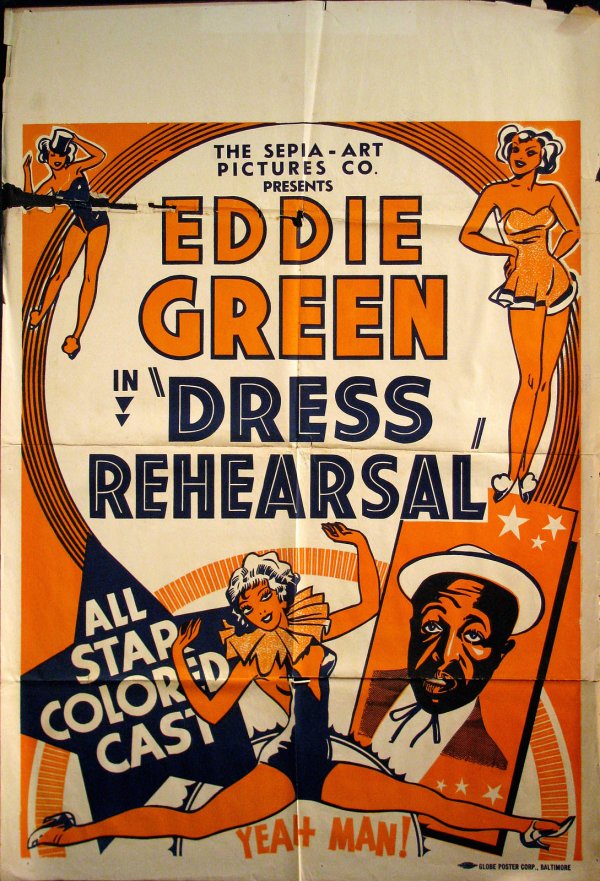
courtesy live auctioneers

In my ongoing research I have actually seen my father’s original script for this movie.  Remarkable!  Though the script lists the cast members, it is difficult to tell which person was in which movie.  Anywho, “Dress Rehearsal” would have a long run, at theaters and on television, as noted below:

NEW YORK, Dec. 21.—History was made here Saturday
afternoon, Dec. 16, when the National Broadcasting Company picked the Sepia-Art Pictures Company’s featurette,”Dress Rehearsal,” featuring Eddie Green, to broadcast over their television station here in New York City. Not only is “Dress Rehearsal” the ” first ” Negro motion picture ever to be broadcast by television, Mr. Green breaks a precedent by staring in the first film of its kind ever to be sent over the air.  Pittsburgh Courier  12/23/39

AND, at the

Vogue  1905 Columbia
Edw. G. Robinson, “Destroyer”
Eddie Green, “Dress Rehearsal”   Dec 9, 1943

I do not have the rights yet, if ever, to post much information regarding scripts, but I did get a piece of a skit:  Eddie (who is the Director, the Writer and the Star of this featurette) is late getting to the set, so he is speeding and gets stopped by a policeman.  The policeman asks Eddie where he is coming from, Eddie says New Jersey, the policeman says “how did you ever get through the Harlem Tunnel?  Eddie says, “there’s a hole on both ends!”  Ba Dump Bump!

I hope that those reading these posts find inspiration for pursuing their own goals even though they may seem unattainable.  No matter the time period or the climate.  More action coming up!  Thanks for stopping by.


HAPPY FATHER’S DAY!!!!

Hello, it’s me.

fatherday2

THE PITTSBURGH COURIER

Eddie Green is A Proud Daddy

LOS ANGELES—It’s a girl for
Mr. and Mrs. Eddie Green (he’s of Duffy’s Tavern fame) and widely known in stage and screen, and she is the former Norma Amato, Los Angeles beauty.

The six-pound, seven-ounce infant, named Elva Diane, was born Sunday, June 22 at 11:15  P. M. at California Hospital.  Both mother and child are doing well.


HANGING OUT AT THE WORLD’S FAIR

Hotmikado

Hello.  In the on-going saga of my research into my father’s life, as far as the book is concerned, I have completed my first draft.  So emotional…..I had to come to the end.  I cried for three days after I finished.  Going so thoroughly into Eddie’s life was almost like being there.  Of course, I still need to edit, add-on, delete, clean up the manuscript.  And I need to add the TOC and a Bibliography, etc.  But it is really happening!

In this blog, after showing you Eddie’s television debut in my last post, and after having already mentioned that Eddie opened a restaurant in Harlem in 1937, I am now at 1939.

“The  Hot Mikado” was a 1939 musical theatre adaptation of Gilbert and Sullivan’s “The Mikado”, with an African-American cast. Mike Todd originally produced it after the Federal Theatre Project turned down his offer to manage the WPA production of “The Swing Mikado” (another all-black adaptation of “The Mikado”).  In this production, Eddie played, Koko, the High Executioner (formerly a tailor).

Eddie Green
Eddie Green

The musical was first produced at the Broadhurst Theatre from March 23, 1939 to June 3, 1939, running for 85 performances. The original cast included Bill “Bojangles” Robinson as The Mikado; Frances Brock as Pitti-Sing; Rosa Brown as Katisha; Maurice Ellis as Pooh-Bah; Eddie Green as Ko-Ko; Rosetta LeNoire as Peep-Bo; James A. Lilliard as Pish-Tush; Bob Parrish as Nanki-Poo; Gwendolyn Reyde as Yum-Yum; Freddie Robinson as Messenger Boy; and Vincent Shields as Red Cap.

The musical was then produced at the 1939–1940 New York World’s Fair for two seasons and was reportedly one of the most popular attractions at the fair.

The video below, which I found on-line and which is extremely rare, is a silent filming of portions of the performance at the World’s Fair.  Eddie enters first as Ko-Ko, the Lord High Executioner, and then you see him standing next to Bill “Bojangles” Robinson, the “Mikado”.  Eddie appears in a few more places in the film.  As Ko-ko, Eddie performed a number of songs, including “Titwillow”, though this was not caught in the film.

“Titwillow”  occurs in a scene with the love interest, Katisha.  “Katisha wonders why death refuses to come and bring peace to her broken heart (she sings “Alone and Yet Alive),  and Ko-Ko springs into action, telling her that he’ll die on the spot if she doesn’t accept his love. Katisha claims no one has ever died of a broken heart, so Ko-Ko responds with the tragic tale of TitWillow, a little bird who wasted away due to blighted affection.”

My mom, Norma, told me about Eddie singing this song in a play, but never did I think I would actually see a portion of this play with my own eyes.  Picturing Eddie singing “Titwillow”, is not easy to do, but according to the Brooklyn Eagle on July 9, 1939:  “Anyway, he gets a hilarious twist into Ko-Ko that Messrs. G. and S. never thought of, and when he swings “Titwillow” usually comes close to stopping the show.”

Eddie was living in Harlem, by now with wife number three, or four, and he already had a grown daughter.  He had met my mother, through friends in Hollywood as he travelled a lot by then from New York, to L. A., but his home at the time was 138th Street in New York.  After the “Hot Mikado” Eddie would begin making his own films.

I love sharing this information.  It may be too old-timey for a younger generation, but keeping the achievements of those who came before us alive, allows the younger generation a chance to see from whence they have come and, also, to see how far they can go, especially with the knowledge, technology, and, yes, opportunities available today.

Hey, comments are welcome, keep comin’ back, and thanks, for stopping by.


Wikipedia


THERE ARE BIG DEALS IN LIFE

Hi there.  In recounting my father’s (Eddie Green) life in the entertainment business on this blog, I have also been writing a biography of my father.  Eddie died in 1950 and I am now in the year 1949 when he began to experience his medical problems.  So, I am almost finished with my first draft, minus add-ons and proofreading.  I have deliberately let this blog lag behind the book so no one will get the whole story before the book comes out.  I have to leave something for which folks will clamor.  Or, not.

Eddie Green-Getty Image
My father, Eddie Green

I have shared in my “Hookups” post about a radio show that Eddie  was on in 1935, “Uncle Charlies Tent Show” starring Charles Winninger, and about Eddie being on the Rudy Vallee show, and about Eddie appearing in and writing comedy sketches for “Hot Chocolates” in 1929, with the music of Fats Waller and Andy Razaf, and Louis Armstrong.  And today I would like to share a bit of my father with you, as he appeared on the first public broadcast demonstration of television.  Woo Hoo!

First, however, I am going to post some information about Mr. George Wiltshire.  George Wiltshire was my father’s “straight man” in an act Eddie had going in 1936.  I needed to do some background searching on George before writing about him, so yesterday I looked him up and while doing so I became aware of the fact that there are a lot of people who have had successful careers in show business of whom we no longer hear.

george wiltshire
GEORGE WILTSHIRE

What a handsome man.  George Wiltshire was born in 1900.  I read that he was an actor, known for Killer Diller (1948), Midnight Menace (1946) and Hi-De-Ho (1947), that he first appeared in the 1930 Broadway revue play “Hot Rhythm” at the Times Square Theatre, that he made his first film appearance in the 1938 all-black film “Keep Punching” and, more recently, that he had  appeared in a couple of episodes of “Sanford and Son” in 1976, as Elroy Pitt, a sidekick of Hutch (Arnold Johnson), and a friend of “Fred” (Redd Foxx).   Imagine that, one person who was alive in 1976, besides my mom and my Godfather, who knew Eddie.   I found an article that spotlighted George  in 1939 as having been one of the leading straight men and as the  only “straight man” still carrying on.  George  died in 1976 in California.   What I found in only one place was this:

EDDIE GREEN AMD GEORGE WILTSHIRE
ON TELEVISION TRYOUT BROADCAST
NEW YORK CITY, July —Eddie Green., popular stage, radio and screen comedian, and George Wiltshire, well-known “straight-man,” are the two men of color chosen to lend their bit to the first test television broadcast by the Radio Corporation of America.  The program was specially broadcast to a select group of listeners and watchers.  The program, announced by Milton Cross, also featured Ed Wynn, Graham MacNamarra, Henry Hull and the Pickens Sisters.

July 7 – At David Sarnoff’s request for an experiment of RCA’s electronic television technology, NBC’s first attempt at actual programming is a 30-minute variety show featuring speeches, dance ensembles, monologues, vocal numbers, and film clips. It is shown to 225 of RCA’s licensees on 22 centimeter screens.

The film can actually be found online as “First Television Broadcast NBC/RCA July 7, 1936 Part 2 of 2.”  Eddie and George’s act is at the very beginning of Part 2.  Trust me, I was a bit shocked at first at the way they looked, but there they were in 1936, on television, because these two men were who the people wanted to see.  As far as I have been able to ascertain, Eddie Green and George Wiltshire were the first two black men to appear on television.  Be aware, the film may begin in the middle on my site, so you might have to run it back to the very beginning which is where you will hear Milton Cross make the introduction, Eddie and George are the first act to appear, then the Rockettes, etc.  If you would like to see an explanation of this broadcast with David Sarnoff go to “First Television Broadcast NBC/RCA July 7, 1936 Part 1 of 2.”

I did not type the whole act, but simply as clarification, I have typed in a portion of Eddie’s “Grandfather Joke”, the last joke of the skit, because the sound portion of the film is not very good.   This was one of Eddie’s stock in trade jokes that his audiences got a kick out of.  This particular joke was about how fast his grandfather can cook a meal in his restaurant (I typed a mini version):

(Eddie) “75 people were coming from L. A. to New York and they only had 10 minutes for lunch.  (George)  There were 75 people and they only had 10 minutes for lunch?  (Eddie)  That’s right.  (George) I bet it scared him (grandpa) to death.  (Eddie) It didn’t even scare the waiter.  Grandpa was back in the kitchen smokin’ a pipe.  The waiter just walked over to the kitchen door and yelled “HAM AND EGGS FOR SEVENTY-FIVE”.  (George) And what did grandpa say?  (Eddie) TAKE ‘EM AWAY BEFORE I BURN THEM!

Ha ha, so funny.  I didn’t even get the joke for about two weeks, probably because I was so busy focusing on the white lips.  I got over it, though.  I love seeing my father on stage, especially since I was only three years old when Eddie died.  I have come to realize that Eddie put in the work necessary to get where he eventually got.   I actually found the script for the joke in the library last month.  I did not put the film up on the internet, but I thank those who did.  I thank Mr. Wiltshire’s people, if there are any left out there, for the chance to bring him a bit of recognition.  And I certainly thank those of you who have stopped by and are hanging in here with me.


historyomestolife

Pittsburgh Courier July 16, 1936

New York Age, November 18, 1938